#RAG LangChain
1044 related articles

·3 min
LangChain v1.3 Hands-On Tutorial: Deep Dive into Agents, RAG, and Local Model Deployment
Deep dive into LangChain v1.3: compare LangChain, LangGraph, and DeepAgent paradigms, explore RAG pipelines, multi-agent systems, and local LLM deployment for enterprise AI apps.
Read more →
·3 min
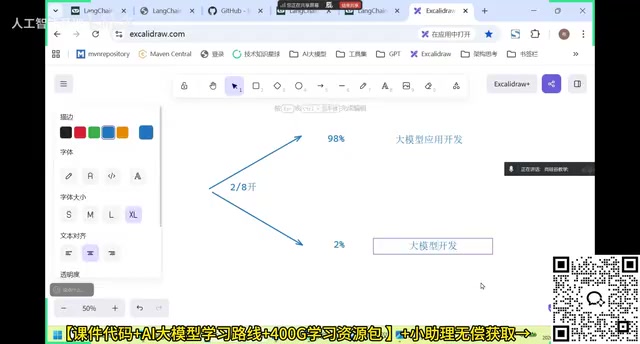
LangChain Practical Guide: From RAG Applications to Intelligent Agent Development
A comprehensive guide to LangChain: core concepts, RAG applications, Agent development, version selection (0.3/1.0), and career opportunities for Java/Python developers entering LLM development.
Read more →

·2 min
LangChain in Practice: Building the ChatDoc Document Chat Application with RAG
An in-depth explanation of RAG (Retrieval-Augmented Generation) principles, with a hands-on guide to loading PDF, Word, and other document formats in LangChain to build a complete ChatDoc Q&A app.
Read more →

·3 min
LangChain V1.3 Hands-On Tutorial: A Complete Breakdown of RAG, Multi-Agents, and Engineering Mindset
An in-depth look at LangChain V1.3's core philosophy: from RAG to multi-agent workflows. Master LangGraph, Chain, and DeepAgent, learn token control and Human-in-the-loop, and become a true master of AI app development.
Read more →
·3 min
LangChain Beginner's Guide: From Environment Setup to RAG — A Complete Hands-On Walkthrough
A systematic guide to LangChain covering environment setup, model invocation, Prompt Templates, Output Parsers, LCEL chain expressions, and hands-on RAG implementation for beginners.
Read more →

·4 min
LangChain4j in Practice: A Complete Tutorial for Building a RAG Medical Q&A System
A complete tutorial on building a RAG medical Q&A system with LangChain4j, covering Ollama local deployment, Redis vector DB, document vectorization, and Cursor AI-assisted development.
Read more →
 Tutorials
·1 min
LangChain Agent Development Tutorial: RAG and Agent Hands-On Learning Path
A systematic learning path for LangChain Agent development covering RAG, autonomous Agent decision-making, and tool calling—from zero to production-ready projects.
Read more →
 Tutorials
·4 min
Agentic RAG in Practice: Architecture Deep Dive and LangChain Implementation Guide
Compare traditional RAG vs Agentic RAG architectures, explore planning, tool use, and multi-step iteration capabilities, with full LangChain/LangGraph ReAct Agent code and ChatBoss project examples.
Read more →
 Tutorials
·3 min
Agentic RAG in Practice: Architecture Deep Dive and LangChain Implementation
Deep dive into Agentic RAG vs traditional RAG, covering planning, tool calling, and multi-step iteration capabilities with complete LangChain and LangGraph code implementation.
Read more →

·3 min
Ollama + Qwen-Agent: Building a Local Private AI Assistant — From Deployment to Security Best Practices
A complete guide to building a local private AI assistant with Ollama and Qwen-Agent. Covers RAG knowledge integration, voice interaction, and permission isolation for a secure local AI Agent architecture.
Read more →

·2 min
AI Agents Running a Real Company: Experiment Results and Capability Boundary Analysis
What happens when AI agents are tasked with running a real company? This analysis examines agent performance, critical shortcomings, and practical enterprise deployment advice.
Read more →

·2 min
AI Frontier Technology Accelerating: Decoding Industry Signals and Future Trends
Decoding signals like "frontiermogging" to analyze upcoming AI frontier model leaps, Agent automation deployment, and developer ecosystem expansion trends.
Read more →

·5 min
Have AI Doomers Actually Used AI? A Developer Exposes the Gap Between Hype and Reality
AI Doomers warn AI will destroy humanity, but have they actually built AI apps? A developer's sharp critique reveals the vast gap between AI demos and real engineering practice.
Read more →

·4 min
Tiling Window Management: A New Interaction Paradigm for Multi-Agent Conversations
Exploring tiling window management for multi-agent AI conversations: how it solves parallel monitoring and observability challenges, real-world limitations, and the evolution from chat boxes to control consoles.
Read more →

·3 min
TraceLLM: An Open-Source LLM Observability Platform Built on OpenTelemetry
TraceLLM is an open-source observability platform for production AI apps, built on OpenTelemetry, offering Prompt tracing, Token monitoring, latency analysis, and full distributed tracing.
Read more →

·3 min
What Kind of GUI Do AI Agents Need? The Evolution from Chat Boxes to Task Consoles
Exploring GUI design for AI Agents: why chat boxes fall short, and how ideal agent interfaces need task visualization, human-in-the-loop intervention, state presentation, and multi-agent orchestration.
Read more →

·3 min
Claude Opus 5 Plays Pokémon: A 12-Hour AI Experiment in Multi-Agent Loop Architecture
Deep analysis of Claude Opus 5 playing Pokémon for 12 hours via multi-agent loop architecture, exploring Agent design patterns, long-horizon planning, and AI Agent trends.
Read more →

·3 min
Claude Opus 5 Plays Pokémon: Analyzing a 12-Hour AI Experiment Under Multi-Agent Loop Architecture
In-depth analysis of Claude Opus 5's 12-hour Pokémon gameplay through multi-agent loop architecture, exploring multi-Agent design, long-horizon planning, and AI Agent trends.
Read more →

·2 min
GPT-5.6 Released: Redefining the Price-Performance Boundary of AI Models
OpenAI releases GPT-5.6, targeting the price-performance frontier. Analysis of how architectural optimization and inference efficiency reduce costs, and how LLM competition shifts from capability to cost efficiency.
Read more →

·3 min
Jina v3 Matryoshka Embeddings in Practice: Cut Vector Storage Costs by 75%
Use Jina v3 Matryoshka embeddings to truncate 1024-dim vectors to 256-dim, cutting Pinecone storage costs by 75% while maintaining retrieval quality with task-specific LoRA adapters and circuit breakers.
Read more →