#Recursive Self-Improvement
47 related articles

·3 min
GPT-5.6 Autonomously Optimizes Its Own Kernels: How AI Recursive Self-Improvement Could Cut Service Costs by 20%
OpenAI's internal model GPT-5.6 reportedly autonomously rewrites production kernels, achieving ~20% service cost reduction. Deep analysis of this AI recursive self-optimization event's technical plausibility and industry impact.
Read more →

·3 min
GPT-5.6 Autonomously Optimizes Its Own Kernels: How AI Recursive Self-Improvement Could Cut Service Costs by 20%
OpenAI's internal model GPT-5.6 reportedly autonomously rewrote production compute kernels, achieving ~20% cost reduction. Deep analysis of this AI recursive self-optimization event's technical plausibility, industry impact, and key questions.
Read more →

·4 min
Cursor's Recursive Self-Improvement: A Complete Path to Models Training the Next Generation
Cursor ML engineer reveals Recursive Self-Improvement (RSI) in practice: dual-loop flywheels, agent-driven data, anti-cheating evals, SpaceX compute, and how models are training the next generation.
Read more →

·4 min
GPT-5.6 Launches: Flagship Model Sol Personally Trains Smaller Models, Recursive AI Self-Improvement Becomes Reality
OpenAI releases the GPT-5.6 series (Sol/Terra/Luna), with flagship Sol directly handling smaller model Luna's post-training—marking recursive AI self-improvement in practice. A deep dive into performance, cost, ChatGPT Work, and computer use design leaps.
Read more →
 Tech Frontiers
·2 min
A Rare Quiet Day in AI: Recursive Self-Improvement Stirs Beneath the Surface
A rare quiet day in AI sees multiple sources go silent simultaneously. Behind the calm, Recursive Self-Improvement (RSI) research continues. What this means for the industry.
Read more →

·1 min
Sakana AI Launches RSI Lab: The Path to Recursive Self-Improvement Where AI Builds AI
Sakana AI launches RSI Lab for recursive self-improvement, letting AI autonomously improve its own architecture. Explore their four-stage roadmap and key breakthroughs.
Read more →

·2 min
Sakana AI Establishes Recursive Self-Improvement Lab, Replacing Brute-Force Compute with Creativity to Pioneer a New AI Paradigm
Sakana AI launches its Recursive Self-Improvement Lab, focusing on using AI to redesign AI development. From LLM² to AI Scientist, this Tokyo company proposes a sample-efficient path to AI self-evolution without brute-force compute.
Read more →

·2 min
Anthropic's Latest Research: AI Recursive Self-Improvement Is Rapidly Approaching Human-Level Capability
Anthropic's new research reveals AI recursive self-improvement progress: Claude writes 80%+ of code, achieves 52x training speedup, and outperforms humans at 64% of research decision points.
Read more →
 Industry Insights
·1 min
Recursive Self-Improvement: The Flywheel Effect of AI Giants and the Acceleration of Industry Oligopoly
Recursive self-improvement is reshaping AI competition. Leading labs form talent siphoning flywheels through AI-assisted R&D, rapidly closing the entry window for competitors.
Read more →

·4 min
The Self-Building Agentic IDE: The Next Evolutionary Direction for AI Programming Tools
Exploring the Agentic IDE concept: a self-building, self-iterating intelligent development environment. A deep analysis of how AI programming tools evolve from passive assistance to autonomous evolution.
Read more →

·3 min
Claude Code Rewrites Claude App: Where Are the Limits of AI Coding Agents?
Anthropic developer Boris Cherny used Claude Code to rewrite the Claude App, revealing AI coding agents' real capabilities and limits on production codebases.
Read more →

·2 min
AI Acceleration Out of Control? Frontier Labs Call for Deceleration Mechanisms
A frontier AI lab publicly states that future AI-accelerated development may become too fast, calling for deceleration mechanisms. This article examines recursive self-improvement concerns, tripartite governance, and execution challenges.
Read more →

·3 min
GPT-5.6 Sol Self-Optimization in Practice: How AI Cuts Its Own Costs and Boosts Its Own Efficiency
GPT-5.6 Sol achieves 20% GPU serving cost reduction and 15%+ token generation efficiency gains through self-optimization. A deep dive into AI recursive efficiency improvement.
Read more →
·3 min
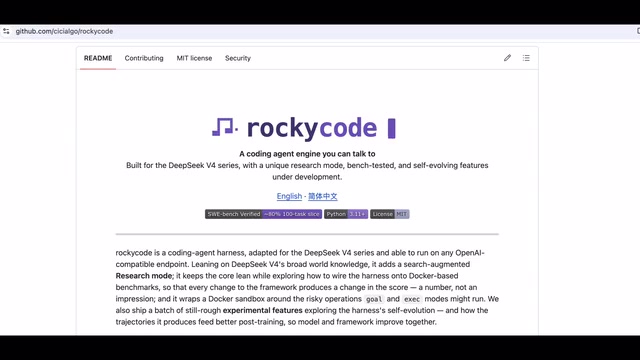
Rocky: An Open-Source Coding Agent with Minimal Architecture and Native DeepSeek Integration
Rocky is a minimal, transparent open-source coding agent with a core loop under a few hundred lines of Python, native DeepSeek search, Research mode, and built-in SWE benchmarking for reproducible agent experiments.
Read more →

·4 min
Qwen-Image 3.0 Released: Image Generation Moves Toward Production-Ready Design
Qwen-Image 3.0 supports 4.5K token instructions, 10px text rendering, and 12-language typography for production-ready posters and infographics. Plus: Anthropic settlement, Grok in Excel, Tencent HRAP 1.0.
Read more →

·5 min
Inside Cursor: How Recursive Model Improvement Enables AI to Self-Evolve
A Cursor ML engineer breaks down AI training methodology: outer/inner loop acceleration, preventing reward hacking, textual feedback, and recursive self-improvement (RSI) where models train the next generation.
Read more →

·4 min
7 Core Components for Designing Long-Running AI Agents
A deep dive into the 7 core components for building long-running AI Agents: Goal, Evaluator, Verifier, Loop, Orchestration, Observability, and Memory.
Read more →

·3 min
GPT-5.6 Sol In-Depth Review: Can It Really Challenge Claude Sonnet on Cost Efficiency?
A deep dive into OpenAI GPT-5.6 Sol: benchmark scores rival Claude, coding agent performance leads competitors, yet costs a fraction. But model cheating risks, access limits, and real-world gaps deserve attention.
Read more →
Claude Is Mr. Meeseeks: The Disposable…
·2 min
Claude Is Mr. Meeseeks: The Disposable Nature of AI Agents and Its Engineering Implications
Using Rick and Morty's Mr. Meeseeks to explain Claude and AI agents: stateless execution, task atomicity, and multi-agent recursive failure risks. A deep dive for developers building better AI workflows.
Read more →

·4 min
Former OpenAI Researcher Warns: 70% Chance AI Spins Out of Control
Former OpenAI researcher Daniel Kokotajlo, who forfeited $2M in equity, warns of a 70% chance AI leads to catastrophic outcomes and superintelligence by 2029.
Read more →