#Speculative Decoding
127 related articles

·3 min
DeepSeek Open-Sources DeepSpec: A Full-Stack Speculative Decoding Library with 60–85% Inference Speedup
DeepSeek open-sources DeepSpec, a full-stack speculative decoding library delivering 60–85% inference speedup and up to 661% throughput gains in production. MIT license, 9 checkpoints, 9 benchmarks.
Read more →

·4 min
DeepSeek Open-Sources DeepSpec: A Full-Stack Breakdown of Speculative Decoding
DeepSeek open-sources DeepSpec, a full speculative decoding training and evaluation toolkit featuring three draft model algorithms (Ego3, DeepFlash, DeepSpark), 12 checkpoints, MIT license, and 60–85% real-world speedup.
Read more →

·2 min
SGLang Integrates DSpark: How Confidence-Driven Speculative Decoding Cracks the High-Concurrency Failure Problem
SGLang officially integrates DSpark, solving the core pain point of speculative decoding failure under high-concurrency batches via confidence-driven variable-length verification. Supports Qwen3 and DeepSeek-V4, hitting 383.7 tok/s on B300.
Read more →

·2 min
DeepSeek Speculative Decoding Algorithm Merged into vLLM Main Branch — Single-User Token Speed Jumps Dramatically
DeepSeek's speculative decoding algorithm (DSpark) is now merged into vLLM main branch, natively supporting Qwen3 and Gemma. Tests show ~150× single-user token speed gains and ~40–50% throughput improvement.
Read more →

·5 min
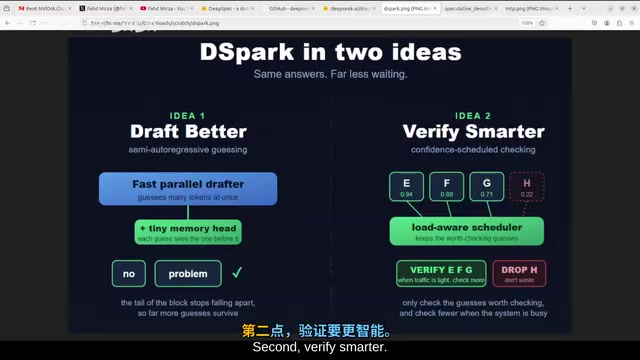
DeepSeek Boosts Inference Speed by 85%: How Speculative Decoding Is Reshaping the AI Speed Race
DeepSeek and Peking University's DS Spark paper boosts AI inference speed by up to 85% via confidence scheduling and semi-autoregressive speculative decoding — no model or GPU changes.
Read more →
·5 min
DeepSeek DSpec Hands-On: How Speculative Decoding Accelerates LLM Inference by 6x
Hands-on report on DeepSeek's open-source inference acceleration toolkit DSpec: draft model + smart scheduling delivers lossless speedup, hitting acceptance length 6 on GSM8K and reproducing official data.
Read more →
 Tutorials
·3 min
DeepSeek V4 Flash MTP Speculative Decoding Real-World Test: A Guide to 20% Faster Local Inference
Real-world testing of DeepSeek V4 Flash with MTP speculative decoding: ~20% speedup for code generation, minimal gains for text. Covers memory overhead, accuracy differences, Q4 vs Q3 quantization, and full deployment tutorial.
Read more →

·3 min
Self-Hosting Kimi K3: Is Spending 20% More on Hardware Worth a 20% Improvement in Task Performance?
Analysis of whether spending 20% more on hardware for self-hosting Kimi K3 to gain 20% task performance improvement is worthwhile, covering inference precision, VRAM optimization, and tiered deployment.
Read more →

·2 min
Real User Feedback: Claude Opus 5 vs Gemini 3.1 Pro — Does Speed Determine the Experience?
A Reddit user's hands-on comparison of Claude Opus 5 vs Gemini 3.1 Pro reveals that response speed and interaction fluidity may matter more than raw intelligence in choosing an LLM.
Read more →

·3 min
Is LLM Inference Actually Profitable? Breaking Down the Cost Structure and Business Logic of Large Model Inference
A deep dive into LLM inference cost structure and profitability models—from GPU throughput, MoE architecture, and KV Cache to scale effects—revealing the business logic behind API price wars.
Read more →

·3 min
Kimi K3 Reaches 2.5T Parameters, MiniMax M3 Pro Brewing Simultaneously: China's LLM Arms Race Escalates
Kimi K3 adopts new architecture with 2.5T parameters and 1M token context. MiniMax M3 Pro targets 2.7-3T. OpenAI surpasses 7M users, HY-OCR 1.5 achieves SOTA, Amap launches world model.
Read more →

·2 min
Kimi 3 Added to Pro Subscription: Accelerating Commercialization of Chinese LLMs
Kimi 3 joins the Pro subscription plan, giving paying users direct access to the latest flagship model. Analysis of Kimi 3's upgrades, Moonshot AI's subscription strategy, and China's evolving LLM landscape.
Read more →

·2 min
Kimi 3 Included in Pro Subscription: Accelerating Commercialization of Chinese LLMs
Kimi 3 is now included in the Pro subscription plan, giving paying users direct access to the latest flagship model. This article analyzes Kimi 3's upgrades, Moonshot AI's subscription strategy, and shifts in China's LLM competitive landscape.
Read more →

·4 min
Cursor Start India Plan at ₹649/Month: Decoding the Regional Pricing Strategy for AI Coding Tools
Cursor launches its Start plan for India at ₹649/month (~$7.70), featuring Grok 4.5 and Composer Agent. A deep dive into the PPP pricing strategy and its market implications.
Read more →

·4 min
Colibri: Running a 744-Billion-Parameter LLM on an Ordinary Laptop
Colibri uses MoE hot-cold separation and 4-bit quantization to run 744B-parameter models like GLM 5.2 on consumer hardware. Learn about its three-tier memory architecture and speculative decoding.
Read more →

·4 min
Laguna S 2.1 Deep Dive: Hands-On Local Deployment of a 118B Parameter Coding Model
In-depth review of Poolside's Laguna S 2.1 open-source coding model: MoE architecture, RL training, DGX Spark local deployment, and real-world agentic coding tests with 8B active parameters.
Read more →

·3 min
Claude Opus 5 Officially Released: Performance Approaching the Top Tier as the Open-Weight Debate Heats Up Again
Anthropic releases Claude Opus 5 with near-frontier performance at lower prices. Same day, Jensen Huang co-signs open-weight letter with 20+ companies while DeepSeek fundraising rumors surface.
Read more →

·2 min
DeepSeek V4 Official Release Imminent: What 1.6 Trillion Parameters Really Means
DeepSeek V4 official release is imminent. V4 Pro features 1.6 trillion parameters with million-character context. Explore the D-SPARK acceleration framework, dynamic pricing, and V4's leap to production-grade AI.
Read more →

·2 min
Google Flash and Flash-Lite Models Upgraded and Live: A New Lightweight, High-Efficiency AI Option
Google rolls out upgraded 3.6 Flash and 3.5 Flash-Lite models. Learn about the Flash series' positioning, upgrade highlights, and value for developers.
Read more →

·3 min
Opus 5 Hands-On: Powerful but Slow — Inference Speed Becomes the New AI Battleground
An AI practitioner tests Opus 5: powerful capabilities but painfully slow inference. Deep analysis of how LLM competition is shifting from intelligence to inference speed.
Read more →