#autoregressive Transformer
237 related articles

·3 min
Self-Hosting Kimi K3: Is Spending 20% More on Hardware Worth a 20% Improvement in Task Performance?
Analysis of whether spending 20% more on hardware for self-hosting Kimi K3 to gain 20% task performance improvement is worthwhile, covering inference precision, VRAM optimization, and tiered deployment.
Read more →

·2 min
Real User Feedback: Claude Opus 5 vs Gemini 3.1 Pro — Does Speed Determine the Experience?
A Reddit user's hands-on comparison of Claude Opus 5 vs Gemini 3.1 Pro reveals that response speed and interaction fluidity may matter more than raw intelligence in choosing an LLM.
Read more →

·3 min
Local LLM Agent Lagging? Lowering num_gpu Is the Key
Local LLM crashing in Agent frameworks? The issue may be num_gpu set too high. Learn what num_gpu really controls (GPU layer offloading, not GPU count) and how to tune it for stable Agent performance.
Read more →

·3 min
Is LLM Inference Actually Profitable? Breaking Down the Cost Structure and Business Logic of Large Model Inference
A deep dive into LLM inference cost structure and profitability models—from GPU throughput, MoE architecture, and KV Cache to scale effects—revealing the business logic behind API price wars.
Read more →

·5 min
Learn AI Agent Development from Scratch: A 3-Step Practical Path to Get Started Quickly
How to learn AI Agent development from scratch? This article outlines a clear 3-step path: Python crash course, LLM theory & practice, and LangChain framework project implementation.
Read more →
·3 min
Deep Dive into Inkling: The First Frontier Open-Source Multimodal LLM from the West
Thinking Machines releases Inkling, an open-source multimodal LLM with near-trillion MoE parameters, 1M token context, Apache 2.0 license. Deep dive into architecture, benchmarks, and pricing.
Read more →

·4 min
Colibri: Running a 744-Billion-Parameter LLM on an Ordinary Laptop
Colibri uses MoE hot-cold separation and 4-bit quantization to run 744B-parameter models like GLM 5.2 on consumer hardware. Learn about its three-tier memory architecture and speculative decoding.
Read more →

·4 min
Laguna S 2.1 Deep Dive: Hands-On Local Deployment of a 118B Parameter Coding Model
In-depth review of Poolside's Laguna S 2.1 open-source coding model: MoE architecture, RL training, DGX Spark local deployment, and real-world agentic coding tests with 8B active parameters.
Read more →

·3 min
Why You Shouldn't Ask LLMs for Confidence Scores: The Pitfalls of Self-Reported Reliability
Asking LLMs to self-report confidence scores is a common mistake. Learn why it fails and discover reliable alternatives like logprobs, self-consistency sampling, and RAG.
Read more →

·2 min
Gemini Always Crashes on the 16th Turn? Error 1076 Root Cause Analysis and Workarounds
Google's Gemini consistently triggers Error 1076 on the 16th conversation turn, regardless of context size. Analysis points to a session state management defect, with three workarounds provided.
Read more →

·3 min
Why You Shouldn't Ask LLMs for Confidence Scores: The Pitfalls of LLM Self-Assessed Reliability
Asking LLMs for self-reported confidence scores is a common mistake. Learn why it fails, and discover reliable alternatives like logprobs, self-consistency sampling, and RAG for uncertainty estimation.
Read more →
·3 min
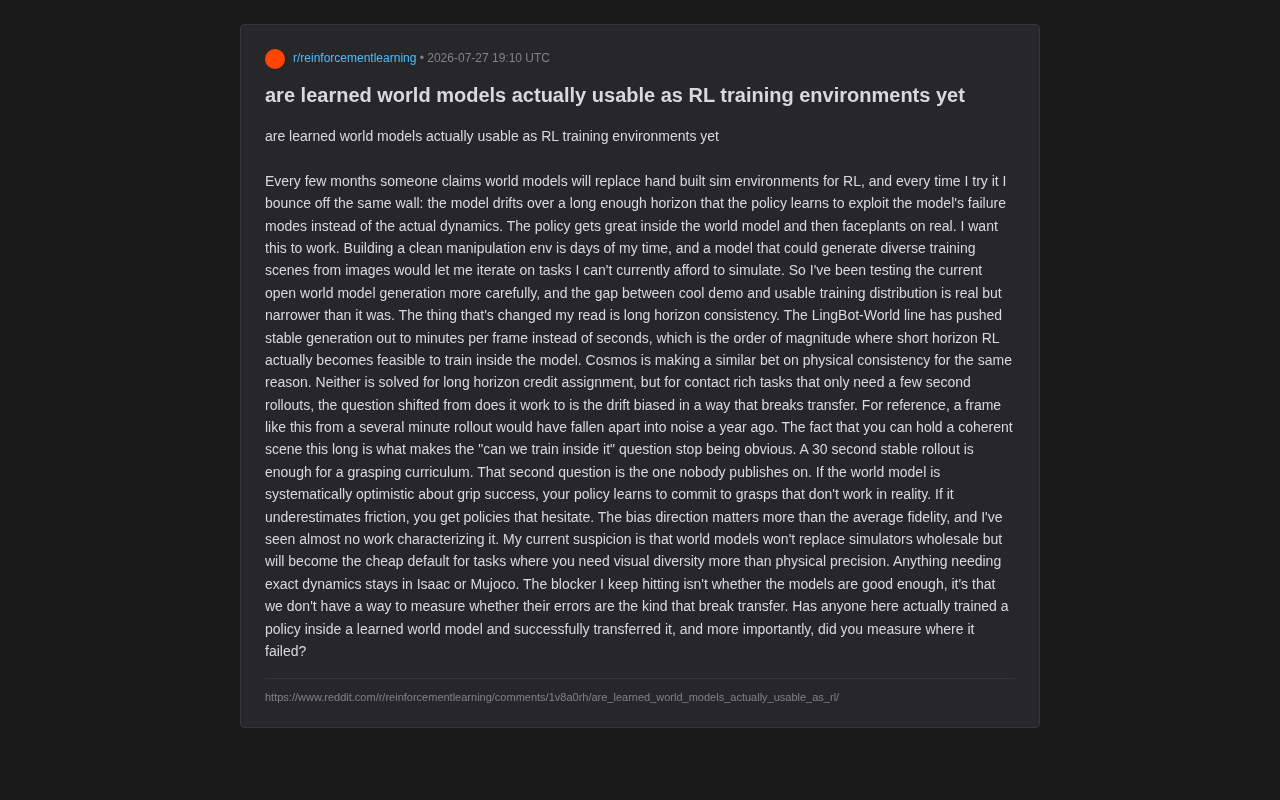
Can World Models Replace RL Training Environments? The Key Lies in the Direction of Error Bias
Analysis of world models as RL training environments: long-horizon consistency progress, how systematic error bias poisons policy transfer, and the emerging division of labor with traditional simulators.
Read more →

·5 min
The Complete Guide to AI Agent Development: A Four-Stage Progressive Roadmap
A systematic guide to AI Agent development across four stages: LLM fundamentals, ReAct paradigm, memory & tools, and multi-agent collaboration for developers.
Read more →

·4 min
The Dao of DeepSeek: Liang Wenfeng on Vision, Restraint, and the Philosophy of Open Source
Analysis of DeepSeek founder Liang Wenfeng's rare investor dialogue, exploring the company's vision-driven culture, strategic restraint toward AGI, and open-source philosophy in the US-China AI race.
Read more →

·4 min
The More Complex the AI Agent, the More It Hallucinates? The Hidden Cost of Architectural Complexity
Why do AI Agents hallucinate more as they grow more complex? This article analyzes the causes from error accumulation, context noise, and model completion nature, with 5 practical production strategies.
Read more →

·2 min
Google Flash and Flash-Lite Models Upgraded and Live: A New Lightweight, High-Efficiency AI Option
Google rolls out upgraded 3.6 Flash and 3.5 Flash-Lite models. Learn about the Flash series' positioning, upgrade highlights, and value for developers.
Read more →

·3 min
Why Can't AI Draw Charts Properly? The Cognitive Blind Spots in LLM Visualization Capabilities
Top AI LLMs can write code and pass professional exams, yet can't produce an accurate chart. This article analyzes why AI fails at chart generation and reveals the uneven nature of AI intelligence.
Read more →

·4 min
Gemini 3.5 Pro Hands-On: No More Lazy Code Generation, Complete Projects in a Single Output
A Reddit user tested Gemini 3.5 Pro in Arena and found it generates 20+ files with hundreds of lines of code per file in a single pass, with no lazy shortcuts or placeholders.
Read more →

·3 min
Kimi K3 Local Deployment Guide: Storage Requirements for q4 and q8 Quantization Explained
Detailed analysis of Kimi K3 quantization deployment options, comparing q4 vs q8 storage requirements, precision trade-offs, and hardware configurations for local self-hosting.
Read more →

·3 min
Multi-Model AI Aggregator Platforms Explained: Access GPT, Claude, Gemini & More from One Chat Interface
AI aggregator platforms promise one interface for GPT, Claude, Gemini, DeepSeek & more. This deep-dive covers core features, real value, data security risks, and safer alternatives.
Read more →