#heterogeneous inference
142 related articles

·3 min
Can Small Local Models Become Software Domain Experts? A RAG Architecture Deep Dive
Can small local models (1.5B–3B) become software domain experts? This article breaks down CPT, SFT, RAG, and Agent architectures, with a layered RAG-centric design for CPU-only local deployment.
Read more →

·3 min
n8n Automated AI Video Generation Pipeline: From Prompts to Batch Output — Complete Guide
A complete guide to n8n AI video generation automation: LLM-structured prompts, batch reference images, async video polling, and Google Sheets cost tracking — triggered by a single Webhook.
Read more →

·3 min
iOS 27 In-Depth Review: Five Major New Features Tested and Analyzed
iOS 27 deep dive: AI photo Extend & Spatial Reframe, a rebuilt Siri with personal data access, 30%+ system-wide speed gains, and long-overdue quality-of-life fixes — all tested and explained.
Read more →
4 Alternatives for Running CUDA on Non…
·3 min
4 Alternatives for Running CUDA on Non-NVIDIA Hardware: A Comparative Guide
A deep dive into running CUDA on non-NVIDIA hardware (AMD, Intel): comparing ROCm/HIP, ZLUDA, SYCL/oneAPI, and OpenCL across principles, use cases, and limitations.
Read more →
·2 min
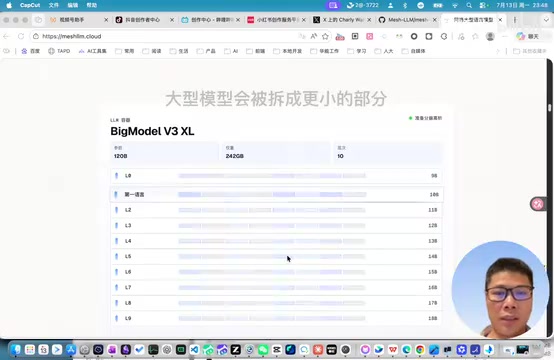
Mesh LLM: Pool Multiple Old Computers Into a Virtual Super GPU for Running Large Models
Mesh LLM is an open-source distributed inference framework that splits model layers across multiple devices, creating a virtual super GPU to run 100GB+ LLMs on consumer hardware.
Read more →
How NVIDIA BioNeMo Breaks Through Co-F…
·2 min
How NVIDIA BioNeMo Breaks Through Co-Folding End-to-End Performance Bottlenecks
How NVIDIA BioNeMo Agent Toolkit uses agent-based orchestration to solve MSA preprocessing, pipeline scheduling, and end-to-end bottlenecks in OpenFold3 co-folding workloads for drug discovery.
Read more →

·3 min
Ornith 1.0 9B Model Local Test: Tower Defense Game Exposes Small Model Coding Limitations
Hands-on test of Ornith 1.0 9B open model on a 16GB M4 Mac mini. A tower defense game task reveals the precision limits of small-parameter models vs 35B.
Read more →

·2 min
VersatIL: A Modular PyTorch Framework Tackling Code Fragmentation in Imitation Learning
VersatIL is a modular PyTorch framework for robot imitation learning that decouples data, network architecture, algorithm, and objective. Supports ACT, Diffusion Policy, pi0, and LeRobot format.
Read more →

·6 min
AI Agent Security in Practice: 7 Attack Techniques and a Five-Layer Defense System
An in-depth breakdown of the 7 major attack techniques against AI agents (prompt injection, data poisoning, image attacks, etc.) and a five-layer defense system, with real cases from Doubao and DeepSeek.
Read more →

·4 min
Home Assistant: The Local-First Open Source Smart Home Platform That Puts Privacy and Freedom First
Home Assistant is the most mature open source smart home hub, prioritizing local control and privacy, supporting thousands of devices across ecosystems with 88,000+ GitHub stars.
Read more →

·6 min
GPT-5.6 Sol Hands-On: How Multi-Agent Parallelism Is Reshaping AI Coding Workflows
Based on Fireship's review, an in-depth look at GPT-5.6 Sol's Ultra Mode multi-agent parallelism, its 91.9% Terminal Bench score, and how it differs from Claude Fable in cost, speed, and precision.
Read more →
Karp Speaks Bluntly: Where Does the An…
·5 min
Karp Speaks Bluntly: Where Does the Anger and Anxiety of CEOs in the AI Era Come From?
Palantir CEO Alex Karp voices what enterprise leaders really feel about AI: the gap between expectations and reality, vendor disappointment, and unclear ROI. A deep analysis of the roots of CEO anxiety and the industry's pivot from hype to value validation.
Read more →
Mesh LLM: A Practical Exploration of B…
·3 min
Mesh LLM: A Practical Exploration of Building a P2P Distributed AI Inference Network with iroh
Mesh LLM leverages the Rust P2P framework iroh to integrate compute from scattered nodes, exploring a viable path for decentralized LLM inference. This article analyzes its architecture, challenges, and prospects.
Read more →

·3 min
TabFM: A Zero-Shot Foundation Model for Tabular Data That Disrupts Traditional Modeling
TabFM is a zero-shot foundation model designed for tabular data, enabling direct prediction without retraining on new datasets. This article analyzes TabFM's positioning, its relationship to TabPFN, key strengths, and real-world challenges.
Read more →

·4 min
Gemini Accidentally Leaks Its Internal Reasoning Architecture: A Deep Dive into Bento Components and Knowledge Graph
An accidental prompt leak revealed the inner workings of Google Gemini's reasoning and UI rendering architecture, including Bento card components, the chameleon adaptive system, and knowledge graph entity ID retrieval.
Read more →

·4 min
No MLP or Attention Required: How Point-Attractor Dynamics Learn Word Embeddings
A minimalist dynamical system experiment: without MLP, Transformer, or attention layers, point-attractor dynamics driven purely by co-occurrence pressure learns semantic similarity on SimLex-999.
Read more →

·4 min
Testing a Research Automation Agent: Zero-Shot Reproduction of a NeurIPS Paper End-to-End
Testing research automation agent Klaus Goh: full reproduction of IBM's TTM time series paper at NeurIPS—from search to zero-shot inference, 2700+ predictions in 10 seconds, MSE 0.363 beating TimesFM.
Read more →

·3 min
DeepSeek-V4 Flash RL Training Successfully Ported to AMD MI355X GPU: A Complete Breakdown
The Miles team and AMD announce the full port of DeepSeek-V4 Flash RL training to AMD Instinct MI355X GPUs on ROCm, boosting AIME pass@1 from 0.39 to 0.49—a milestone for compute ecosystem diversity.
Read more →

·5 min
ChatGPT Work Officially Launches: How GPT-5.6 Is Reshaping the Way You Work
OpenAI launches the GPT-5.6 model family (Sol/Terra/Luna) and ChatGPT Work, enabling automated financial analysis, local file operations, Codex coding, and cross-app workflows—AI officially becomes a real work partner.
Read more →

·3 min
Apple Executive Explains: Why the Mac Mini Has Become AI Developers' Top Choice for Local Inference
An Apple chip executive explains the surge in Mac Mini demand among AI developers: unified memory architecture breaks the VRAM bottleneck, superior energy efficiency enables long-term local deployment—the Mac Mini is becoming a top pick for local LLM inference.
Read more →