#neural combinatorial optimization
16 related articles

·4 min
Cracking TSP: A Closure Theory for Identifying Critical "Exception Edges"
Exploring a mathematically precise definition of "exception edges" in TSP, using closure problem theory to identify critical non-local edges that determine optimal solutions, providing verifiable structural priors for RL and NCO solvers.
Read more →
·3 min
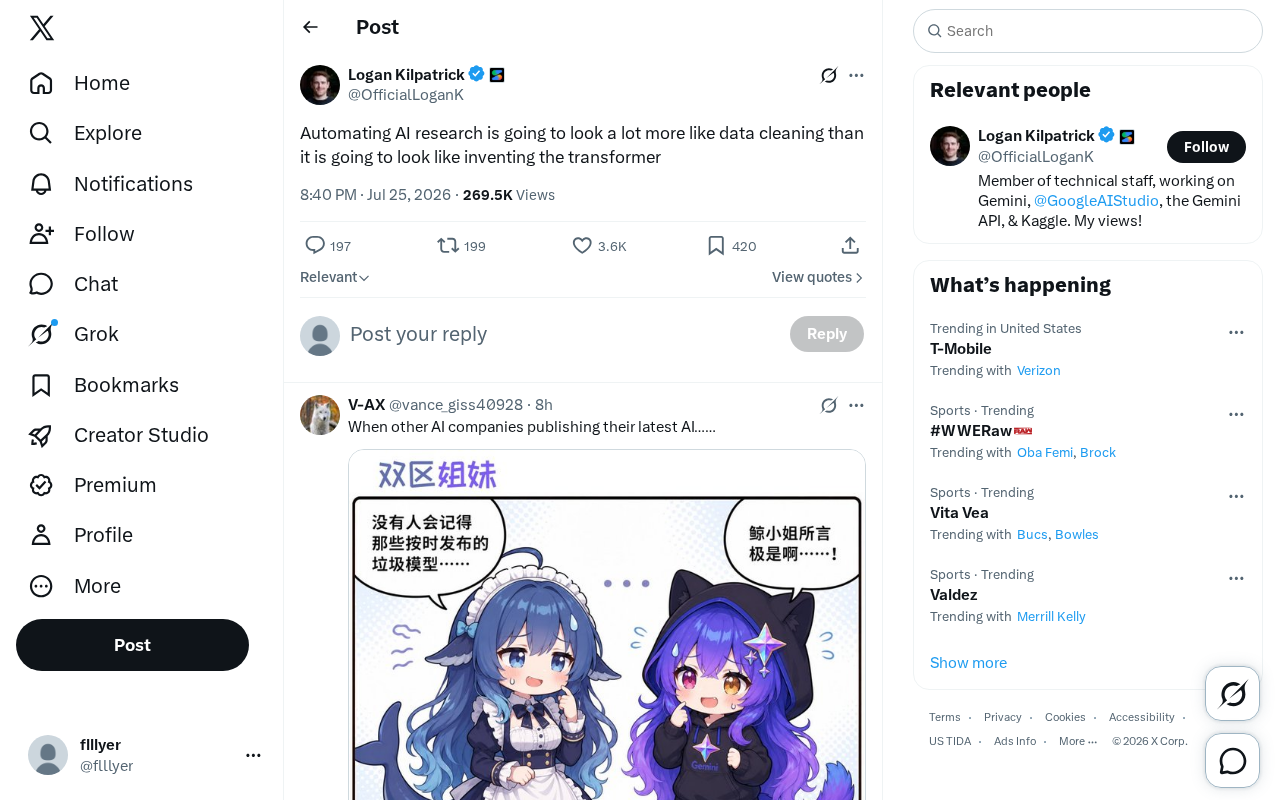
AI Research Automation: More Like Data Cleaning Than Inventing the Transformer
AI research automation will look more like data cleaning than inventing the Transformer. Explore how automating 60%-80% of repetitive research work reshapes the AI research paradigm.
Read more →
·3 min
AI Research Automation: More Like Data Cleaning Than Inventing the Transformer
Why AI research automation looks more like data cleaning than inventing the Transformer. Exploring the value of automating 60%-80% of repetitive research work and how human-AI collaboration reshapes the research paradigm.
Read more →

·6 min
Hands-On with Qwen 3.8 Max: How an Open-Source Model Closes In on Top-Tier Closed Models
Qwen 3.8 Max has 2.4 trillion parameters and will be open-sourced. In KingBench testing it scored 81.25%, ranking second, beating Claude Opus 4.8 and trailing only Fable 5. A deep dive into its performance across 8 tests.
Read more →

·3 min
AI Large Language Models for Beginners: Core Concepts and Chinese Model Landscape
New to AI? This guide clarifies AI, machine learning, deep learning, and LLMs, traces milestones from Deep Blue to DeepSeek, and maps out China's LLM landscape.
Read more →

·2 min
Google RLMF: Training LLMs to Honestly Express Uncertainty via Metacognitive Feedback
Google and Yale propose RLMF, using metacognitive feedback to train LLMs for honest uncertainty expression, achieving 63% calibration improvement in benchmarks.
Read more →

·2 min
Symbolic AI and Neural Networks: A Systematic Learning Path and Core Mathematical Tools
A deep dive into symbolic vs. neural AI paradigms — exploring type theory, category theory, and algebraic geometry as mathematical bridges toward neuro-symbolic integration.
Read more →

·3 min
New Retrieval Paradigms: Hobbit's Hard Negative Construction and Disco's Collaborative Coverage Index Design
A deep dive into two frontier dense retrieval works: Hobbit uses gradient analysis to automatically construct hard batches; Disco replaces single-document competition with submodular collaborative coverage, reshaping Top-K retrieval.
Read more →

·5 min
Practical AI Cost Optimization: A Deep Dive into Intelligent Routing and Context Compaction
AI bills keep soaring? This article breaks down two core cost-reduction strategies: intelligent routing via an LLM Gateway, and context compaction to cut Token usage—no major refactoring needed.
Read more →

·5 min
GPT-5.6 Launches: Comprehensive Upgrades to ChatGPT Work, Sites, and Desktop Client
OpenAI releases the GPT-5.6 model family, launching enterprise-focused ChatGPT Work, one-click ChatGPT Sites, and a major desktop client upgrade, with coding now ahead of rivals. Meta, Google, and Kimi follow intensively.
Read more →

·5 min
Krea 2 Turbo Style Reference LoRA: Define Your Generation Style with a Single Image
ostris releases the Krea 2 Turbo Style Reference LoRA, supporting single or multi-image style extraction for precise AI style transfer. Open-source, free, and locally deployable.
Read more →

·6 min
MIRA: An Analysis of a Multiplayer Interactive World Model Built on Rocket League
MIRA is an interactive world model project for the multiplayer competitive game Rocket League, exploring how neural networks simulate multi-agent interaction and complex physics. An in-depth look at its significance, challenges, and prospects.
Read more →

·7 min
Getting Started with LangGraph Multi-Agent Development: Architecture Analysis and Three Practical Case Studies
Learn LangGraph multi-agent development covering Supervisor and Collaboration architectures, with three hands-on projects: code assistant, prompt assistant, and WebRTC digital human.
Read more →

·4 min
Harness Engineering in Practice: Taming AI Agents with Hermes Agent
Deep dive into Harness Engineering: using the open-source Hermes Agent framework's four-layer memory system and Skill evolution to build controllable, evolvable AI agents.
Read more →

·2 min
Gemini Core Team Makes Rare Joint Appearance: Noam Shazeer and Other Key Figures in Public Conversation
Google Gemini core leaders Oriol Vinyals, Noam Shazeer, and Koray Kavukcuoglu make a rare joint public appearance — analyzing the team lineup, strategic significance, and competitive signals.
Read more →

·3 min
OpenAI Cracks Erdős Unit Distance Conjecture: AI Independently Disproves 80-Year-Old Math Problem for the First Time
OpenAI's general reasoning model independently disproved Erdős's 1946 unit distance conjecture without human guidance—the first time AI has autonomously solved a core open math problem, verified by nine top mathematicians.
Read more →