#out-of-distribution generalization
43 related articles
·2 min
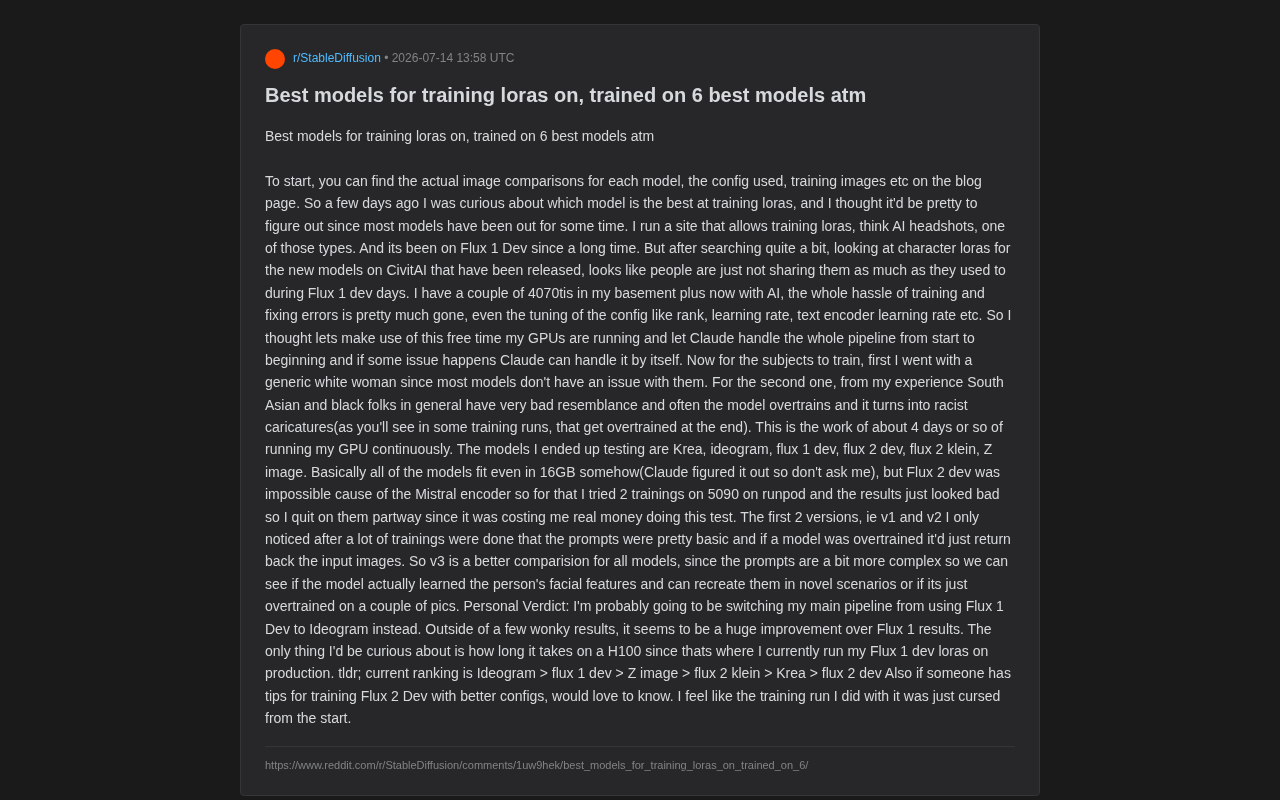
LoRA Training Showdown: Which Base Model Is Best for Character Fine-Tuning? A 6-Model Real-World Test
Real-world LoRA training comparison across Ideogram, Flux 1 Dev, Z Image, Flux 2 Klein, and Krea — revealing which base model best handles face fidelity and generalization for AI portrait developers.
Read more →

·2 min
Building Agent Trajectory Datasets: A Practical Methodology from Zero to Production
Random chat logs are useless for training tool-using AI agents. Learn the 6 elements of quality trajectories, full data pipeline design, and feedback loop strategies.
Read more →
Evaluating General-Purpose Robot Polic…
·2 min
Evaluating General-Purpose Robot Policies: A Scientific Framework for Real-World Deployment
How do you scientifically evaluate general-purpose robot policies for real-world deployment? This article breaks down evaluation challenges, task design, generalization testing, and the sim-to-real gap.
Read more →

·3 min
Why Does Reviewing AI Code Take Longer Than Reviewing a Junior Engineer's Code?
An engineer found that reviewing AI-generated code took four times as long as reviewing a junior engineer's code. This article dissects the trust mechanisms, process traceability issues, and the right approach to code review in the AI-assisted development era.
Read more →

·3 min
Neuro-Symbolic AI Architecture: A New Approach Inspired by Neurotransmitters and Sleep Cycles
Explore how neuro-symbolic AI architecture fuses neural networks with symbolic reasoning, simulating neurotransmitter regulation and sleep cycles to tackle hallucination and catastrophic forgetting.
Read more →

·4 min
Gemini Accidentally Leaks Its Internal Reasoning Architecture: A Deep Dive into Bento Components and Knowledge Graph
An accidental prompt leak revealed the inner workings of Google Gemini's reasoning and UI rendering architecture, including Bento card components, the chameleon adaptive system, and knowledge graph entity ID retrieval.
Read more →

·2 min
MOSS-Transcribe-Diarize: A 0.9B End-to-End Multi-Speaker Speech Transcription Model
MosiAI open-sources MOSS-Transcribe-Diarize-0.9B: unified speech transcription and speaker diarization, 128K context for 90-min audio, hotword boosting, SGLang Day-0 support, edge-deployable.
Read more →

·6 min
Is AI Really Smart? The Future Directions and Capability Boundaries of Next-Generation Artificial Intelligence
Are large language models truly intelligent? This article analyzes core AI limitations — pattern matching, hallucinations, reasoning deficits — and explores next-gen directions like inference-time compute, neuro-symbolic AI, and embodied intelligence.
Read more →

·2 min
Toto-2.0: Multivariate Time Series Forecasting Enters the Foundation Model Scaling Era
Toto-2.0 is a major breakthrough in time series forecasting, applying LLM scaling philosophy to achieve zero-shot multivariate prediction across domains via unified representations.
Read more →

·3 min
Huawei Pangu 2.0-Flash Benchmark Review: #1 in Instruction Following, Last in Engineering Code
Huawei OpenPangu 2.0 Flash review: 92B MoE open-source model tops instruction following at 95.9, excels in math & Agent tasks, but scores last on SWE-Bench engineering code at 63.1.
Read more →

·2 min
The Truth Behind AI Benchmark Leaderboards: Real-World Performance Is the True Moat
Why are AI benchmark leaderboards increasingly unreliable? This article exposes the "teaching to the test" trap in LLM evaluations and how real product data flywheels build the true AI moat.
Read more →

·5 min
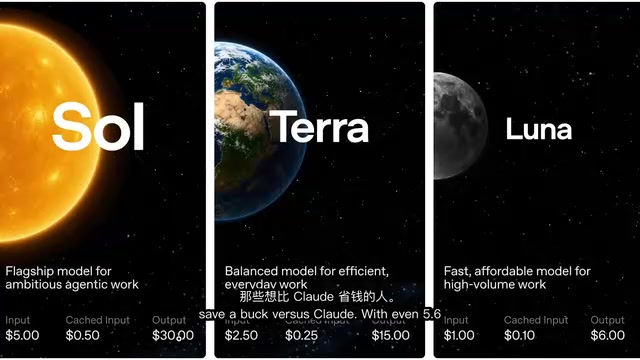
GPT-5.6 Launches: Three Product Lines + Government Approval — The Rules of the AI Industry Are Being Rewritten
OpenAI releases GPT-5.6 with three models — Sol, Terra, Luna — bringing major gains in coding and cybersecurity. More critically: the U.S. government now reviews AI model releases, making frontier AI regulation the new industry norm.
Read more →
·7 min
GPT-5.6 Sol vs. Fable 5: Can Half the Price Match the Flagship?
OpenAI launches GPT-5.6 Sol at half the price of Anthropic's Fable 5. We compare both models on HealthBench, cybersecurity and more using hard system-card data, analyzing Sol's cost-effectiveness and shifts in AI power.
Read more →

·6 min
Fable 5 vs GPT-5.6 Sol: Cost-Efficiency Redefines the Frontier AI Landscape
An in-depth analysis of the head-to-head between Anthropic's Fable 5 and OpenAI's GPT-5.6 Sol: the performance gap, the logic behind pricing strategies, and the concentration-of-power concerns raised by U.S. government involvement.
Read more →

·2 min
Training Just One Transformer Layer Can Match Full-Parameter RL Training?
A controversial study shows training just one Transformer layer can match full-parameter RL training. We analyze the technical principles, engineering value, and limitations of this approach.
Read more →
Stronger Models, Worse Tools? The Hidd…
·4 min
Stronger Models, Worse Tools? The Hidden Pitfalls of Tool Calling in Claude's New Models
Developers found Claude's flagship models Opus and Sonnet perform worse with third-party editing tools than older versions — likely due to RL over-optimization on built-in tools degrading generalization.
Read more →
Neural Render Proxies: A New Paradigm …
·3 min
Neural Render Proxies: A New Paradigm for Real-Time Interaction and Differentiable Lighting
A deep dive into Neural Render Proxies: how neural networks replace costly lighting computation to enable real-time interaction, inverse rendering, and end-to-end differentiable optimization across games, digital twins, and NeRF.
Read more →

·8 min
MCP Server or Agent Skills? A Clear Guide to Architecture Decision-Making
MCP Server vs Agent Skills: how to choose? This article systematically outlines an AI Agent architecture decision framework across three dimensions—essential differences, applicable scenarios, and judgment criteria.
Read more →
The True Nature of Moving Fast: Freque…
·3 min
The True Nature of Moving Fast: Frequent Contact with Reality Is a Form of Humility
"Moving fast" isn't recklessness — it's intellectual humility. This article explores the shared logic behind Agile, MVP, and AI iteration: true arrogance is believing you don't need to be tested.
Read more →

·2 min
OpenAI's New Research: Keeping AI Safe During High-Stakes Tasks
OpenAI's new research on "broadly and persistently beneficial" AI explores how to keep models safe in high-stakes scenarios beyond their training distribution.
Read more →