Training Just One Transformer Layer Can Match Full-Parameter RL Training?

Research suggests training a single Transformer layer can rival full-parameter RL training performance.
A study sparking debate on Hacker News claims that training just one Transformer layer can match full-parameter reinforcement learning results. This article explores the technical rationale behind this finding, its implications for redundant computation in post-training, engineering benefits like reduced memory and faster training, community skepticism about generalization and benchmark rigor, and what it means for the future of parameter-efficient RL training.
A Counterintuitive Discovery
In reinforcement learning (RL) training for large language models, the standard practice is to update all parameters across the entire model. This process is not only computationally expensive but also demands massive amounts of GPU memory and training time. However, a study that sparked heated discussion on Hacker News (142 points, 38 comments) proposes a rather counterintuitive claim: training just a single Transformer layer can match the performance of full-parameter RL training.
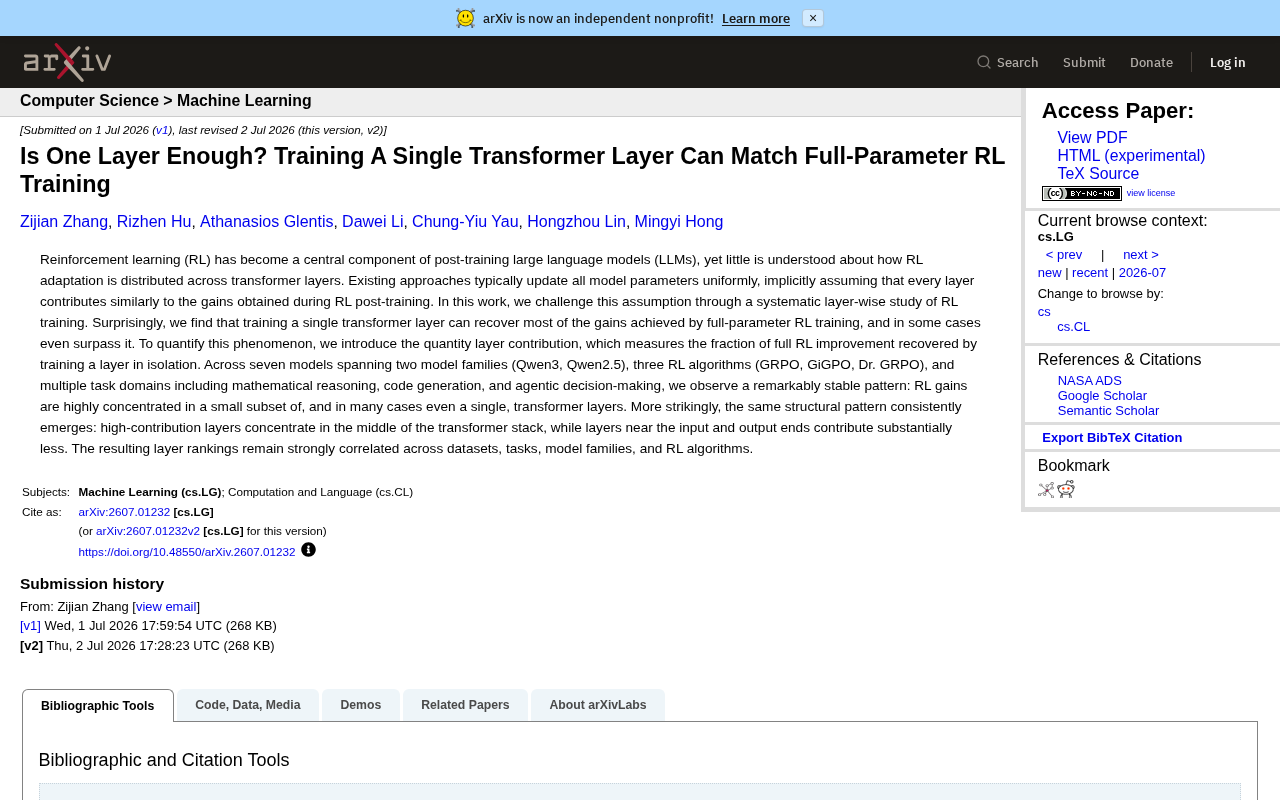
If this finding holds up, it would have profound implications for current RLHF (Reinforcement Learning from Human Feedback) and RLVR (Reinforcement Learning with Verifiable Rewards) training paradigms. It suggests that the capabilities truly being optimized during the RL phase may be far more "localized" and "concentrated" than we previously imagined.
Background: RLHF and RLVR RLHF is the core of mainstream large model alignment techniques, systematically introduced by OpenAI in the InstructGPT paper. Its basic workflow includes: collecting human preference annotations on model outputs, training a Reward Model, and then optimizing the language model using RL algorithms like PPO. RLVR is a recent variant primarily applied to tasks with objective answers, such as math and code — it requires no human annotation and directly uses programmatic answer verification as the reward signal. Models like DeepSeek-R1 have adopted this approach, significantly reducing the training cost of high-quality reasoning models.
What Does Reinforcement Learning Actually Change?
To understand the significance of this research, we first need to clarify a core question: after pretraining is complete, what exactly does the RL phase change inside the model?
A growing body of recent research suggests that RL (especially RLVR on math and reasoning tasks) doesn't truly inject substantial new knowledge into the model. Instead, it functions more like "activating" and "aligning" capabilities the model already acquired during pretraining. In other words, RL is more of a behavior shaping process than knowledge injection.
If this hypothesis holds, then full-parameter updates seem like overkill — what truly needs adjustment may be only a small subset of parameters responsible for certain decisions or output distributions. The core contribution of this research is experimentally demonstrating that compressing the optimization degrees of freedom down to a single Transformer layer still allows the model to achieve performance comparable to full-parameter training.
Division of Labor Across Transformer Layers A Transformer model consists of multiple stacked layers with identical structures, each containing two core sub-modules: Multi-Head Self-Attention and a Feed-Forward Network (FFN). Research has shown that layers at different depths exhibit clear functional specialization: shallow layers primarily process lexical and syntactic features, middle layers handle semantic integration, and deeper layers take on higher-order reasoning and output distribution control related to the task. This hierarchical property forms the structural basis for the "single-layer training" approach — if RL's optimization objective is primarily about adjusting output behavior rather than reshaping underlying knowledge representations, then concentrating updates on specific layers most relevant to the output is theoretically sound. Recent work in Mechanistic Interpretability continues to reveal the localized nature of functional components within Transformers, providing indirect support for such hypotheses.
An Extension of Parameter-Efficient Fine-Tuning
This approach is a natural extension of the parameter-efficient fine-tuning (PEFT) methods that have gained tremendous popularity in recent years. Techniques like LoRA, Adapter, and Prefix-Tuning have long demonstrated that training only a tiny fraction of parameters can adapt large models to downstream tasks. However, these methods have been primarily applied in supervised fine-tuning (SFT) scenarios.
Overview of the PEFT Ecosystem Parameter-Efficient Fine-Tuning (PEFT) is a family of techniques that adapt large models with minimal parameter modifications. LoRA (Low-Rank Adaptation) injects low-rank decomposition matrices alongside weight matrices, training only the newly added parameters; Adapter methods insert small bottleneck networks between Transformer layers; Prefix-Tuning prepends trainable soft prompt vectors to the input sequence. The common core assumption behind these methods is that the parameter space of pretrained models contains substantial redundancy, and the effective degrees of freedom needed for task adaptation are far fewer than the total parameter count. In practice, LoRA requires training less than 1% of parameters while approaching full fine-tuning performance on most SFT tasks, dramatically reducing GPU memory requirements and training costs.
This research pushes the "extreme minimalism" philosophy into RL training — a setting typically considered more unstable and more sensitive to parameter updates than SFT. The fact that single-layer training can achieve performance parity in such a demanding scenario suggests that RL signals may indeed have a highly concentrated area of effect within the model.
Technical Significance and Engineering Value
From a practical engineering perspective, if single-layer Transformer training can replicate full-parameter RL results, the benefits are substantial:
- Dramatically reduced memory footprint: Only needing to maintain gradients and optimizer states for a single layer makes it possible to complete training tasks on consumer-grade or mid-range hardware that would otherwise require a cluster.
- Faster training speed: Backpropagation computation is significantly reduced, shortening iteration cycles.
- Enhanced interpretability: Concentrating effective updates on a specific layer provides researchers with a new experimental handle for understanding "which layer RL actually acts upon."
These advantages are particularly critical for resource-constrained research teams and small-to-medium enterprises — it means high-quality RL alignment is no longer exclusive to big tech companies.
Community Skepticism and Discussion
Among the 38 comments on Hacker News, the community response was far from unanimously positive. Several noteworthy questions were raised:
How rigorous is the "matching"? A common challenge: when they say "comparable to full-parameter training," on which benchmarks and which tasks does this hold? RL training evaluation itself is noisy, and matching performance on a single or handful of benchmarks doesn't necessarily generalize to broader capability dimensions.
Which layer should be trained? Another focal point: if only one layer is trained, choosing which layer is critical. Should it be the final layer closest to the output, a middle layer, or does it need to be dynamically selected per task? This directly impacts the method's practicality and generalizability.
Does it sacrifice generalization ability? Some commenters worry that overly constraining parameter updates might perform well on specific tasks while collapsing in out-of-distribution (OOD) scenarios.
The Challenge of OOD Generalization Out-of-Distribution (OOD) generalization is a core challenge in machine learning, referring to a model's ability to maintain performance in novel scenarios outside its training distribution. In large model post-training, this issue is particularly acute: over-optimizing for specific evaluation benchmarks can lead to "benchmark contamination" or capability degradation. While full-parameter RL training is expensive, broad parameter updates provide an implicit regularization effect — coordinated adjustments across multiple layers make overfitting in any single direction harder. The highly concentrated gradient updates of single-layer training are theoretically more prone to overfitting on the target task, and the generalization trade-offs need to be systematically verified through diverse evaluation benchmarks (such as cross-domain test sets like MMLU, GSM8K, HumanEval, etc.) rather than drawing conclusions from a handful of benchmarks alone.
Full-parameter training may be expensive, but its "redundancy" might be precisely the source of its robustness.
Implications for Future Training Paradigms
Regardless of whether this study's conclusions ultimately withstand large-scale reproduction, it points to an emerging consensus: the post-training phase of large models likely involves substantial redundant computation.
From LoRA to today's single-layer RL training, the trend is crystal clear — we are constantly pushing toward the boundary of "achieving maximum alignment with minimum modification." This is not merely a cost issue but reflects a deeper understanding of the model's internal mechanisms. When we can precisely locate where "intelligent behavior" is stored and regulated, training, alignment, and interpretability research will all gain new tools.
For developers and researchers following the cutting edge, studies like this remind us: before chasing larger models and more compute, perhaps we should first ask — do we really need to update all the parameters?
Conclusion
The question "is one layer enough" fundamentally challenges the default assumptions of current large model training. It may not immediately overturn mainstream engineering practices, but it has already opened a door worth exploring deeply for efficient RL training. In an era where compute costs are increasingly becoming a bottleneck for AI development, any approach that can dramatically reduce training overhead without sacrificing performance deserves serious attention from the community and rigorous experimental verification.
Related articles

A Developer's Hands-On Test of Doubao Phone Assistant: AI Phones Are Evolving from Chatbot to Agent
A developer's hands-on test of Doubao Phone Assistant — from screen Q&A and calendar actions to server port checks and FFmpeg vulnerability patching — exploring how AI phones evolve from Chatbot to Agent.
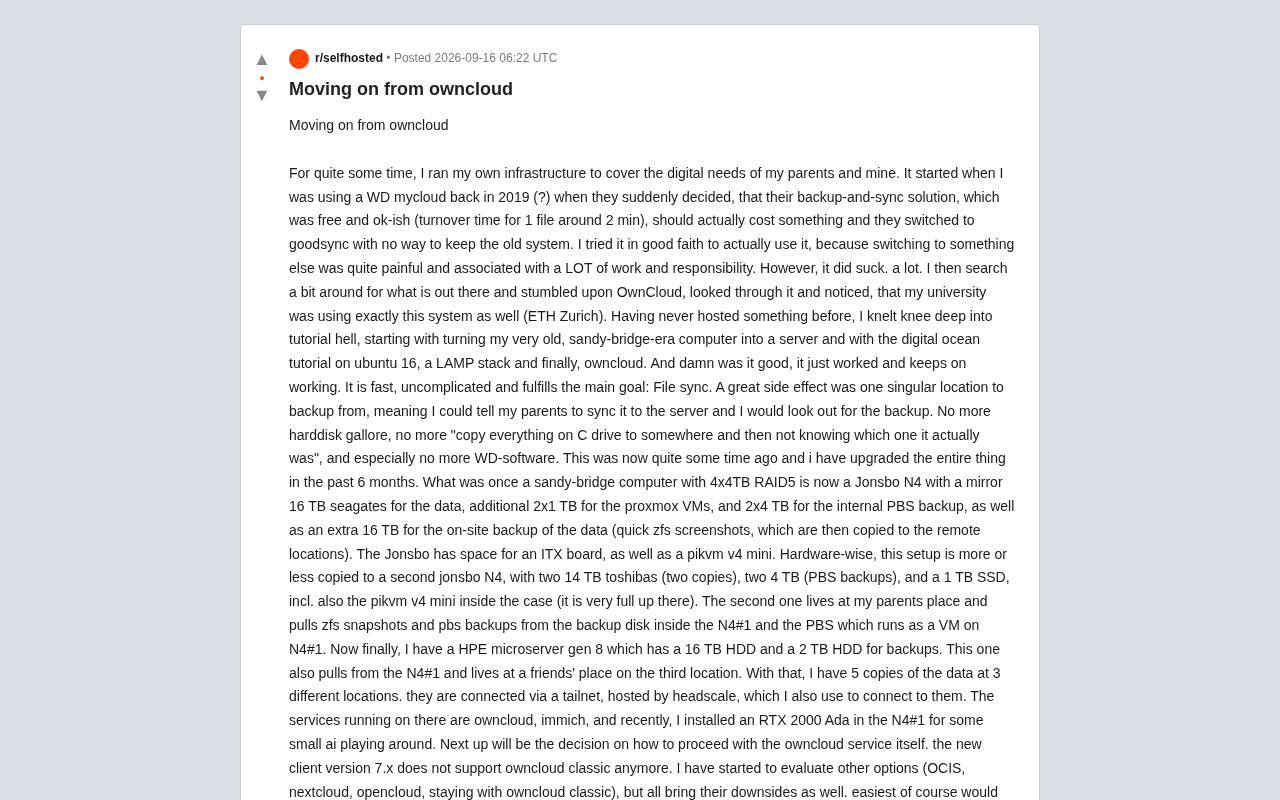
Moving On from ownCloud: Building a 5-Copy, 3-Location Home NAS Backup System
A Reddit user's journey from WD MyCloud to a 5-copy, 3-location ZFS+Proxmox home NAS, and the hard choices facing ownCloud Classic users as the official client drops support.

What Are Agent Skills? A Beginner's Guide from Understanding to Customization
What are Agent Skills? This guide breaks down the Skill concept, its role in ecosystems like Claude Code, and a three-step learning path from understanding to customization.