#tensor processing unit
377 related articles

·3 min
Why AI Companies Are Reluctant to Open Source: The Strategic Dilemma and Game Theory of Market Leaders
Deep analysis of why leading AI companies refuse to open-source core models. Exploring moat mentality, competitive game theory, and the open vs. closed source dialectic.
Read more →

·3 min
Why AI Companies Resist Open Source: The Strategic Dilemma and Game Theory of Market Leaders
Deep analysis of why leading AI companies resist open-sourcing core models. Exploring moat mentality, competitive game theory, and the evolving open vs. closed source dynamics in the AI industry.
Read more →

·2 min
Behind the Open-Source Model Frenzy: Who Will Provide Cheap Inference Services?
Open-source LLM weights don't equal low-cost access for developers. This article analyzes the inference service gap in open-source AI and how providers like Together AI and Groq are addressing it.
Read more →

·2 min
Behind the Open-Source Model Frenzy: Who Will Provide Cheap Inference Services?
Open-source LLM weights don't mean developers can use them cheaply. This article examines the inference service gap in open-source AI and how providers like Together AI and Groq are addressing it.
Read more →

·4 min
How Much Math Do You Need for Machine Learning? Finding the Balance Between Preparation and Practice
How much math do you really need before starting ML projects? This article analyzes the 'bottomless pit' trap, proposes a minimum viable math framework, and offers project-driven learning strategies.
Read more →

·3 min
TokenTown: A Visual Approach to Understanding How LLMs Predict the Next Token
TokenTown is an open-source visualization project that intuitively presents the internal token prediction process of LLMs using a town metaphor. Learn its design philosophy and educational value.
Read more →

·3 min
Production-Grade LLM Inference Deployment: A Practical K8s Handbook
Complete guide to deploying production-grade LLM inference on Kubernetes, covering GPU scheduling, vLLM engine selection, autoscaling, observability, and cost optimization.
Read more →

·3 min
Is LLM Inference Actually Profitable? Breaking Down the Cost Structure and Business Logic of Large Model Inference
A deep dive into LLM inference cost structure and profitability models—from GPU throughput, MoE architecture, and KV Cache to scale effects—revealing the business logic behind API price wars.
Read more →

·3 min
Moonshot AI Open-Sources FlashKDA: A Deep Dive into High-Performance CUDA Kernels for KDA Attention
Moonshot AI open-sources FlashKDA, providing high-performance CUDA kernels for Kimi Delta Attention. Learn about its technical principles, performance gains, and value for long-context training and inference acceleration.
Read more →

·3 min
Moonshot AI Open-Sources FlashKDA: A Deep Dive into High-Performance CUDA Kernels for KDA Attention
Moonshot AI open-sources FlashKDA, providing high-performance CUDA kernels for Kimi Delta Attention. Explore its technical principles, performance gains, and value for long-context training and inference.
Read more →

·3 min
ncnn Vulkan Cross-Platform Edge Inference in Practice: Solving the GPU Fragmentation Deployment Challenge
Facing GPU fragmentation on edge devices, the PostSlate team used ncnn's Vulkan backend for cross-platform ML inference, achieving 10× speedup on RTX 4070 with half the model size and zero runtime installation.
Read more →

·2 min
awesome-systematic-trading: A Complete Guide to the 9,000-Star Quantitative Trading Open Source Resource List
Deep dive into the 9,100-star awesome-systematic-trading GitHub project covering backtesting frameworks, strategy implementations, data tools, and classic books for quantitative traders.
Read more →

·3 min
Gemini Batch API Major Upgrade: 80% Latency Reduction, Success Rate Exceeds 99.998%
Google's Gemini Batch API completes major infrastructure upgrade with 80% lower p95 latency, 99.998%+ success rate, 98% fewer expirations, and new partial batch support for large-scale AI inference.
Read more →

·3 min
Kimi K3 Launch: A 2.8 Trillion Parameter Flagship Model Makes Its Grand Entrance
Moonshot AI launches Kimi K3 with 2.8 trillion parameters and 1M token context. Google delays Gemini 3.5 Pro, AI coding tools upgrade collectively as competition shifts to coding and Agent capabilities.
Read more →

·5 min
Open-Source STEM Education Robot: Smart Ball-Fetching Interaction Powered by Edge AI Object Detection
An open-source STEM education robot using Edge Impulse edge AI for local object detection, teaching kids computer vision and ML through an engaging ball-fetching game with anthropomorphic design.
Read more →

·3 min
Backend Developer Transition to AI/LLM: 4 Core Skills and a Practical Learning Roadmap
Complete guide for backend developers transitioning to AI/LLM engineering. Covers the 4 core skills—Python, RAG, Fine-tuning, and Agents—with a phased learning roadmap and practical project advice.
Read more →

·2 min
Gemini Always Crashes on the 16th Turn? Error 1076 Root Cause Analysis and Workarounds
Google's Gemini consistently triggers Error 1076 on the 16th conversation turn, regardless of context size. Analysis points to a session state management defect, with three workarounds provided.
Read more →

·3 min
Monocular RGB Human Mesh Reconstruction: Real-Time Motion Capture at 18 FPS with Rust + CUDA
A deep dive into a real-time 3D human mesh reconstruction project using a single RGB camera, built with Rust, Candle, and CUDA, achieving 55ms/frame on an RTX 5080.
Read more →

·3 min
Monocular RGB Human Mesh Reconstruction: Real-Time Motion Capture at 18 FPS with Rust + CUDA
Deep dive into a real-time 3D human mesh reconstruction project using a single RGB camera, built with Rust, Candle, and CUDA, achieving 55ms/frame on RTX 5080. Exploring its architecture, Metal porting plans, and applications in VTuber, AR/VR, and sports analysis.
Read more →
·3 min
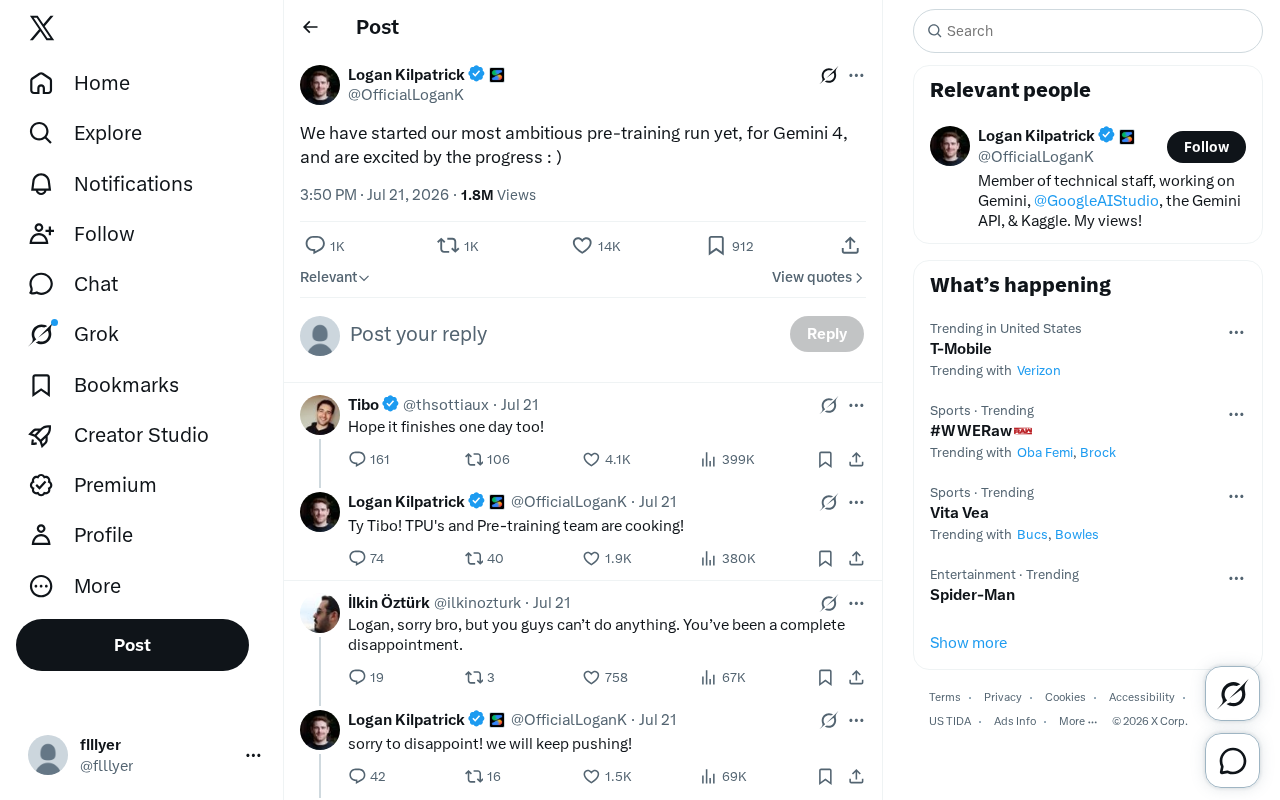
Google Launches Gemini 4 Pre-training: Its Most Ambitious AI Model Training Yet
Google DeepMind announces Gemini 4 pre-training has begun, calling it their most ambitious training yet. A deep dive into its technical direction, compute scale, multimodal breakthroughs, and competitive impact.
Read more →