AI Agent: A Complete 6-Week Learning Roadmap from Beginner to Production

A structured 6-week roadmap to master AI Agent development from fundamentals to production deployment.
This guide breaks down AI Agent development into a clear 6-week learning path, covering the three core components (planning, memory, tool use), the ReAct reasoning paradigm, multi-agent collaboration patterns, RAG integration for domain knowledge, and the engineering challenges of deploying Agents to production — including performance, security, and observability.
AI Agent Is One of the Hottest Technical Directions Right Now
AI Agent technology is rapidly entering the mainstream — from humanoid robots on national TV stages to intelligent assistants launched by major model providers. This article distills a systematic AI Agent curriculum into a clear learning path from zero to production-ready, helping developers and tech enthusiasts build a solid foundation in Agent development.
Why You Should Care About AI Agents Now
The reason Agents keep generating buzz comes down to what they represent: the next stage of LLM applications. If ChatGPT-style conversational models solve "answering questions," Agents solve "completing tasks" — they can autonomously plan, call tools, maintain context, and iteratively work toward a goal across multiple steps.
The rise of AI Agents builds on breakthroughs in large language model (LLM) capabilities. ChatGPT's launch in late 2022 demonstrated LLMs' potential in language understanding and generation, but pure conversational models have clear limitations: they can't access real-time information, execute code, or interact with external systems. The Agent architecture was born to overcome these constraints — using the LLM as a "brain" and equipping it with "hands and feet" through tool use and planning, transforming the model from a passive information responder into an active task executor. This paradigm shift has a clear academic lineage: in 2023, OpenAI researcher Lilian Weng published the survey blog post LLM Powered Autonomous Agents, which systematically organized the Agent technical framework and quickly became one of the most widely cited references in the field.
For developers, mastering AI Agent development is not just a technical upgrade — it's the key entry point for capturing the next wave of AI application opportunities.
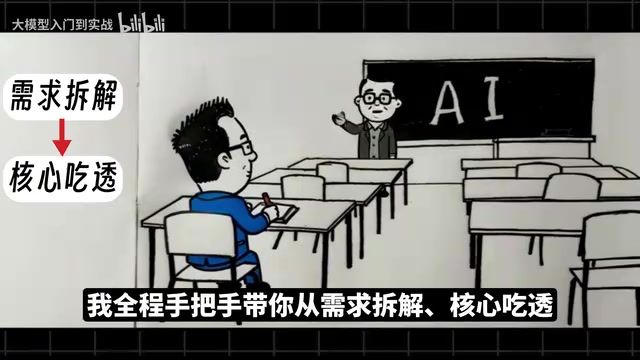
Notably, the barrier to Agent development keeps dropping. With mature frameworks like LangChain, AutoGen, and CrewAI, even beginners can quickly build working Agent prototypes. LangChain has accumulated over 90,000 GitHub stars since open-sourcing in October 2022, making it the most ecosystem-complete Agent development framework available. Microsoft's open-source AutoGen focuses more on multi-agent conversational orchestration — the two represent the most mainstream technical approaches today.
Building the Foundation: Core AI Agent Architecture
The first step in learning AI Agents is understanding the underlying architecture. A complete Agent typically consists of three core components:
Planning Module
The planning module is responsible for breaking complex tasks into executable sub-steps. This is the core capability that distinguishes Agents from ordinary conversational models — rather than generating an answer in one shot, the Agent first thinks through "what steps are needed," then executes them incrementally. Planning is typically implemented using Chain-of-Thought (CoT) prompting, formally introduced by the Google Brain team in 2022 in the paper Chain-of-Thought Prompting Elicits Reasoning in Large Language Models.
The core insight of CoT is that LLMs don't naturally reason step by step — this potential needs to be "activated" through specific prompt structures. Researchers found that simply demonstrating a "thinking process" in few-shot examples dramatically improves model performance on math reasoning and commonsense QA tasks. Even more notable is the "Zero-shot Chain-of-Thought" phenomenon — simply appending "Let's think step by step" to a prompt significantly improves reasoning even without any examples, revealing that CoT ability has been internalized as an emergent capability in large models. Building on this, methods like Tree-of-Thought and Graph-of-Thought further expand the planning search space. Tree-of-Thought allows the model to simultaneously explore multiple reasoning paths and select the best one, making it ideal for complex decisions requiring global optimization.
Memory Module
The memory module allows Agents to maintain contextual continuity. It consists of short-term memory (current session context stored in the LLM's context window) and long-term memory (cross-session knowledge storage, typically persisted via vector databases). Short-term memory is bounded by model context length (e.g., GPT-4 Turbo supports 128K tokens), while long-term memory requires embedding models to convert information into vectors for semantic storage and retrieval.
Vector databases have become the dominant solution for long-term memory because they retrieve information by semantic similarity rather than keyword matching — much closer to how human associative memory works. Platforms like Pinecone, Chroma, and Milvus convert text into high-dimensional dense vectors (typically 768–1536 dimensions) and use approximate nearest neighbor (ANN) algorithms to complete similarity searches across billions of vectors in milliseconds. The quality of the embedding model directly determines the semantic quality of the vector space — OpenAI's text-embedding-3 series and open-source models like BGE and E5 each have their strengths across different languages and domains. Advanced frameworks like MemGPT have even experimented with autonomous memory management mechanisms, letting Agents actively decide what information to retain long-term and what to forget — breaking through the physical limits of context windows.
Tool Use
Tool use allows Agents to transcend the knowledge boundaries of the base model. By connecting to search engines, code executors, databases, APIs, and other external tools, Agents can access real-time information and execute concrete actions. OpenAI's Function Calling mechanism, launched in June 2023, was an important standardization milestone — it allows developers to define tool interfaces in JSON Schema format, and the model can autonomously judge when to call which tool and correctly pass parameters.
Function Calling's significance goes beyond technical implementation: it elevated tool use from a "prompt engineering trick" to a "native model capability." The model learns to recognize the optimal timing for function calls during training rather than relying on carefully crafted prompts. In 2024, Anthropic proposed the Model Context Protocol (MCP), aiming to establish a unified cross-model, cross-platform standard for tool calling. MCP's core value is solving ecosystem fragmentation: developers implement a tool service once according to the MCP spec, and it can be called directly by all models and frameworks that support the protocol — marking a shift from proprietary protocols toward open interoperability.
Mastering the Core: How Agents Work and the ReAct Paradigm
After understanding the components, the second phase focuses on how Agents actually work — and the most critical concept is the ReAct paradigm (Reasoning + Acting).

ReAct originated from the 2022 paper ReAct: Synergizing Reasoning and Acting in Language Models, jointly published by Princeton University and Google Research. The researchers found that interleaving reasoning traces (Chain-of-Thought) with action steps outperformed pure action sequences or pure reasoning chains alone — surpassing the then-SOTA on knowledge-intensive benchmarks like HotpotQA and Fever while significantly improving interpretability. The paper was quickly adopted as the default Agent strategy in mainstream frameworks like LangChain, and has now accumulated over 2,000 citations on Google Scholar.
The core idea of ReAct is to have the Agent cycle between "reasoning" and "acting": first think about the current state and what to do next (Reasoning), then execute a concrete action (Acting), observe the result, and then reason again. This "Thought → Action → Observation" loop is the theoretical foundation of most mainstream Agent frameworks. A typical ReAct trace looks like this:
- Thought: I need to query today's weather data
- Action: Call
weather_api(city="Beijing") - Observation: Result returned — Sunny, 25°C
- Thought: Data retrieved, now I can generate travel recommendations
Mastering ReAct means not just understanding the theory, but knowing the real engineering challenges: how to design effective prompts, handle tool call failures, and prevent Agents from entering infinite loops. To address ReAct's potential reasoning deadlocks, follow-up methods like Reflexion and LATS (Language Agent Tree Search) have emerged. Reflexion introduces a "self-reflection" mechanism where Agents generate linguistic summaries of past failures and store them in memory. LATS borrows from Monte Carlo Tree Search (MCTS) — notably the same algorithm at the core of AlphaGo — to perform heuristic exploration across multiple possible action paths, dramatically improving completion rates on complex tasks.
Going Further: Multi-Agent Collaboration
The capabilities of a single Agent are ultimately limited. When tasks become sufficiently complex, multi-agent collaboration becomes the natural solution.
The theoretical roots of multi-agent systems (MAS) trace back to distributed AI research at MIT in the 1980s. However, constrained by early AI systems' limited intelligence, MAS remained largely academic. The LLM era gave this theoretical framework a new implementation path — each LLM-based Agent has natural language understanding and generation capabilities, enabling near-human collaborative communication between Agents.
Frameworks like AutoGen (Microsoft open-source), CrewAI, and LangGraph make it easy for developers to define Agent roles, communication protocols, and collaboration topologies. Typical orchestration patterns include: orchestrator-worker (one Orchestrator Agent assigns tasks to multiple Worker Agents), debate mode (multiple Agents challenge each other to reduce hallucinations and improve answer quality), and pipeline mode (Agents pass intermediate results sequentially, each specializing in a specific role).
In 2023, Stanford University's "Generative Agents" experiment placed 25 LLM-driven virtual characters in a simulated town, where they spontaneously exhibited emergent group behaviors like elections and social information spread — demonstrating the complexity and potential of multi-agent systems. The profound insight of this experiment was that researchers preset almost no rules for group behavior; all emergent social phenomena arose entirely from natural language interactions and memory mechanisms between individual Agents. This also touches on the core concept of "emergence" in complex systems science: system-level behavioral patterns cannot be directly predicted from the rules of individual components — posing unique safety evaluation challenges when large numbers of Agents collaborate.
This phase also requires mastering tuning techniques to ensure precise Agent outputs — covering prompt optimization, parameter adjustment, and error handling mechanism design.
Ecosystem Integration: Combining RAG with Agents
The fourth phase centers on integrating RAG (Retrieval-Augmented Generation) with Agents.
RAG was formally proposed by Meta AI in 2020 in the paper Retrieval-Augmented Generation for Knowledge-Intensive NLP Tasks. The core idea is to retrieve relevant document fragments from an external knowledge base before generating a response, then provide these as context to the language model — reducing hallucination and introducing knowledge beyond the model's training cutoff. Understanding hallucination is key to appreciating RAG's value: LLMs trained to predict the next token store statistical patterns rather than explicit facts, making them prone to "fluently fabricating" answers when training data coverage is insufficient.
As the technology has evolved, RAG has progressed from the original Naive RAG to more sophisticated architectures like Advanced RAG and Modular RAG. Advanced RAG introduces techniques such as Query Rewriting (transforming the user's original question into a form more suitable for retrieval), Reranking (using cross-encoders to finely sort initial retrieval results), and Hybrid Retrieval (combining BM25 keyword search with vector semantic search to complement each other for different query types). Modular RAG goes further by decomposing the RAG pipeline into flexible, independently combinable modules.
Combining RAG with Agents allows intelligent systems to reason and make decisions based on domain-specific knowledge bases, rather than being limited to the LLM's static training knowledge.
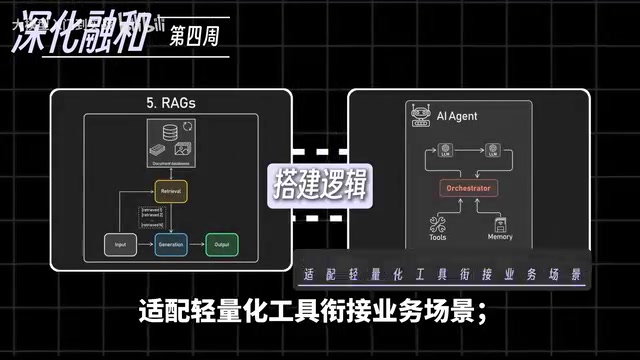
This combination is especially valuable for enterprise applications. By integrating with lightweight tools and specific business scenarios, AI Agents can evolve from general assistants into specialized domain experts — whether in customer service, legal consulting, or technical support, providing accurate and traceable answers based on an organization's proprietary knowledge base.
In practice, building the knowledge base itself is a systems engineering challenge often underestimated by enterprises: the choice of chunking strategy (fixed-length, sentence-level, or semantic chunking), the completeness of metadata annotation, and the mechanisms for regular updates and version management all critically affect the final system's performance.
Deployment: From Prototype to Production
The final two phases focus on engineering and deployment. Phase five covers lightweight Agent deployment, understanding business scenario customization and compatibility solutions. Phase six is the full-cycle hands-on phase — integrating all knowledge and completing multi-scenario Agent implementations.

The leap from prototype to production is often the most overlooked yet most critical step. Real-world deployment requires carefully addressing multiple engineering dimensions:
Performance: Optimize LLM call latency and token costs through techniques like streaming output, replacing general-purpose large models with smaller specialized models, and using caching layers to reduce redundant calls. Prompt Caching is an important cost optimization mechanism introduced by major model providers — for frequently reused system prompts in Agents, model providers can cache them at the KV Cache level. Both Anthropic and OpenAI have launched this feature, reducing input token processing costs by up to 90% for long system prompts — especially critical for token-intensive multi-agent systems.
Stability: Design robust error retry, timeout circuit-breaker, and graceful degradation mechanisms to prevent a single tool call failure from crashing the entire Agent task chain.
Security: Guard against Prompt Injection attacks — attackers may hijack Agent behavior through crafted malicious inputs, such as embedding hidden instructions in an apparently normal document to induce the Agent to execute unauthorized operations (data leakage, unauthorized API calls). OWASP has ranked prompt injection as the #1 security risk in LLM applications. Defense strategies currently have no silver bullet: input filtering, instruction delimiters, privilege separation, and output monitoring used in combination is the most reliable approach in current industrial practice.
Observability: Establish comprehensive log tracing and Agent decision chain monitoring. Debugging LLM applications is more complex than traditional programs — the same input may produce very different outputs due to model temperature parameters and subtle context differences. Platforms like LangSmith and Langfuse, purpose-built for LLM application observability, can record every Thought, Action, and Observation step along with token consumption, and are becoming standard tools in production environments.
These dimensions collectively define the real boundary between a "toy demo" and a "production-ready product."
Summary and Learning Recommendations
This six-week learning roadmap provides a well-structured framework for AI Agent development: from core architecture and working principles, to multi-agent collaboration and RAG integration, to final deployment — covering the complete Agent development lifecycle.
A word of caution: claims like "zero prerequisites required" or "double your salary after completion" carry obvious marketing overtones and should be taken with a grain of salt. AI Agent development is fundamentally a technical discipline that requires solid engineering skills and continuous hands-on practice. Real growth comes from building things, not from rushing through courses.
Alongside following tutorials, it's recommended to read the official documentation for LangChain, AutoGen, and similar frameworks, follow technical blogs from researchers like Lilian Weng, actively contribute to open-source projects, and gradually build your own AI Agent knowledge system.
Related articles

MiniMax H3 Open-Source Video Model AMA Deep Dive: Architecture, Capabilities, and Future Roadmap
MiniMax H3 team hosts Reddit AMA detailing their open-source video generation model's architecture, image-to-video capabilities, inference optimization, and future roadmap.

GPT-5.6 Sol Continues Optimization, Luna Opens to Free Users: Decoding the Model Tiering Strategy
OpenAI releases dual GPT-5.6 updates: Sol continues optimizing reasoning capabilities while Luna opens to free users. Analysis of the model tiering strategy and its industry implications.

ComfyUI Integration with MiniMax H3: Complete Video Generation Workflow Deployment and Optimization Guide
Complete guide to deploying MiniMax H3 video generation in ComfyUI, covering text-to-video, image-to-video, first/last frame animation, environment setup, VRAM optimization, and prompt techniques.