Aix-DB Open-Source Framework: A Multi-Agent Approach to Natural Language Database Querying

Aix-DB enables end-to-end natural language to data insights through multi-agent collaboration.
Aix-DB is an open-source project built on LangChain/LangGraph that combines the MCP protocol with a multi-agent collaboration architecture, enabling users to complete data querying, analysis, and visualization through natural language alone—no SQL required. Its core strengths lie in the high accuracy and error self-healing capabilities enabled by specialized agents (intent understanding, SQL generation, data analysis, visualization), representing a paradigm shift in Text-to-SQL from single-model to multi-agent collaboration and driving enterprise data democratization.
What Is Aix-DB? Understanding the Project in One Sentence
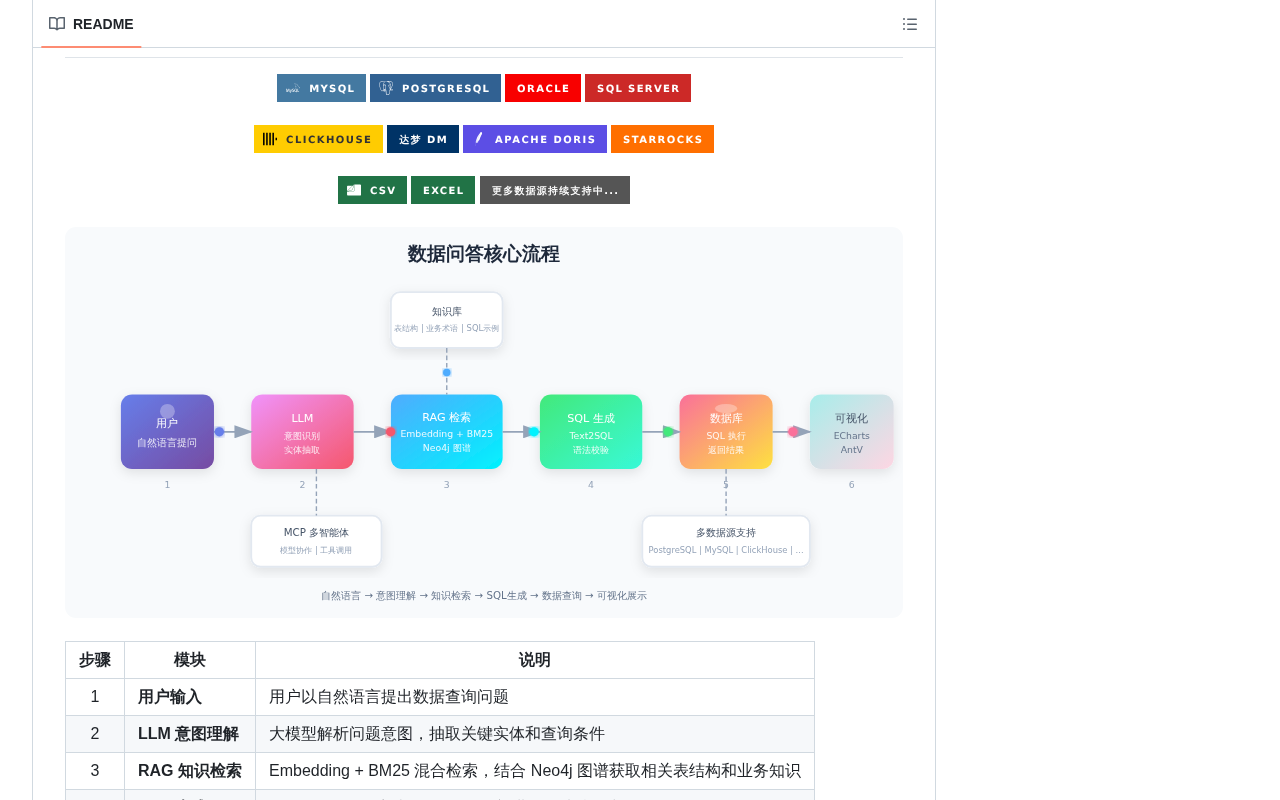
Aix-DB is an open-source project built on the LangChain/LangGraph framework that achieves end-to-end conversion from natural language to data insights through an MCP Skills multi-agent collaboration architecture. Users simply describe their data needs in everyday language, and the system automatically handles the entire workflow of data querying, analysis, and visualization—without writing a single line of SQL.
The project has earned over 2,100 Stars and 400+ Forks on GitHub. Developed in JavaScript with steadily growing community engagement, it reflects strong developer demand for natural language-driven data analysis.
Core Technical Architecture Analysis
LangChain/LangGraph Framework Foundation
LangChain is one of the most mainstream development frameworks for large language model applications today, offering rich capabilities for chain-based invocation and tool integration. A "Chain" refers to linking multiple processing steps—such as prompt construction, model invocation, and output parsing—into a reusable processing pipeline, allowing developers to combine different functional modules like building blocks. LangChain also has built-in support for dozens of components including vector databases, document loaders, and memory modules, significantly lowering the barrier to LLM application development. Since its open-source release in late 2022, LangChain has become one of the highest-starred LLM application frameworks on GitHub, with a massive developer ecosystem built around it.
LangGraph builds on this foundation by introducing graph-structured workflow orchestration, enabling complex multi-step tasks to be managed and executed as directed graphs. Unlike traditional DAG (Directed Acyclic Graph) workflow engines, LangGraph supports cyclic structures—meaning agents can iterate repeatedly within the graph until specific conditions are met before exiting. This feature is crucial for AI Agent scenarios that require "think-act-observe-rethink" loops. LangGraph's core abstraction is the StateGraph, where each node represents a processing step, nodes are connected through conditional edges, system state flows and updates between nodes, and developers can precisely control the execution logic and branching conditions at each step.
Aix-DB's choice of this technology stack as its foundation brings three practical advantages:
- Flexible model switching: Can connect to different LLM providers including OpenAI, Claude, and open-source models, without being locked into a single model
- Structured workflow management: Through LangGraph's state graph mechanism, precise control over every stage of data processing, with the ability to pinpoint specific nodes when errors occur
- Rich ecosystem integration: Easy connection to various data sources like MySQL and PostgreSQL, as well as various middleware and tools
MCP Skills Multi-Agent Collaboration Mechanism
MCP (Model Context Protocol) is a model context protocol proposed by Anthropic in late 2024, rapidly becoming an important interoperability standard in the AI Agent space. Simply put, MCP defines a standardized communication protocol that allows AI models to connect to external tools and data sources in a unified way—the industry often compares it to "the USB-C port of AI." Before MCP, every AI application needed custom integration code to connect with external tools. Through its Server/Client architecture and standardized JSON-RPC communication, MCP encapsulates tool capabilities as reusable service endpoints that any MCP-compatible client can call in a plug-and-play manner. Currently, MCP has gained support from major vendors including OpenAI, Google, and Microsoft, with its ecosystem developing rapidly.
Aix-DB combines MCP with a multi-agent architecture to build a Skills system—each Skill is essentially an agent with specific capabilities, exposing standardized interfaces through the MCP protocol. This design makes each Skill both an independent capability unit and one that can be flexibly scheduled and composed by the upper-level orchestration engine. Compared to traditional single-Agent architectures (where one large model handles all tasks), the core advantage of multi-agent architecture lies in separation of concerns: each agent has its own system prompt, toolset, and context window, avoiding attention dilution and hallucination problems caused by overly long single contexts.
Under this architecture, a complete data insight task is decomposed into multiple subtasks, completed collaboratively by different agents:
- Intent Understanding Agent: Parses the user's natural language input, identifying query intent and key parameters
- SQL Generation Agent: Generates accurate query statements based on the understood intent and database schema
- Data Analysis Agent: Performs statistical analysis and pattern recognition on query results
- Visualization Agent: Transforms analysis results into charts or reports
This division-of-labor approach, compared to a single Agent handling all tasks, shows clear improvements in both accuracy and maintainability. Each agent only needs to focus on its area of expertise, resulting in lower overall error rates.
Natural Language to Data Insights: End-to-End Process Breakdown
From One Sentence to One SQL Query
Traditional data analysis workflows require users to master SQL or other query languages, which presents too high a barrier for business personnel and management. Aix-DB's core value is eliminating this barrier—users only need to say "compare sales across regions last month" or "user growth trend over the past three months," and the system automatically handles everything that follows.
Text-to-SQL technology has evolved through several key stages: early solutions relied on rule templates and keyword matching, handling only fixed sentence patterns; around 2017, deep learning methods based on Seq2Seq (Sequence-to-Sequence) emerged, modeling the problem as a machine translation task; since 2023, the emergence of large language models like GPT-4 has enabled a qualitative leap in Text-to-SQL capabilities, with models achieving significantly higher accuracy on standard benchmarks through powerful semantic understanding and code generation abilities. However, even the most advanced large models still face significant accuracy bottlenecks when dealing with complex multi-table join queries, nested subqueries, and domain-specific terminology—which is an important reason Aix-DB chose a multi-agent approach.
This seemingly simple process requires solving several key technical challenges:
- Semantic disambiguation: Natural language inherently contains ambiguity—for example, does "last month" mean the calendar month or the most recent 30 days? The system needs to make accurate judgments by combining context with database metadata
- Schema mapping: Mapping what users call "sales" to the specific
order_amountfield in the database, and "region" to theregiontable. This process is known in academia as Schema Linking, one of the most critical and error-prone steps in the Text-to-SQL pipeline. Schema Linking requires the system to understand database table structures, field meanings, and inter-table relationships, accurately mapping entities and attributes in natural language to specific database elements. High-quality Schema Linking typically requires combining multiple dimensions of information including column name annotations, sample data, and foreign key relationships—Aix-DB's intent understanding agent plays a core role at precisely this step - Query optimization: The generated SQL must not only be syntactically correct and logically accurate, but also reasonably efficient in execution, avoiding performance issues like full table scans
Error Self-Healing Through Multi-Agent Collaboration
A key advantage of multi-agent architecture is error self-healing. Consider a practical scenario: if the SQL generated by the SQL Generation Agent fails to execute, the Data Analysis Agent feeds the error information back, and the SQL Generation Agent automatically corrects the query and re-executes it. The entire process is transparent to the user, requiring no need to re-describe the requirement.
The theoretical foundation for this error self-healing capability comes from two important paradigms in recent AI Agent research. First is ReAct (Reasoning + Acting), proposed by Google and Princeton University in 2022, whose core idea is to have models alternate between "reasoning" and "acting" during task execution—first thinking about what to do next, observing results after execution, then deciding on subsequent actions. Second is Reflexion, which further introduces explicit summarization and memorization of failure experiences—agents can not only retry but also "learn" from errors, avoiding the same error patterns in subsequent attempts. Unlike simple exception catching and retry mechanisms in traditional software engineering, AI Agent error self-healing is semantic-level self-correction—the model can understand the cause of errors (such as "table does not exist" or "field type mismatch") and adjust its generation strategy accordingly, rather than mechanically repeating the same operation.
This closed-loop feedback mechanism significantly improves system robustness and is one of the core competitive advantages of multi-agent solutions over traditional single-model Text-to-SQL approaches.
Technology Trends and Industry Significance
Text-to-SQL Enters a New Multi-Agent Paradigm
Text-to-SQL is not a new topic—academia and industry have been exploring it for years. The two most authoritative evaluation benchmarks in this field are Spider and Bird. Spider was released by Yale University in 2018, containing over 10,000 natural language questions with corresponding SQL queries across 200 databases, serving as the standard test set for cross-database Text-to-SQL. Bird was released in 2023, focusing more on real-world large-scale database scenarios with dirty data and complex domain knowledge. On the Spider benchmark, early single-model approaches (such as fine-tuned T5-based models) achieved approximately 70% accuracy, large models like GPT-4 pushed this to over 80%, and systems employing multi-agent collaboration strategies (such as DIN-SQL, CHESS, etc.) have achieved execution accuracy of 85% or higher. On the more challenging Bird benchmark, multi-agent solutions show even more pronounced advantages over single-model approaches, especially in complex scenarios involving multi-table JOINs, nested queries, and domain-specific knowledge.
Aix-DB represents a paradigm shift in this field: early solutions mostly relied on rule matching or single-model end-to-end generation, with accuracy often falling short in complex query scenarios. Aix-DB's multi-agent collaboration approach decomposes complex problems into multiple controllable sub-problems, each handled by a specialized agent—highly consistent with the "divide and conquer" development trend in the current AI Agent field.
MCP Protocol Implementation in Data Analysis
Since its release, the community has been searching for best-practice scenarios for the MCP protocol. Aix-DB's application of MCP in data analysis provides a compelling reference case. Through MCP Skills' standardized interfaces, third-party developers can easily extend system capabilities—such as connecting new data source types, adding industry-specific analysis templates, or developing custom visualization components.
Driving Enterprise Data Democratization
From a broader perspective, tools like Aix-DB are driving the democratization of enterprise data. Data Democratization refers to enabling all members of an organization—not just data engineers and analysts—to conveniently access and leverage data for decision-making. Gartner noted in its 2024 Data and Analytics Trends report that by 2026, over 80% of enterprises will adopt natural language querying as one of the primary interaction methods for data analysis. However, the reality is that most enterprises face a severe data talent gap—it's estimated that the global supply-to-demand ratio for data analysts is approximately 1:5, meaning a large volume of data analysis needs are backlogged in data teams' work queues, with business departments often waiting days or even weeks for a single data report.
When business personnel, product managers, and even executives can directly obtain data insights through natural language, "data-driven decision making" will no longer be just a slogan but a truly actionable daily work practice. The bottleneck of data analysis shifts from "knowing how to write SQL" to "knowing how to ask questions"—a fundamental transformation. The emergence of tools like Aix-DB promises to compress data analysis response times from "days" to "seconds," fundamentally changing how data is consumed within enterprises.
Conclusion: A Technical Direction Worth Watching
Aix-DB integrates LangChain/LangGraph, the MCP protocol, and multi-agent architecture, staying at the forefront of industry trends in its technology choices while addressing core pain points in enterprise data analysis. Although the project is still in a rapid iteration phase, its architectural design philosophy and technical roadmap already demonstrate a clear sense of direction.
For developers exploring AI Agent implementation scenarios, or enterprise teams looking to lower the barrier to data analysis, Aix-DB is an open-source project worth deep study and continuous tracking.
Related articles
 Product Reviews
The Programmer's Desk Setup Guide: Building a Workspace That Feels Like Home
Discover how programmers build productive, comfortable workspaces. From multi-monitor setups to ergonomic design, explore the desk philosophy that drives focus and flow.
 Product Reviews
Qoder vs Cursor Real-World Comparison: Which $20/Month AI IDE Is Better?
Hands-on comparison of Qoder vs Cursor AI IDEs: Agent autonomy, human interaction count, and architecture decisions. Qoder needed only 2 interactions vs Cursor's 8.
 Product Reviews
Cursor Cloud Agent Demo: Eliminating Bottlenecks Across the Entire Software Development Lifecycle
Deep analysis of Cursor's Cloud Agent demo showing how cloud VMs, automated test artifacts, and a full-chain control plane systematically eliminate human bottlenecks across the software development lifecycle.