Enterprise RAG Development Team Evaluation Guide: Retrieval Quality, Engineering Details & Production Readiness

A systematic guide for enterprises evaluating RAG vendors based on retrieval quality, engineering depth, and production readiness.
This guide helps enterprises evaluate RAG development partners by focusing on what truly matters: retrieval quality metrics (MRR, NDCG), hallucination detection mechanisms, chunking and indexing strategies, hybrid retrieval capabilities, and production observability with feedback loops—rather than simply which models or frameworks are supported.
Introduction: Common Misconceptions in RAG Vendor Selection
In the wave of enterprise AI adoption, Retrieval-Augmented Generation (RAG) has become the core technical approach for building reliable knowledge Q&A systems. RAG was first proposed by Meta AI's research team in 2020, with the core idea of decoupling information retrieval from text generation—first retrieving relevant document fragments from external knowledge bases, then feeding these fragments as context into large language models for answer generation. This paradigm effectively addresses the knowledge cutoff problem and hallucination issues of purely parameterized models, enabling AI systems to generate responses based on up-to-date, verifiable information sources. Compared to fine-tuning, RAG offers lower knowledge update costs, stronger auditability, and doesn't require model retraining.
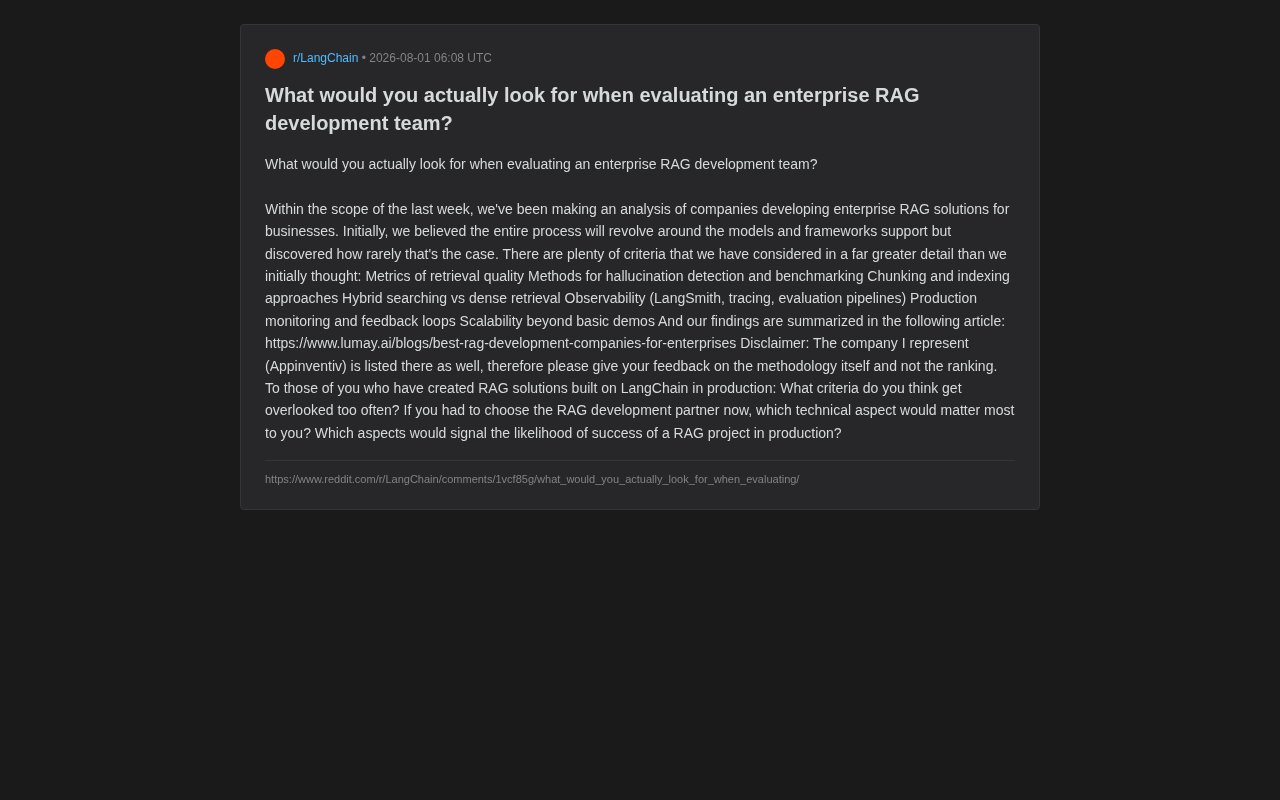
However, when enterprises actually begin searching for RAG development partners, they often fall into a common cognitive trap—believing the evaluation process should focus on "which models are supported" and "what frameworks are used."
Recently, a practitioner deeply experienced in the RAG field (from the Appinventiv team) shared their week-long research findings on enterprise RAG vendors on Reddit. They candidly stated: "Initially we thought the whole process would revolve around model and framework support, but found that's rarely the case." This discovery is quite revealing—what truly determines the success or failure of a RAG project is often the engineering details that are easily overlooked.
Retrieval Quality: The Core Evaluation Dimension for RAG Systems
Retrieval Metrics Are the Foundation
Many teams can deliver impressive results during demos, but once they enter production environments, shortcomings in retrieval quality become glaringly apparent. The original post's author listed "Metrics of retrieval quality" as the top evaluation dimension—a point worth serious attention from all buyers.
The essence of RAG is "retrieve first, generate second." If the context recalled during the retrieval phase is itself incorrect or irrelevant, then even the most powerful LLM can only produce "garbage in, garbage out." Therefore, a mature RAG development team should be able to clearly explain how they measure Recall, Precision, and ranking relevance (metrics like MRR, NDCG), rather than merely showcasing a few carefully selected Q&A examples.
MRR (Mean Reciprocal Rank) measures the average of the reciprocal of the rank position of the first correct result returned by the system, directly reflecting how efficiently users find the correct answer. NDCG (Normalized Discounted Cumulative Gain) considers the quality of the entire ranked list, assigning higher weight to relevant documents ranked near the top. In RAG scenarios, these metrics better reflect the actual performance of retrieval systems than simple accuracy, because LLM generation quality is highly dependent on the relevance of the top few retrieval results.
Hallucination Detection and Benchmarking
The second critical dimension is "Hallucination detection and benchmarking." Enterprise RAG applications have extremely low tolerance for inaccuracy—an incorrect answer in financial or medical contexts can lead to severe consequences.
Truly professional teams establish systematic hallucination detection mechanisms, such as groundedness checks (verifying consistency between answers and retrieved context), citation capabilities, and independent evaluation benchmarks to quantify the probability of the model "fabricating" content. The principle behind groundedness checks is to compare each claim generated by the model against the original retrieved documents one by one, determining whether generated content is supported by evidence. Currently, widely used evaluation frameworks in the industry include RAGAS, TruLens, and DeepEval, which quantify dimensions such as Faithfulness, Answer Relevancy, and Context Precision through automated evaluation pipelines. In high-risk domains like financial compliance and medical diagnosis, every percentage point reduction in hallucination rate represents significant risk convergence.
If a RAG vendor cannot provide reproducible benchmark test data, their reliability should be questioned.
Engineering Details: Chunking, Indexing & Retrieval Strategies
Chunking and Indexing Methods Determine the Retrieval Ceiling
"Chunking and indexing approaches" may seem like technical minutiae, but they directly determine the upper limit of RAG retrieval quality. How documents are segmented, whether semantic overlap is preserved between chunks, and how metadata is organized—these decisions profoundly affect subsequent retrieval effectiveness.
Crude fixed-length chunking may split complete semantic units, while overly granular chunking loses contextual associations. Excellent RAG development teams employ differentiated chunking strategies based on document types and business scenarios, such as dynamic chunking based on semantic boundaries and hierarchical indexing (parent-child chunking).
Parent-child chunking is a representative hierarchical indexing strategy: the system segments documents into smaller child chunks for precise semantic retrieval matching, but after a retrieval hit, returns the parent chunk containing more context to the LLM for answer generation. This design cleverly balances retrieval precision with the contextual completeness needed for generation. Additionally, semantic chunking dynamically determines split points by calculating embedding vector similarity between adjacent sentences, only splitting when semantic jumps exceed a threshold, thereby avoiding the mechanical destruction of complete semantic units by fixed-length chunking. The selection and combination of these strategies directly reflects a team's depth of understanding of RAG engineering details.
Hybrid Retrieval vs. Dense Retrieval: The Litmus Test of Engineering Experience
The original post specifically mentioned "Hybrid searching vs dense retrieval." Pure vector (dense) retrieval excels at capturing semantic similarity but often falls short when handling exact keyword matching, proper nouns, product codes, and similar scenarios.
Hybrid retrieval achieves a balance between semantic understanding and exact matching by combining traditional sparse retrieval (such as BM25) with dense vector retrieval. BM25 is a classic sparse retrieval algorithm based on improvements to TF-IDF (Term Frequency-Inverse Document Frequency), and has remained the baseline standard in information retrieval since the 1990s. It calculates document relevance through exact term matching, offering natural advantages for proper nouns, abbreviations, and product codes. Typical implementations of hybrid retrieval fuse and re-rank results from BM25 and vector retrieval using Reciprocal Rank Fusion (RRF) or weighted linear combinations. Currently, mainstream vector databases including Elasticsearch, Weaviate, and Pinecone all natively support hybrid retrieval capabilities.
Whether a mature RAG team defaults to hybrid retrieval solutions, and whether they can dynamically adjust the weight ratio between sparse and dense retrieval based on different query types, is often an important signal for assessing their engineering experience depth.
Production Readiness: The Chasm Between Demo and Scaled Deployment
Observability Is Essential for Production Environments
The original post listed "Observability" separately, specifically naming tools like LangSmith, tracing, and evaluation pipelines. This reflects a profound industry consensus: RAG systems in production are complex systems requiring continuous monitoring and tuning, not one-time deliverables.
LangSmith is an LLM application observability platform launched by the LangChain team, supporting fine-grained tracing of every step in the RAG pipeline (document retrieval, re-ranking, prompt construction, model generation), recording inputs/outputs, latency, and token consumption for each call. Similar tools include Weights & Biases' Weave, Arize AI's Phoenix, and the open-source Langfuse. Evaluation pipelines refer to integrating automated assessments of retrieval quality and generation quality into CI/CD processes, ensuring that every code change or knowledge base update doesn't cause system performance regression—a concept directly aligned with regression testing in traditional software engineering.
Without observability, teams cannot determine whether an incorrect answer originated from the retrieval phase or the generation phase, nor can they quantify the actual improvements brought by each system iteration. RAG projects lacking evaluation pipelines are essentially "flying blind."
Monitoring and Feedback Loops Distinguish Professional from Amateur
"Production monitoring and feedback loops" is another watershed separating professional RAG teams from amateur ones. Truly deployed RAG systems need to continuously collect user feedback, monitor drift in retrieval hit rates, identify emerging failure patterns, and feed these signals back into system optimization.
Specifically, feedback loops encompass multiple layers: explicit user-level feedback (such as thumbs up/down, answer corrections), implicit system-level signals (such as whether users performed follow-up queries, session abandonment rates), and data-level drift monitoring (such as changes in retrieval distribution after adding new documents). Mature teams automatically translate these signals into retrieval strategy adjustments, chunking parameter optimizations, and even prompt template iterations, forming a virtuous cycle of continuous improvement.
Scalability: Real Capabilities at Scale
"Scalability beyond basic demos" strikes directly at an industry pain point. Many RAG solutions perform perfectly when handling dozens of documents, but collapse when document scale expands to millions and concurrent users surge. When evaluating RAG development teams, it's essential to examine their real engineering capabilities in high-concurrency, large-scale knowledge base scenarios.
Scaling challenges manifest primarily in three dimensions: vector index retrieval latency (approximate nearest neighbor search performance at million-vector scale), efficiency of incremental knowledge base updates (whether full index rebuilding is required), and multi-tenant isolation with resource scheduling capabilities. These issues never surface during the demo phase and only become bottlenecks under real production loads.
RAG Vendor Evaluation Recommendations for Buyers
Based on the findings from this research, enterprises evaluating RAG development teams should consider the following angles:
- Demand quantitative data: Ask vendors to provide benchmark test results for retrieval quality metrics and hallucination rates, rather than relying solely on demo presentations. Specifically, request their Faithfulness, Context Recall scores on standard evaluation datasets, along with comparisons against industry baselines.
- Examine engineering depth: Ask about their chunking strategies, whether they employ hybrid retrieval, and how they design index structures. Probe their experience handling different document types (such as PDF tables, scanned documents, multilingual documents).
- Verify observability: Confirm whether they have a complete tracing, evaluation, and monitoring system. Request a demonstration showing how they trace from an incorrect answer back to the specific failure point through the tracing chain.
- Focus on production experience: Prioritize teams with large-scale production deployment cases who can demonstrate feedback loop mechanisms. Examine their system stability under scenarios of continuous knowledge base updates and growing user scale.
As the original post's author asked the community: "Which criteria are most often missed? If you were selecting a RAG development partner now, which technical dimension would matter most to you?" These questions have no standard answers, but one thing is certain—what determines the success or failure of a RAG project is never which model or framework was chosen, but rather the engineering prowess hidden behind the production environment.
Key Takeaways
Related articles

How Theoretical Physicists Can Efficiently Get Started with Machine Learning: Optimal Paths and Resource Guide
A systematic guide for theoretical physicists transitioning to ML, covering math advantages, a three-stage learning path, classic textbooks, and physics-ML cross-disciplinary research directions.

Learning Machine Learning from Scratch: How to Find a Study Partner and Level Up Efficiently
A complete learning path for machine learning from scratch—from Python basics to PyTorch deep learning—plus practical strategies for finding study partners and overcoming self-study plateaus.

6-Month AI Engineer Learning Roadmap: A Deep Review and Pitfall Guide
Deep analysis of a viral Reddit AI learning roadmap: covering Python, ML, deep learning, LLM engineering to job prep, identifying common pitfalls like missing math foundations and overly broad scope.