91% of Enterprises Use Multiple AI Coding Tools: How to Tackle the 'Tool Sprawl' Problem

91% of enterprises run multiple AI coding tools — scalable Agent strategy requires Choice, Context, and Control.
With 91% of engineering teams running two or more AI coding tools simultaneously, tool sprawl and fragmentation have become the core barriers to scaling AI development. The article proposes three pillars for a scalable Agent strategy: Choice (avoiding lock-in to any single model or framework), Context (giving all Agents a shared, governed source of truth), and Control (centralizing governance of models, tools, MCP servers, skills, and Agents). The competitive focus is shifting from adopting more AI tools to governing existing AI capabilities at a higher level of maturity.
The Reality of AI Coding Tool Sprawl in the Enterprise
One striking statistic reveals a new normal in enterprise software development: 91% of companies are currently running two or more AI coding tools simultaneously. The era of a single dominant tool is over — multi-tool environments are now the reality for the vast majority of engineering teams.
From Copilot to Cursor, from model-driven coding assistants to custom-built Agent frameworks, engineering teams have rapidly embraced productivity tools — while inevitably accumulating a sprawling collection of AI capabilities that operate in silos with little coordination. What looks like a thriving ecosystem on the surface is quietly becoming a liability. As the original argument points out, the hard problem isn't adopting tools — it's managing the sprawl.
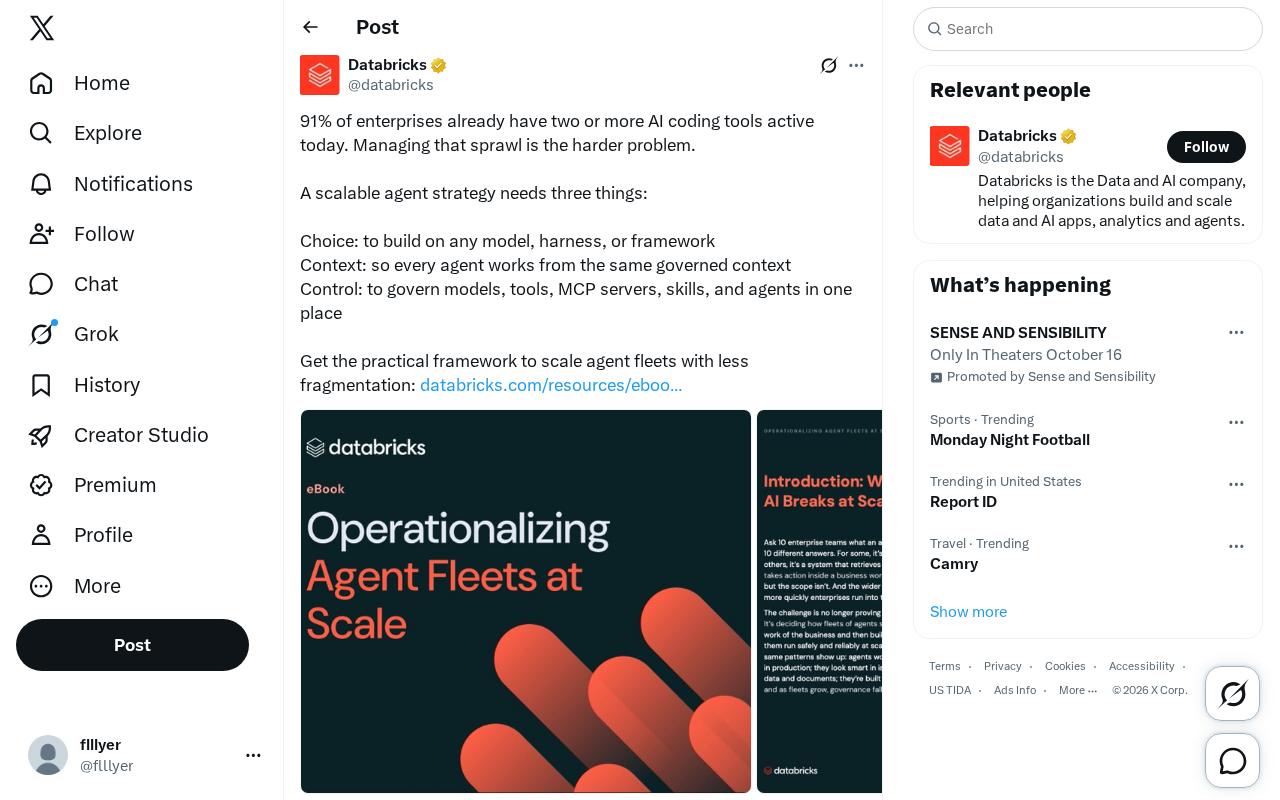
When every team and every developer chooses different AI tools, connects to different models, and maintains their own context, enterprise-wide consistency, security, and governance all take a hit. Fragmentation has become the central barrier to scaling AI development.
Three Pillars of a Scalable Agent Strategy
Stacking more tools won't get you far when it comes to scaling AI Agents reliably across an organization. The original framework offers a clear answer: a scalable Agent strategy requires three essential elements — Choice, Context, and Control.
Choice: Avoid Lock-in to Any Single Stack
The first pillar is Choice — the ability to build on any model, any harness, or any framework. AI technology evolves at a rapid pace; today's best-in-class model may be surpassed in a matter of months. If an enterprise is locked into a single vendor or framework, it loses the flexibility to adopt better-suited technologies when they emerge.
Preserving choice means organizations can freely mix and match underlying capabilities based on task requirements, cost, and performance — rather than being forced into a painful trade-off between lock-in and migration.
The term "harness" here refers to the execution framework or runtime container that hosts and orchestrates AI models — think LangChain, LlamaIndex, AutoGen, or an internally built invocation layer. It governs how a model receives inputs, calls tools, manages memory, and produces outputs. Different harnesses vary significantly in latency, cost, observability, and scalability. That's why "freedom to choose your harness" matters just as much as "freedom to choose your model" — being locked into a specific harness often means that even if you can swap the underlying model, the orchestration logic, tool integrations, and context management approach remain tightly bound, making migration just as costly as switching vendors.
Context: Give Every Agent a Shared, Governed Source of Truth
The second pillar is Context. The value an Agent delivers depends heavily on the context it can access. When multiple Agents operate in isolation with fragmented context, output quality and consistency suffer.
The ideal state is one where every Agent works from the same governed context. A unified, governed context layer improves collaborative outcomes across Agents while ensuring that access to sensitive information meets the organization's compliance requirements. This is the critical step from "standalone tools" to "a fleet of Agents."
In multi-Agent architectures, the technical challenge of "context governance" is far more complex than it sounds. The context each Agent relies on typically includes: the current state of the codebase, user intent and conversation history, internal enterprise knowledge (such as documentation and standards), and intermediate outputs from other Agents. When this context is stored and transmitted in isolation, different Agents may make decisions based on inconsistent or even conflicting information — leading to degraded output quality or security vulnerabilities. A "unified, governed context" requires a trusted context storage layer combined with access control policies, ensuring Agents can only read information within their permission scope, while the source, version, and changes to all context remain auditable. In practice, this is an engineering challenge that deeply integrates RAG (Retrieval-Augmented Generation) systems with enterprise identity and access management.
Control: Govern Everything from One Place
The third pillar is Control. As the number of models, tools, MCP servers, skills, and Agents continues to grow, decentralized management is almost guaranteed to spiral out of control. The core argument is clear: you need to govern models, tools, MCP servers, skills, and Agents from a single, unified place.
A centralized control plane gives the enterprise full visibility and authority over its entire AI capability stack — who is using which model, which tools are connected, and which data is being accessed should all be auditable and manageable. This is both a security requirement and a prerequisite for operating at scale.
MCP (Model Context Protocol) is an open protocol introduced by Anthropic in late 2024 that has steadily gained industry traction. Its goal is to standardize how AI models connect to external tools and data sources — much like USB-C provides a universal interface for hardware devices, MCP gives Agents a common "socket" to interact with file systems, databases, API services, and other external capabilities without requiring custom integration logic for each tool. As more tools and services publish MCP Servers, a new set of enterprise challenges emerges: Which MCP Servers are trustworthy? Who has authorized which Agents to call which services? This is precisely why a "unified control plane" needs to cover MCP Server governance.
The Mindset Shift: From "Adding Tools" to "Governing a Fleet"
Underlying this framework is a deeper industry trend: the center of gravity in enterprise AI development is shifting from "adopting more tools" to "governing existing capabilities." When 91% of enterprises are already running multiple tools, competitive advantage no longer comes from whether you've adopted AI — it comes from whether you can harness those capabilities with lower fragmentation costs and higher governance maturity.
In other words, the sophistication of an Agent strategy will increasingly depend on whether an organization can integrate its scattered tools and Agents into a coordinated, controllable, and scalable "fleet" — rather than allowing them to proliferate without structure.
For technology decision-makers evaluating AI development investments, this offers a practical checklist: Does your tooling stack preserve freedom of choice? Do your Agents share a unified, governed context? Do you have a centralized control plane? Answering these three questions well may matter far more than adopting yet another tool.
Note: This article is based on a single-source perspective from social media. The framework presented reflects the original author's practical viewpoint — readers should evaluate it in the context of their own organization's circumstances.
Related articles

Free Unlimited Claude Code Solution: Agnes AI + CC Switch Setup Guide
No paid subscription needed — pair the free AI platform Agnes AI with the open-source tool CC Switch to provide a backend for Claude Code, enabling unlimited free calls to text, image, and video models. This guide covers the full setup, test results, and usage boundaries.

A Complete Zero-Cost Guide to Getting Started with Claude Code for Beginners in China
A beginner's guide to Claude Code for users in China: two installation methods (command line and IDE plugin), full configuration steps for replacing the official API with the free domestic LongCat model, and a hands-on demo of building a small tool with natural language, plus tips.

When the NSA Gets Involved: The AI Supply Chain Crisis Behind Open-Source CVEs and API Key Hijacking
Multiple open-source projects disclosed severe CVEs in one day, PHP flaws alarmed the FBI, and Railway and OpenCode were breached with API keys stolen. This article breaks down the vulnerability window, AI-accelerated exploitation, and the AI supply chain crisis behind the API key black market, with a developer defense checklist.