Advanced AI Development for Java Backends: From Spring Source Code to Spring AI RAG in Practice
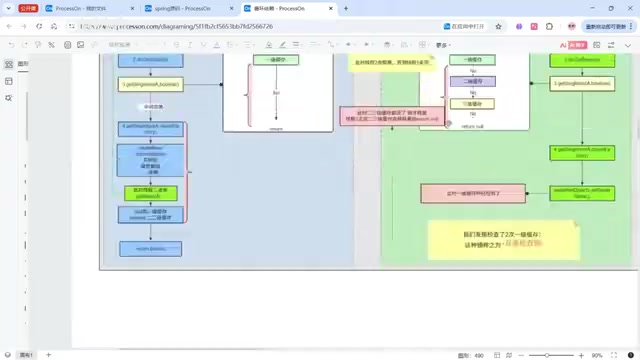
Advanced AI development for Java backends: a five-stage engineering roadmap from Spring source code to Spring AI RAG.
This article breaks down an advanced AI development course for Java backend engineers. The course follows a five-stage roadmap: first master Spring IOC and AOP source code and Spring Boot auto-configuration principles, then build up AI and Agent architecture knowledge, and finally use Java + Spring AI to implement multi-model switching, SSE streaming, custom Advisor interception, enterprise APIs, and MCP integration, culminating in an enterprise RAG knowledge base. The article emphasizes that building Spring fundamentals first is not superfluous—AI component assembly, proxying, and troubleshooting all rely on the IOC container and three-level cache. The RAG section directly addresses production issues like chunking strategies, TopK bottlenecks, answer traceability, and incremental cleaning rather than staying at the demo level. This roadmap suits backend engineers with a Java foundation who want to move into AI application development and job seekers targeting big tech, but it does not cover model training or algorithm tuning.
Advanced AI Development for Java Backends: From Spring Source Code to Spring AI RAG in Practice
Large model application development is no longer the exclusive domain of Python. An advanced course aimed at Java backend engineers is trying to put an end to the awkward situation of "only knowing how to call APIs"—covering everything from Spring IOC/AOP source code and Spring Boot auto-configuration all the way to Spring AI, RAG knowledge bases, and Agent engineering implementation. Based on the core structure of this course, this article breaks down the technical logic and practical value of this five-stage roadmap.
The Five-Stage Roadmap: Build Inner Strength First, Then Practice the Moves
The design philosophy of this course is clear: don't skip the Spring fundamentals and jump straight into AI component assembly, otherwise troubleshooting in production will be nearly impossible. According to the course introduction on Bilibili, the complete roadmap is divided into five stages:
- Fully master Spring IOC and AOP source code;
- Grasp the principles of Spring Boot auto-configuration;
- Build up understanding of AI and Agent architecture (no Python algorithms involved);
- Use Java + Spring AI to implement multi-model switching, SSE streaming conversation, custom Advisors, enterprise APIs, and MCP external capability integration;
- As the finale, implement an enterprise RAG knowledge base, covering chunking strategies, TopK bottlenecks, answer traceability, and incremental cleaning.
The first two stages are "inner strength"—the prerequisite for Spring AI components to be assembled correctly and for locating faults in production; the last three are "moves"—truly embedding large model capabilities into the Java engineering system.
Why You Must Dig Into Spring IOC Source Code First
The course spends a great deal of space at the beginning on Spring IOC and circular dependencies, for a very practical reason: in interviews, Spring IOC and circular dependencies are almost always asked, accounting for as much as 80-90% of questions. But the more important reason is that the assembly, proxying, and interception of AI components all fundamentally rely on the IOC container and AOP mechanisms.
The instructor starts from the difference between "creating an object yourself with new" and "getting a bean from the container": an object you create yourself doesn't go through the lifecycle and dependency injection, whereas a Spring Bean needs to complete its entire lifecycle before you can get a fully formed object. When A depends on B and B depends on A, both sides wait for each other during creation, and the circular dependency problem arises. Spring solves this with a three-level cache, but interviewers often follow up with "can a two-level cache solve it?" and "how do you ensure safety under multithreading?"—these chain questions can only be handled by truly understanding the source code.
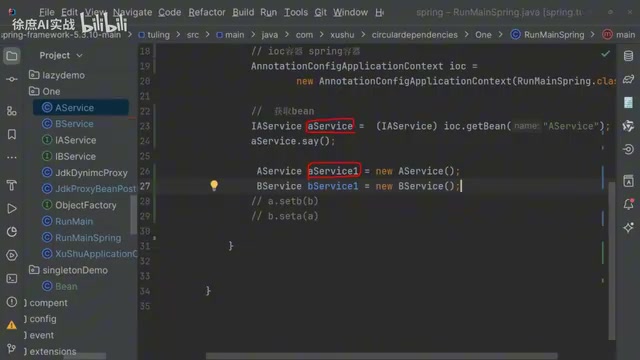
Key Milestones in IOC Container Loading
The course breaks IOC container loading into several key steps: after creating the ApplicationContext, it first reads bean definition information (BeanDefinition), including class, scope, lazy, dependenceOn, etc.; this definition information is maintained in the BeanDefinitionMap, where the key is the bean name and the value is the BeanDefinition object.
A troubleshooting signal worth remembering: if a "NoSuchBeanDefinition" exception is thrown when calling getBean, it usually means the bean was not scanned. Because as long as it is scanned, the corresponding BeanDefinition will be generated. Only beans that meet conditions such as non-lazy loading and singleton are actually created when the container loads.

Instantiation Relies on Reflection
The underlying instantiation of a bean is done through reflection—the BeanDefinition already holds the bean's class object, and the container uses it to reflectively create an instance, then fills in properties such as singleton/prototype. Only by understanding this can you see why Spring AI components can be taken over by the container and intercepted by Advisors.
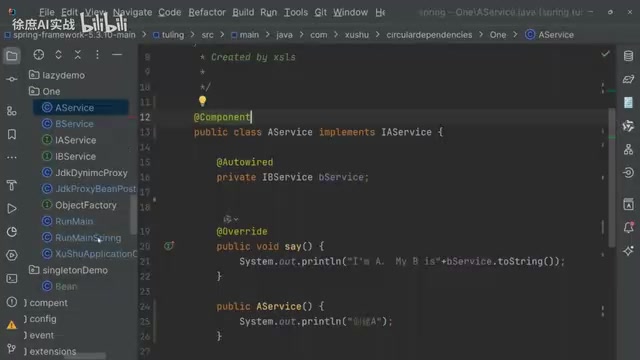
Spring solves circular dependencies using a "three-level cache": the first-level cache singletonObjects stores fully initialized beans; the second-level cache earlySingletonObjects stores early bean references exposed in advance; the third-level cache singletonFactories stores the ObjectFactory used to generate early references. When A depends on B and B depends on A, after A is instantiated it first puts the factory into the third-level cache, then when filling properties it finds B is needed and goes to create B; when B fills properties and looks back for A, it can get A's early reference from the third-level cache and promote it to the second-level cache, thus breaking the deadlock.
A common interview follow-up is "is a two-level cache enough?" For ordinary beans it is indeed enough, but once AOP proxies are involved, the two-level cache won't work: because what should ultimately be injected is the proxy object, not the original object—the third-level cache's factory allows the proxy to be generated early when needed, whereas the second-level cache can only hold objects that are already determined. Another follow-up is multithread safety: Spring locks singletonObjects during getSingleton to ensure only one thread creates the singleton at any given moment.
Spring AI in Practice: Multi-Model, Streaming Conversation, and External Capabilities
The fourth stage enters the core of AI engineering. The course emphasizes completing everything with Java + Spring AI rather than switching to Python algorithms. The capabilities covered include: multi-model switching, SSE streaming conversation, custom Advisor conversation interception, and enterprise API and MCP integration for external capabilities.
These capabilities correspond to real demands in production environments: model vendors need to be replaceable, conversation experiences need streaming output, sensitive content needs interception, and existing enterprise systems need to be callable by large models. The value of Spring AI lies in bringing these capabilities into Spring's assembly system rather than building a separate tech stack.
SSE (Server-Sent Events) is an HTTP-based server-side one-way push protocol with the response header text/event-stream. The server can continuously send data events to the client until the connection closes. Compared with WebSocket's bidirectional long connection, SSE is lighter, naturally compatible with HTTP infrastructure, and can automatically reconnect after disconnection, which is why it has become the mainstream solution for large model streaming output: the model pushes once for each token it generates, so users don't have to wait for the entire answer to be generated before seeing content. In the Spring ecosystem, you can use SseEmitter or WebFlux's Flux to return streaming responses, and then hand them over to Spring AI's streaming API. Understanding SSE's frame format, heartbeat keep-alive, and timeout handling is key to troubleshooting production issues like "the answer is stuck" or "the connection is cut off by the gateway."
MCP (Model Context Protocol) is a standardized protocol for letting large model applications access external tools and data sources in a unified way. It abstracts "what the model can call and how to call it" into capabilities such as tools, resources, and prompts exposed by the server side; clients (such as Spring AI applications) discover and call them according to the protocol, thereby avoiding writing a separate set of adapter code for each external system. For enterprises, MCP means existing internal APIs, databases, and document systems can be reused by multiple model applications after a single integration, and the permissions and boundaries of tool calls become more controllable. Spring AI provides integration support for MCP clients and servers, so such external capabilities can be injected and managed like ordinary Spring components.
RAG Knowledge Base Implementation: Chunking, TopK, and Traceability
The finale is the enterprise RAG knowledge base. The course doesn't stop at a "fill-in-the-bubble demo" but directly confronts production issues: how to define chunking strategies, where the bottlenecks of TopK retrieval lie, how to trace answers, and how to clean incremental data. Ordinary tutorials only teach you to get a demo running; this course has everything ready: persistence, model switching, full-line interception, tool-call fallback, retrieval tuning, troubleshooting, code configuration templates, and a list of pitfalls to avoid.
For Java backends, this means RAG is no longer a black box but an engineering module that can be debugged, replaced, and monitored like an ordinary Spring component.
TopK is the parameter in vector retrieval that determines "return the K most similar results." If K is too small, recall is insufficient and the model doesn't get enough context; if K is too large, on one hand irrelevant content gets stuffed into the prompt, diluting key information and increasing hallucination risk, and on the other hand it quickly fills up the context window and drives up latency and cost. Therefore TopK often needs to be tuned together with similarity thresholds, reranking, and other methods, rather than simply increased.
Answer traceability means letting the model cite the original text snippets or document sources when generating, which both improves credibility and facilitates manual verification. In engineering, retrieval results are usually required to carry document IDs, page numbers, or paragraph offsets, and the prompt requires the model to cite numbers; incremental cleaning means that when knowledge base documents are updated, only the changed parts are reprocessed through hash or version comparison, avoiding the overhead of rebuilding the entire index.
Who This Roadmap Is For
The positioning of this course is clear: backend engineers with a Java foundation who want to move into AI application development; job seekers preparing for interviews at big tech companies who need to explain Spring's underlying principles clearly; and engineering teams that are integrating large model capabilities into enterprise systems. Its limitations are equally obvious—it doesn't cover model training or algorithm tuning, and focuses on engineering implementation capabilities.
From Spring assembly principles to RAG tuning, being able to explain it clearly and withstand follow-up questions is what this roadmap truly aims to deliver.
Related articles
WorkBuddy in Practice: Building AI Agent Automated Workflows and File Batch Processing
WorkBuddy hands-on tutorial: using a real case of batch Word-to-PDF conversion and archiving, it shows how an AI Agent goes from understanding requirements to autonomously executing tasks, covering authorization, credit consumption, and result acceptance, and analyzes its applicable boundaries.

AI + Cybersecurity in Practice: From Getting Started with Agents to Using Intelligent Agents to Find Vulnerabilities
Bilibili AI + cybersecurity tutorial explained: treat AI as a tool rather than a replacement, from Agent building and MCP invocation to real-world Web vulnerability practice, clarifying AI's role in penetration testing and the judgment practitioners must have.

Four-Stage Learning Roadmap for Embodied AI: From ROS to VLA in Practice
A complete embodied AI learning roadmap in four stages covering Python/C++ and Linux basics, ROS communication, perception and control (MoveIt2, Nav2, Gazebo/Isaac Sim), imitation and reinforcement learning, VLA models, plus hands-on projects and portfolio building—ideal for developers who want to enter the field systematically.