Agent-first-browse: Rebuilding Web Automation with Delta Snapshots and LangGraph
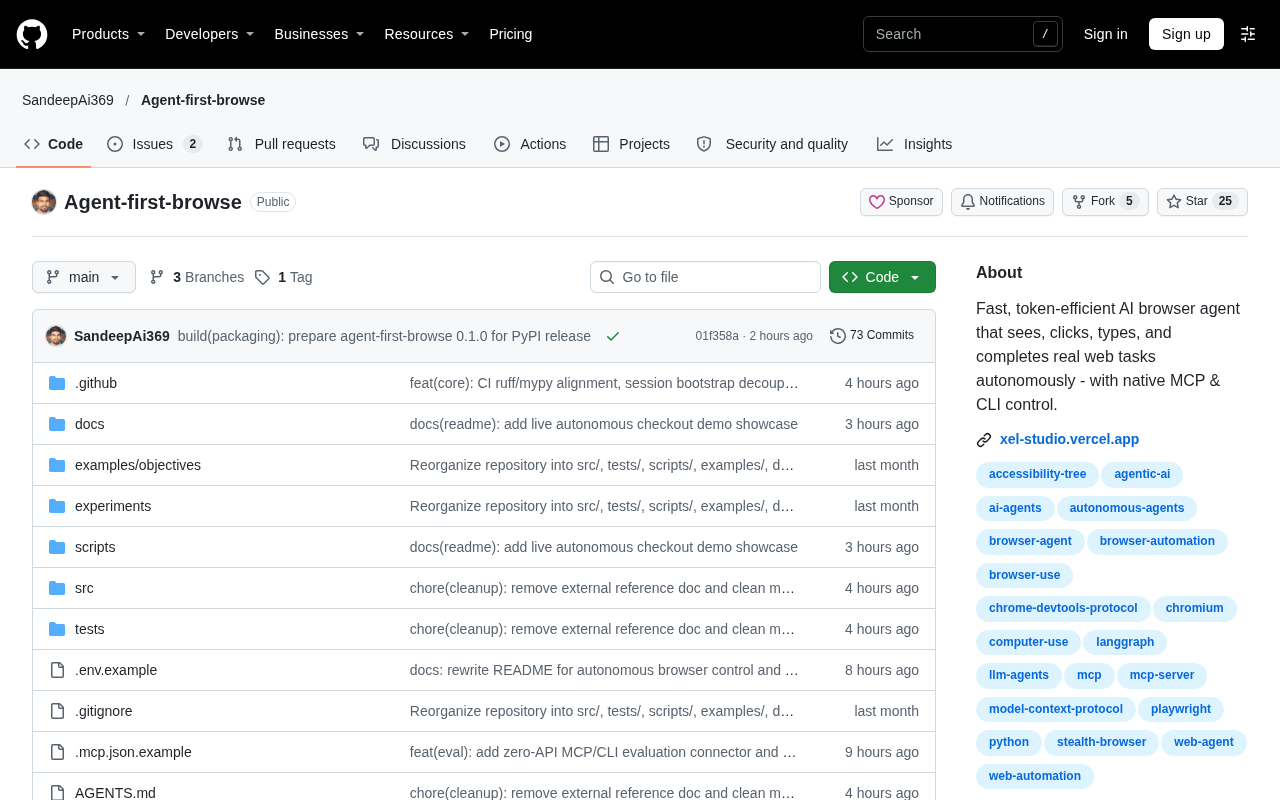
Agent-first-browse uses delta snapshots to lower perception costs and LangGraph for controllable browsing workflow orchestration.
Agent-first-browse is an early-stage project on Hacker News Show HN that addresses state-tracking efficiency and workflow controllability in AI agent web automation. It uses delta snapshots to transmit only page changes to the agent, analogous to Git diff, significantly reducing token consumption and noise so agents can locate responsive elements more precisely; it also adopts LangGraph as the orchestration layer, modeling browsing steps as a graph with branches and loops, providing explicit state transition logic and forming a perceive-decide-execute loop. The article considers the design direction noteworthy and the delta snapshot idea independently reusable, but the project is still early and the definition of 'meaningful changes' in dynamic pages and its robustness remain to be validated in practice.
Agent-first-browse: Rebuilding Web Automation with Delta Snapshots and LangGraph
On Hacker News' Show HN section, a project called Agent-first-browse has drawn attention. It attempts to solve two core pain points facing AI agents in web automation: the efficiency of state tracking and the controllability of workflows. By combining "delta snapshots" with "LangGraph," the project offers a new approach to agent-first web browsing.
When Web Automation Meets AI Agents
Traditional web automation tools (such as Selenium and Puppeteer) are typically designed for deterministic scripts, where every step must be explicitly defined by the developer. When AI agents take over the browser, things get complicated: agents need to perceive changes in page state, yet full-page snapshots are both expensive and redundant; at the same time, multi-step decision processes require reliable state management, otherwise they easily fall into loops or lose context.
Agent-first-browse is a solution proposed to address these challenges. As the project name suggests, its design philosophy is "agent-first"—rather than making agents adapt to traditional tools, it redesigns the browsing automation layer around how agents work.
Selenium and Puppeteer are the two most representative tools in traditional web automation. Selenium is based on the WebDriver protocol and directly controls real browsers through browser drivers, supports multi-language bindings, and has long been the de facto standard for web testing; Puppeteer is a Node.js library released by Google that controls headless Chrome via the Chrome DevTools Protocol, excelling at page scraping and PDF generation. The common premise of both is deterministic scripting: developers must know element selectors, wait timing, and operation sequences in advance. When AI agents replace fixed scripts, this "pre-orchestrated" model breaks down, because agents need to dynamically decide the next action based on the real-time state of the page, while traditional tools do not provide state abstractions oriented toward model perception—this is exactly the gap Agent-first-browse attempts to fill.
Delta Snapshots: Transmitting Only What Changed
Delta snapshots are the most noteworthy technical point of the project. During the interaction between agents and web pages, pages constantly change (DOM updates, asynchronous loading, pop-ups appearing, etc.). If the full page content is sent to the LLM every time, it not only consumes a large number of tokens but also introduces noise that interferes with the agent's judgment.
Agent-first-browse computes the difference between two consecutive page states and transmits only the changed parts to the agent. This is similar to Git's diff mechanism: what the agent sees is "what changed," not "what the current page looks like." This design brings two direct benefits: first, it significantly reduces context length, allowing the agent to handle more interaction steps within a limited token budget; second, it makes the changes themselves a signal, enabling the agent to more precisely locate the elements that need a response.
For automation tasks that need to run for a long time, delta snapshots also help the agent maintain a coherent understanding of how page state evolves, rather than parsing the full page from scratch every time.
DOM (Document Object Model) is the tree structure formed after the browser parses HTML. Every interaction on the page, every asynchronous request response, or every front-end framework re-render causes DOM nodes to be added or removed or attributes to change. For agents, the DOM is both a source of perception and a target of operation. The core challenge of delta snapshots is that DOM changes are often fine-grained and high-frequency; if raw differences are passed directly, they will contain a large amount of noise unrelated to the task (such as animation styles or ad slot refreshes). Therefore, practical implementations usually need to perform semantic filtering and aggregation on the differences—for example, retaining only structural changes of visible nodes and merging multiple changes within the same event loop—so that the changes passed to the model are both lightweight and "meaningful." This also explains why, in highly dynamic single-page applications, the granularity design of difference computation directly affects the quality of the agent's judgment.
LangGraph: Providing a State Machine Skeleton for Browsing Workflows
Web automation is essentially a stateful decision process: click, wait, verify, roll back, retry. LangGraph, as the graph-structured orchestration framework in the LangChain ecosystem, is naturally suited to expressing such workflows with branches and loops. Agent-first-browse choosing LangGraph as the workflow orchestration layer means that the agent's browsing steps can be modeled as nodes and edges in a graph.
The value of this combination lies in controllability. Agents driven purely by prompts easily "get lost" on complex pages, whereas LangGraph provides explicit state transition logic: under what conditions to retry, when to terminate, and how to handle exception branches can all be defined at the graph level. Delta snapshots then provide lightweight perceptual input for these state transitions. Together, they form a closed loop of "perceive—decide—execute."
LangGraph is a graph-structured orchestration framework launched by the LangChain team. Its core abstractions are nodes and edges: nodes encapsulate a computation or model call, and edges define state transition conditions, supporting conditional branching, loops, and persistent checkpoints. Unlike linear Chains, LangGraph allows explicit definition of loops and rollback paths and can save state snapshots at each step, thereby supporting interruption recovery and human-machine collaboration. In browsing automation scenarios, this means that "click—wait—verify—retry" can be modeled as a closed loop in the graph, with the model responsible only for local decisions within nodes (such as which element to select), while the termination conditions and exception branches of the global workflow are guaranteed by graph-level logic, avoiding the infinite loops and context drift commonly seen in purely prompt-driven agents.
What This Means for Developers
Judging from the Show HN launch, the project is still at an early stage (with only a small amount of discussion at release). But its design direction deserves attention from developers in the web automation field.
On one hand, the delta snapshot idea can be borrowed independently. Whether or not LangGraph is used, any scenario that requires LLMs to perceive web page changes—from RPA to page assistance in intelligent customer service—can benefit from "transmitting only differences." On the other hand, the combination of LangGraph and browsing automation suggests a more structured paradigm for agent development: rather than stuffing all logic into prompts, use graphs to manage workflows and let the model focus on local decisions.
Interestingly, the actual effectiveness of such tools depends heavily on the accuracy of difference computation and the reasonableness of state graph design. For highly dynamic single-page applications, how to define "meaningful changes" remains an open question. Whether Agent-first-browse can prove its robustness in real scenarios still requires more practical testing.
Conclusion
Agent-first-browse combines delta snapshots with LangGraph to provide a technical solution for AI agent web automation that emphasizes efficiency and controllability. It reflects a trend in the current agent toolchain: shifting from "letting models directly operate the browser" to "building appropriate perception and orchestration infrastructure for models." For developers exploring browser agents, this project offers a reference implementation worth studying.
Related articles
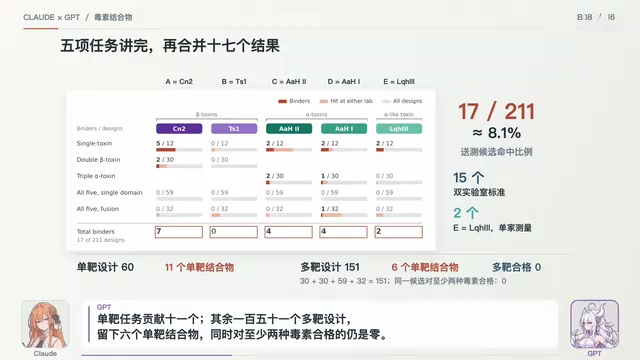
Claude Designs Scorpion Venom-Neutralizing Proteins: With 17 Binders, How Far Are We From an Antidote?
Anthropic's Claude helped design scorpion venom-neutralizing proteins: only 17 of 211 candidates passed, multi-target coverage failed, and channel function and animal testing remain absent.
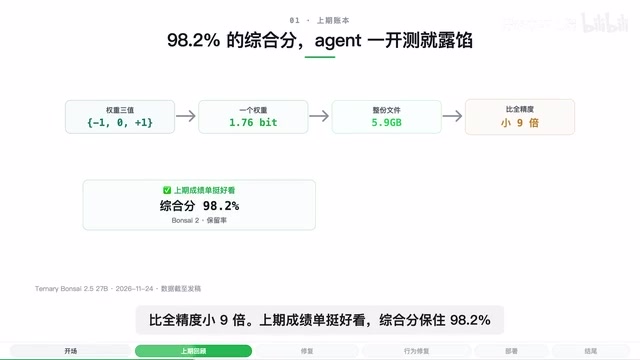
Fitting a 27B Model into 5.9GB: Ternary Bonsai 2.5 Fixes Its Agent Weaknesses
Prism ML releases Ternary Bonsai 2.5: a 27B model in just 5.9GB, with ternary quantization compressing weights to 1.76 bits. The new version focuses on fixing Agent capabilities, raising Tao3Bench Verify to 75.6 and Upworld from 51.2 to 90.5, hitting 291 tokens/s on a single A700, open-sourced under Apache 2.0.
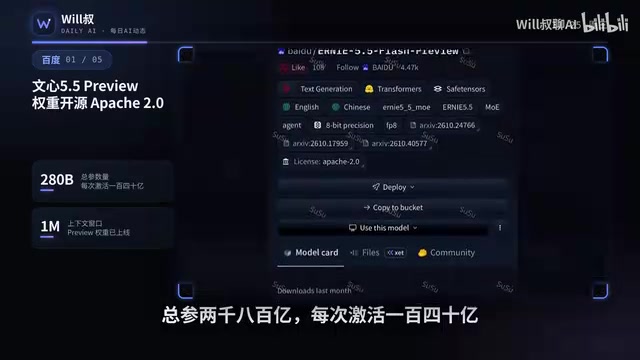
GPT-6-Designed Proteins Validated in Lab; ERNIE 5.5 Preview Open-Sourced
GPT-6 designed proteins using reasoning and code alone, with lab binding evidence across five targets; Baidu open-sourced ERNIE 5.5 Flash Preview under Apache 2.0 with 280B parameters and 1M context.