Agent Skills Deep Dive: Concepts, Structure, and Real-World Examples

A deep dive into Agent Skills — concepts, structure, and real-world examples for modular AI Agent development.
This article systematically explores Agent Skills — the modular capability units powering modern AI Agents like Claude Code. It explains what Skills are, how they differ from simple prompts, breaks down the SKILL.md file structure with its optional references, scripts, and assets directories, and walks through a real-world restaurant branding example. The piece also covers trigger mechanisms, lightweight RAG via references, and the emerging npm-style Skill ecosystem.
With the explosive popularity of AI Agent tools like Claude Code and Hermes Agent, Skills are becoming a core component of the Agent ecosystem. More and more developers are asking: What exactly is a Skill? How does it differ from a Prompt? And why is it considered a critical piece of extending Agent capabilities?
This article systematically covers the core concepts, directory structure, and real-world examples of Agent Skills, helping you fully understand Skills from the ground up.
What Is an AI Agent, and Why Do Skills Matter?
An AI Agent is an artificial intelligence system capable of autonomously perceiving its environment, formulating plans, and executing multi-step tasks — fundamentally different from traditional single-turn Q&A language models. Claude Code is Anthropic's programming assistant built on the Claude model, capable of autonomously reading and writing files, executing code, and invoking terminal commands. Hermes Agent is another Agent framework that emphasizes tool calling and task orchestration capabilities.
The core capability of these tools lies in "Tool Use" and "Task Chains" — meaning the Agent can decompose complex goals like a human, sequentially invoke different tools to complete subtasks, and ultimately aggregate the results.
Technical Background: The tool-calling capability of AI Agents stems from a major breakthrough in large language models around 2023. OpenAI pioneered Function Calling in GPT-4, allowing models to invoke external functions in structured JSON format; Anthropic subsequently introduced its Tool Use specification in Claude. This technology evolved models from "conversation generators" into "task executors" capable of interacting with real-world APIs, file systems, and computing environments.
It's worth understanding deeply that Function Calling doesn't mean the model actually "executes" the function. Instead, the model outputs a structured description of the calling intent (typically JSON), and the host program is responsible for actual dispatch and execution, feeding results back to the model as messages. This three-phase protocol of "model proposes, host executes, results feed back" is the underlying communication paradigm of virtually all mainstream Agent frameworks today. The task chain concept draws from the ReAct (Reasoning + Acting) framework — the model reasons before each step, then decides the next action based on tool-returned results, forming a "Think → Act → Observe → Think again" loop. ReAct was jointly proposed by Princeton University and Google Research in 2022, and experimental results showed that compared to pure reasoning (Chain-of-Thought) or pure action modes, combining both via ReAct significantly improved performance on multi-hop Q&A and interactive decision-making tasks. This is the core mechanism that distinguishes Agents from ordinary conversational models.
The emergence of Skills addresses the problem of "fragmented capabilities" in Agents — consolidating scattered prompts, scripts, and documents into standardized capability units that make an Agent's specialized abilities reusable and shareable.
What Is an Agent Skill?
Skill literally means "ability" or "competency" — a concept that closely maps to everyday understanding. Every person and every profession has corresponding specialized skills.
Think of it this way: students can write essays, solve math problems, and do English homework; programmers can understand requirements, write code, and debug. These are all capability sets associated with specific "roles."
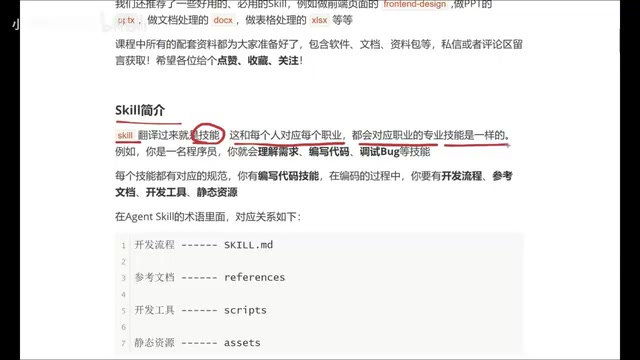
Agent Skills are exactly this logic mapped into the AI world: the various skills a person has correspond to the various Skills an Agent has. Giving an Agent a Skill essentially tells it, "You now possess the specialized ability to complete a specific type of task."
The elegance of this design lies in transforming the abstract question of "what can AI do" into concrete, composable, and reusable capability modules. You can "install" different Skills for an Agent just like arranging job training for employees.
From a broader perspective, the concept of Skills echoes the classic distinction in cognitive science between types of expertise: declarative knowledge ("knowing what") and procedural knowledge ("knowing how"). Brand guidelines and output format requirements in SKILL.md represent declarative knowledge, while executable scripts and tool-calling logic in the scripts directory represent procedural knowledge. The completeness of a Skill lies precisely in unifying both types of knowledge within a single capability unit.
What Makes Up a Skill: Starting from How Humans Work
To understand the internal structure of a Skill, imagine what a programmer needs to complete their coding work.
Four Elements of a Programmer's Work
- Development Process: Before writing code, you need to map out business logic — what comes first, what comes next, and how modules relate. This is your methodology.
- Reference Documentation: API docs or requirement specs that clarify "how this code should be implemented."
- Development Tools: Java developers use IntelliJ IDEA; frontend or Python developers use VS Code — nobody writes a full project in Notepad.
- Static Resources: Image, audio, and video assets needed for web development.
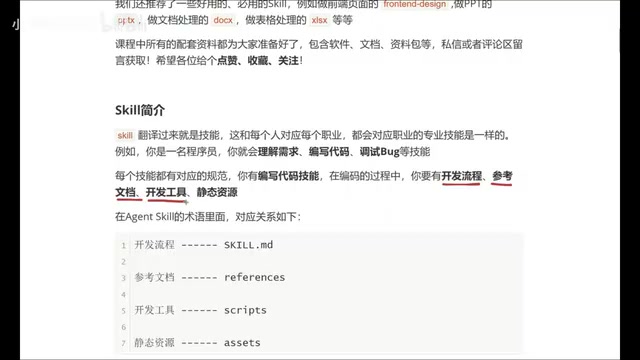
Doctors need surgical instruments, programmers need a solid IDE — behind every professional skill lies a support system of "process + documentation + tools + resources."
Mapping to the Agent Skill Directory Structure
These four elements have direct counterparts in the Agent Skill specification:
| Human Work Element | Skill Equivalent |
|---|---|
| Development Process | SKILL.md file |
| Reference Documentation | references/ directory |
| Development Tools | scripts/ directory |
| Static Resources | assets/ directory |
Package all of these into a single folder, and you have a complete Skill.
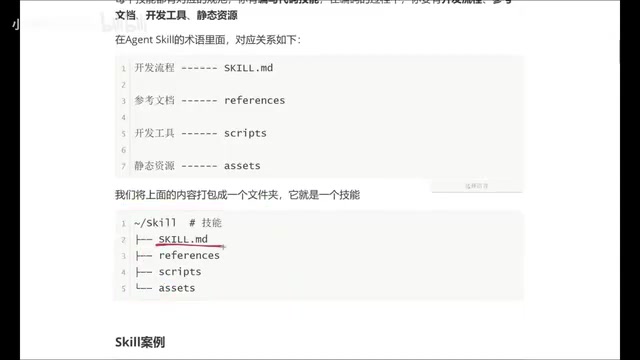
Key Point: Not every file and directory is required. In this structure, SKILL.md is the only mandatory item. The references, scripts, and assets directories are added flexibly based on actual business needs — sometimes none are needed, sometimes all three are used, depending entirely on the type of task the Skill is designed to accomplish.
This design philosophy of "minimal necessary core + on-demand extension" is known in engineering as Progressive Enhancement — first ensure the universality of basic functionality, then layer on advanced capabilities through optional additions. This aligns with the classic web development principle of "first ensure the HTML semantic structure works, then layer on CSS styling and JavaScript interactivity," ensuring Skills remain executable in their simplest configuration while retaining ample room for extension in complex scenarios.
Understanding SKILL.md in Depth: The Engineering Wisdom Behind Its Format
SKILL.md is written in Markdown format — a deliberate choice. Markdown is both human-readable and easy for large language models to parse, serving the needs of both "human writing" and "machine reading."
The top of the file typically carries metadata via YAML Front Matter or specific header blocks, including fields like name, description, and trigger. The body contains instructions written in natural language, which can include conditional branching, output format requirements, constraint rules, and more.
Technical Background: YAML Front Matter is a standard convention for embedding structured metadata at the top of Markdown files. It was first popularized by the static site generator Jekyll and later widely adopted by mainstream static site frameworks like Hugo, Hexo, and Gatsby. Its format consists of a YAML block wrapped by triple dashes (
---), where key-value pairs like name, version, description, and trigger can be defined.YAML itself (YAML Ain't Markup Language) was designed in 2001 by Clark Evans and others. Compared to JSON, it prioritizes human readability and supports comments, multi-line strings, and anchor references, making it one of the mainstream formats for configuration files (Kubernetes, GitHub Actions, and Docker Compose all use YAML as their configuration language). In the Agent Skill specification, YAML Front Matter is borrowed to provide a machine-readable "self-description" for Skills. When an Agent framework scans a Skill directory, it first parses the Front Matter to decide whether to activate the Skill — similar to how an operating system reads the magic number in an executable file header to determine the file type. This "separation of data and instructions" design also aligns closely with the modern engineering practice of Configuration as Code — clearly decoupling the declarative description of "what this Skill is" from the imperative logic of "how this Skill works."
This structural design draws from the concept of "interface definitions" in software engineering: metadata is like a function signature, telling the caller "what this skill is called and when to use it"; instructions are like the function body, defining the specific execution logic. A well-crafted SKILL.md should have a single responsibility with clear boundaries, avoiding the bundling of multiple unrelated tasks into a single Skill.
Dissecting a Real Skill Example
Using "generating brand collateral designs for the iwen restaurant" as an example, let's look at how a SKILL.md is actually written. The entire file can be broken down into two major parts.
Metadata
The top of the file contains metadata, including the Skill's name and description. For example:
Generate creative collateral designs that match the iwen restaurant's brand identity. When a user asks to create a specific type of collateral (such as a poster, roll-up banner, packaging box, etc.), you need to output the creative design for that collateral.
The name defines "what this skill is," and the description explains "what it can do" and "under what circumstances it should be triggered." This section determines when and how the Agent invokes this Skill.
The design of trigger conditions is particularly critical. In Agent systems with multiple coexisting Skills, the framework needs to dynamically select the most matching Skill to activate based on user input. This process is typically implemented in two engineering approaches: first, keyword matching, where the framework performs string pattern matching between user input and each Skill's description; second, semantic similarity computation, where user intent and Skill descriptions are vectorized and cosine similarity is calculated to activate the highest-scoring Skill. The latter is more robust in scenarios with diverse intent expressions but requires greater inference infrastructure.
Instructions
Everything below the metadata belongs to the instructions section, similar to the natural language we use when chatting with large models.
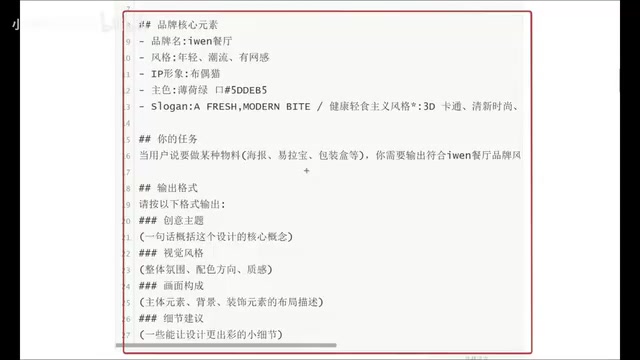
In this example, the instructions define in detail:
- Core Brand Elements: Brand name, style, IP mascot, primary color palette, and slogan.
- Task Description: When a user requests a specific type of collateral, output content that matches the iwen restaurant's style.
- Output Format: Clear specifications across dimensions like theme concept, visual style, composition, and detail suggestions.
A core lesson is: the more detailed the description, the closer the generated content will match expectations. This is the fundamental reason Skills are more powerful than casually written prompts.
From a prompt engineering perspective, this detailed description is essentially providing the model with richer context constraints. The generation process of large language models is sampling in a high-dimensional probability space, and each constraint acts as a boundary within that space, ensuring the final sample falls within the expected region. Therefore, the more precise and multi-dimensional the constraints, the lower the output variance and the higher the predictability of results — this is the core advantage of specialized Skills over generic prompts.
Skill vs. Prompt: Similar, But Much More
At this point, many readers will wonder: doesn't this instruction content just look like a prompt?
To clarify this, we first need to understand the background and limitations of Prompt Engineering. Prompt Engineering refers to the technique of carefully designing input text to guide large language models toward desired outputs — one of the hottest practical domains in AI applications since 2022. However, prompts alone have clear limitations: they are stateless and one-off, difficult to carry external knowledge, unable to invoke script tools, and extremely costly to reuse across different contexts.
A Skill can be understood as an "engineered prompt" — it introduces modular encapsulation, resource mounting, and tool integration on top of prompts:
- references directory: Injects domain knowledge documents, similar to a local knowledge base for RAG (Retrieval-Augmented Generation), giving the Agent evidence to reference when responding;
- scripts directory: Mounts executable scripts, granting the Agent real computational and operational capabilities — not just the ability to "talk";
- assets directory: Provides static material support, ensuring generated content maintains brand visual consistency.
Technical Background: RAG (Retrieval-Augmented Generation) is a technical paradigm proposed by Meta AI Research in 2020. The original paper was authored by Patrick Lewis et al. and published at NeurIPS 2020. Its core idea is to retrieve relevant document fragments from an external knowledge base before the model generates a response, injecting them into the context to overcome the timeliness and domain limitations of the model's parametric knowledge.
A standard RAG pipeline typically includes four stages: document chunking, vector embedding, similarity retrieval, and context-augmented generation. Vector embedding relies on specialized embedding models (such as OpenAI text-embedding-3-small or the open-source BGE series), and similarity retrieval relies on vector databases (such as Pinecone, Weaviate, Chroma, and Milvus). The overall engineering complexity is substantial, and operational costs are non-trivial. The references directory in a Skill can be viewed as a "lightweight local RAG" — placing domain documents directly within the Skill package, with the Agent framework concatenating relevant file contents into the context window at execution time, eliminating the infrastructure costs of vector indexing. Academically, this approach is close to a "Full Document Injection" strategy, suitable for specialized scenarios with relatively small document volumes (typically within the LLM's context window limits, e.g., 128K tokens) and relatively stable content, such as internal API documentation, brand guideline manuals, or industry standard texts. When document scale grows further, vector retrieval can be introduced for precise recall, forming a complete RAG architecture.
These three dimensions of extension elevate a Skill from "telling AI how to do something" to "equipping AI with a complete workbench."
| Dimension | Prompt | Skill |
|---|---|---|
| Form | A piece of text | A complete capability package |
| Extensibility | Limited | Supports docs/scripts/resources |
| Reusability | Low | Modular and composable |
| Use Case | Simple instructions | Complex business workflows |
In other words, a prompt is "a single sentence of guidance," while a Skill is "a complete standardized work plan."
Modularity and Composability: The Engineering Foundation of the Skill Ecosystem
Modularity and Composability are two core principles of modern software engineering, now being introduced into AI Agent capability design. In traditional software development, modularity means decomposing complex systems into single-responsibility components, each independently developed, tested, and maintained; composability means these components can be freely assembled like LEGO bricks to build more complex functionality.
Agent Skills follow the same philosophy: a "generate poster concepts" Skill and a "call image generation API" Skill can be orchestrated within the same workflow, each handling its own responsibility.
In more complex Agent systems, the coordinated orchestration of multiple Skills typically relies on DAG (Directed Acyclic Graph) structures to describe task dependencies — nodes represent each Skill's execution unit, and directed edges represent the direction of data flow and control flow. This closely mirrors the design philosophy of workflow engines like Apache Airflow and suggests that future Skill orchestration tools may evolve toward visual DAG editors, enabling non-technical users to intuitively design complex multi-Skill collaborative workflows.
Industry Background: This design has also given rise to a Skill community ecosystem, whose evolution closely parallels the rise of software package managers. npm (Node Package Manager) was released alongside Node.js in 2010 and currently hosts over 2.5 million open-source packages with more than 5 billion daily downloads, making it the world's largest software package registry; PyPI (Python Package Index) hosts over 500,000 Python packages, and pip install has become muscle memory for Python developers. The core of their success lies in establishing standardized "publish-consume" protocols: each package declares metadata and dependencies through descriptor files like package.json or pyproject.toml, allowing developers to incorporate others' validated, mature code with a single command.
The Agent Skill ecosystem is evolving along the same path — the standardized directory structure (SKILL.md + three optional directories) serves as the equivalent of the package.json specification, establishing a universal description language for "capability units." A future Skill Registry would be the equivalent of the npm registry, where developers can publish, search, and rate Skills; version management (Semantic Versioning) and dependency declaration mechanisms will gradually emerge as the ecosystem matures. This trend means that "AI capabilities" are undergoing a commoditization and community-driven process similar to what "software components" experienced over the past two decades — moving from being handcrafted by a few experts to community-built, out-of-the-box, scaled production.
Application Value and Learning Path for Skills
From restaurant poster generation to frontend page development, presentation creation, and document and spreadsheet processing, the application scenarios for Agent Skills are rapidly expanding. At its essence, Skills standardize and modularize the professional workflows of various human industries and "transplant" them to AI Agents.
From a longer-term perspective, the maturation of the Skill ecosystem will profoundly change the development paradigm for AI applications. Currently, most AI applications are built by "designing prompts and tool chains from scratch for specific scenarios," heavily relying on individual experience and difficult to reuse. A mature Skill ecosystem will make "composing existing Skills to rapidly build vertical applications" the mainstream approach — similar to how today's web developers spend more time composing npm packages than implementing low-level algorithms from scratch. This shift will dramatically lower the barrier to building specialized AI applications while also giving rise to new business models centered on Skills as core assets.
For learners looking to master this technology, the recommended progression path is:
- Understand Skills — Grasp the structural principles and design logic;
- Customize Skills — Write specialized Skills tailored to your own business needs;
- Leverage Skills — Incorporate validated, mature Skills from the community.
When you can tailor Skills for your own business, you've truly mastered the key capability of making Agents "specialized."
Key Takeaways
- A Skill is an engineered capability unit, not a simple prompt. It packages process (SKILL.md), knowledge (references), tools (scripts), and materials (assets) into reusable modules, unifying "declarative knowledge" and "procedural knowledge" in a single unit.
- SKILL.md is the only required item. Its YAML Front Matter provides machine-readable metadata, while the body instructions define execution logic — drawing from the interface definition concept in software engineering. The progressive enhancement design ensures Skills remain executable even in their simplest configuration.
- Trigger mechanisms determine intelligent dispatch in multi-Skill systems: Keyword matching suits precise scenarios, while semantic similarity computation suits complex systems with diverse intents — each involves engineering tradeoffs.
- The references directory implements lightweight RAG — injecting domain knowledge for the Agent without requiring a vector database. It's ideal for small-to-medium document scenarios that fit within the context window, lowering the barrier to building specialized Agents.
- The Skill ecosystem is moving toward npm-style community-driven development. Standardized structure makes publishing, sharing, and reusing capabilities possible. Future multi-Skill orchestration will evolve toward visual DAG tools, signaling the emergence of an AI capability marketplace.
- The learning path is clear: Understand the structure → Customize business Skills → Reuse community Skills. Following this progression will help you master the core capability of making Agents specialized.
Related articles
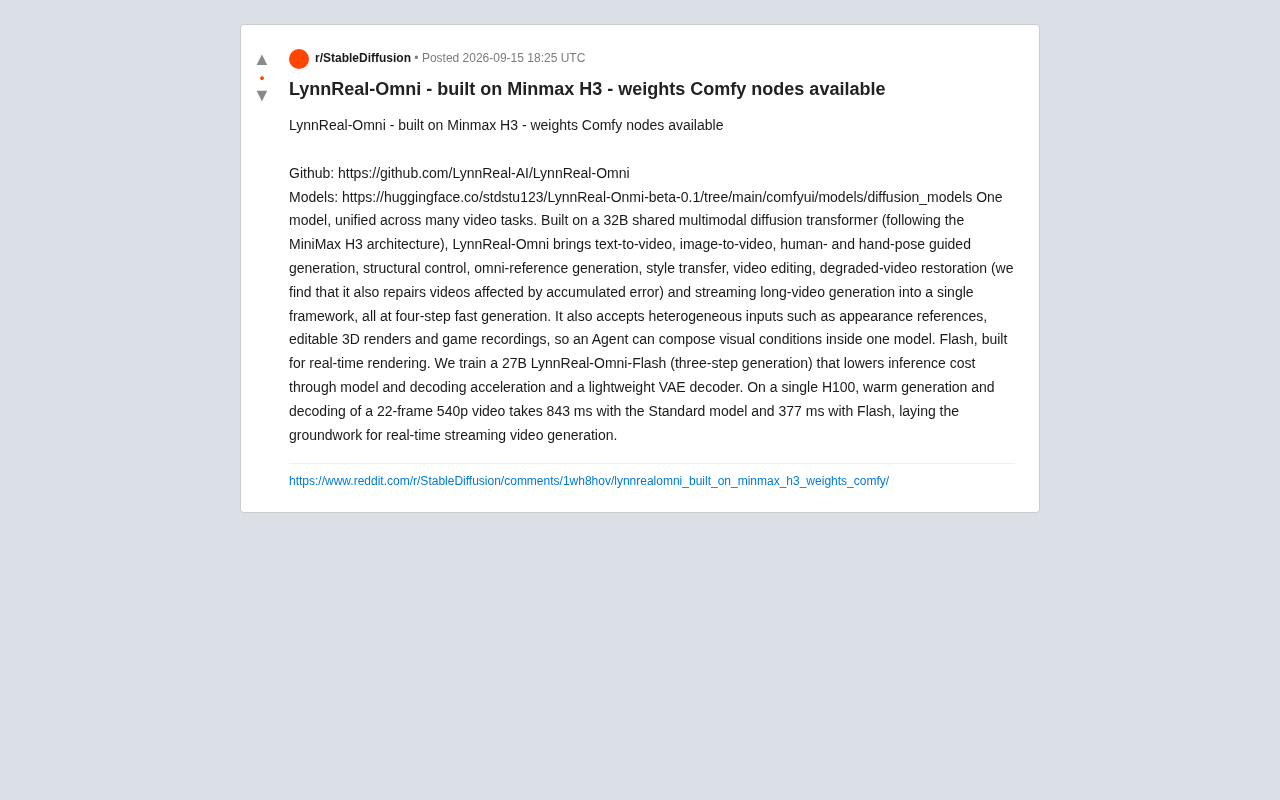
LynnReal-Omni: 32B Unified Video Diffusion Model Goes Open Source with Multi-Task Coverage in Four Steps
LynnReal-Omni is a 32B unified video diffusion model on MiniMax H3, covering text-to-video, pose guidance, style transfer, restoration in 4 steps. Flash version generates 540p video in 377ms on one H100.

Anthropic Co-Founder: AI 'Kill Switch' May Need to Be Mandatory by Law
Anthropic's co-founder tells the BBC that AI 'kill switches' may need to be legally mandated. We analyze the industry logic, technical challenges, and the tension between regulation and innovation.

The AI Data Center Boom Is Colliding With Cities Scarred by Heavy Industry
The AI data center boom is clashing with post-industrial communities. Philadelphia's case reveals structural conflicts between AI growth, energy use, water, and environmental justice.