Agent Skills Progressive Disclosure Architecture Explained: Giving AI Agents Unlimited Capabilities

Agent Skills extends a single Agent's professional capabilities in a lightweight way through modular skill packs and progressive disclosure.
The article systematically introduces Agent Skills, an open standard released in October 2025. A Skill is a folder containing SKILL.md, storing metadata, instructions, and optional resources, allowing a general-purpose Agent to gain professional capabilities by mounting skill packs. It uses the "boss and secretary" analogy to explain loading on demand and unloading when done, and analyzes progressive disclosure: layered exposure of metadata, full instructions, and resources to solve context bloat. Compared with Multi-Agent, Skills Agent is lighter and more cost-controllable, and the two can be combined. It concludes with engineering practices for metadata standardization and skill lifecycle management.
In AI agent development, how can a general-purpose agent quickly acquire various specialized capabilities while keeping the architecture lightweight and flexible? Agent Skills offers a modular answer. This article is based on the livestream course by Bilibili creator "Lian Pengju" (Mashibang Education) and systematically covers the core concepts of Agent Skills, the progressive disclosure mechanism, and its essential differences from Multi-Agent.
What Are Agent Skills?
Agent Skills is an open standard officially released in October 2025, designed to guide the new agent development ecosystem. Its official description is: a lightweight, open-source format that extends the capabilities of AI agents with specialized knowledge and workflows. Specifically, a Skill is a folder containing a SKILL.md file, which stores metadata and operating instructions that guide an agent through specific tasks, and optionally includes resources such as scripts, reference materials, and templates.
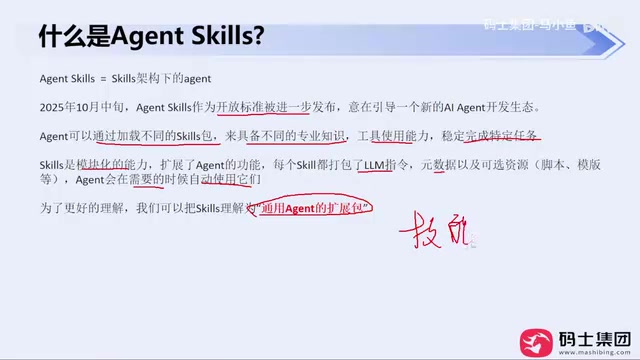
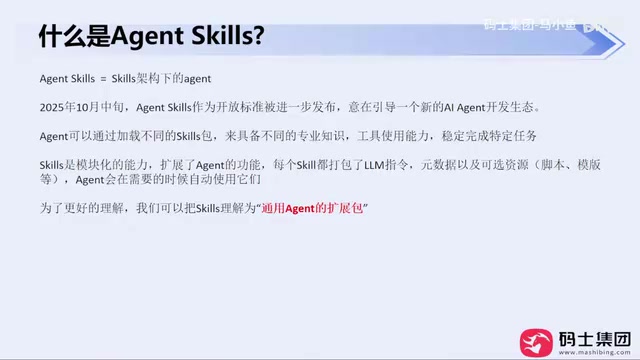
This definition is not beginner-friendly. In plainer terms: Agent Skills equals "an Agent under the Skills architecture." Originally, when you developed an Agent, it could only complete single-responsibility tasks; but after mounting Skills, this Agent can load different skill packs to gain different specialized knowledge and tool-usage capabilities, thereby completing diverse and stable tasks. Skills are modular capability extensions. Each Skill packages instructions, metadata, and optional resources, and the Agent automatically invokes them when needed.
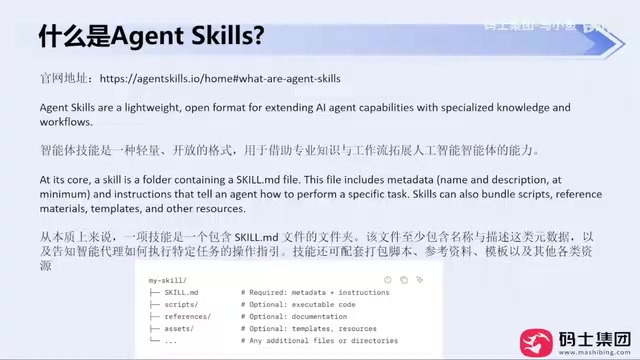
SKILL.md and the Agent Runtime
SKILL.md is the entry file for each skill pack, typically consisting of YAML-formatted metadata (frontmatter) and a Markdown-formatted instruction body. The metadata section declares the skill name, description, trigger conditions, and required tool permissions, while the instruction body describes the specific operating steps. The Agent Runtime is the program environment responsible for parsing and executing this file. During a conversation, it scans the list of available skills, matches user intent, and injects the SKILL.md content into the model context as needed. This design decouples skill packs from specific Agent frameworks, so the same SKILL.md can be loaded by different runtimes, enabling cross-platform reuse.
A Real-Life Analogy: The Boss and the Secretary
To understand the value of Skills, imagine a scenario: you are the boss of a company and have a secretary with decent basic abilities but notable professional gaps—he doesn't understand law when drafting contracts, can't use Photoshop to make posters, and isn't familiar with the booking process for flights. Faced with these gaps, there are two traditional solutions: first, spend several months and a lot of effort sending the secretary to professional training; second, hire additional specialists for each need, which is costly.
Skills offers a third solution: don't train people, and don't add people, but package various professional capabilities into pluggable skill packs. When contracts need to be written, mount a "legal expert" skill pack on the secretary; when posters need to be made, mount a "Photoshop" skill pack; when travel arrangements are needed, mount a "ticketing" skill pack. After the task is completed, the skill pack can be immediately unloaded to release resources. This is the core design essence of Skills: "load on demand, unload when done," and also the source of its modularity, low cost, and high flexibility.
The same logic applies to programmers. In the past, to work on project development, one had to start with programming syntax, then learn databases and frameworks, and only then could work on projects; under the Skills architecture, as long as ready-made skill packs exist on the market, or you define a Skill yourself, the Agent can directly gain the corresponding capability.
Progressive Disclosure: How Skills Solve Context Bloat
The course highlights "Progressive Disclosure" as the most challenging and most refined technical point in the Agent Skills architecture. As an Agent mounts more and more skills, if the complete instructions of all skills are stuffed into the large model's context window at once, token consumption will balloon rapidly, and the model's attention will be diluted.
The idea of progressive disclosure is layered loading: the first layer exposes only the metadata of each Skill to the model (name, short description, trigger conditions), letting the model know "what skills are available"; the second layer loads the full instructions of a skill only when the model determines that the skill is relevant; the third layer reads additional resources such as scripts and templates on demand during task execution. This progressive information exposure ensures that the model can obtain sufficient detail when needed while avoiding unnecessary occupation of context.
The same architecture also answers what problem Skills actually solves: it gives single-responsibility Agents an extensible capability boundary while controlling costs through metadata-first exposure and lazy resource loading. This is also why the course calls it a "cross-era design"—it changes the path to capability acquisition, shifting from "training/fine-tuning models" to "orchestrating skill packs."
Context Window and Token Consumption
The context window refers to the maximum number of tokens a large model can process in a single inference, including all inputs such as system prompts, conversation history, tool definitions, and skill instructions. A token is the basic unit of text processed by the model; one Chinese character roughly corresponds to 1-2 tokens. When an Agent mounts dozens of skills, if the complete instructions of each skill are placed into the context at once, it is easy to squeeze the window space, causing the model to forget earlier conversations or ignore key instructions. Progressive disclosure compresses the first-layer overhead to only a few dozen tokens per skill through "metadata first," and expands full instructions only when trigger conditions are hit, thereby supporting the coexistence of many skills within a limited window.
Differences Between Skills and Multi-Agent
The course includes a dedicated segment comparing B2B networks, Multi-Agent, and Skills Agent. Both attempt to solve the problem of "a single Agent's insufficient capabilities," but take different paths. Multi-Agent covers complex tasks by splitting into multiple specialized Agents and having them collaborate, at the cost of communication overhead, coordination complexity, and higher overall cost; Skills Agent keeps a single Agent body and extends capabilities by dynamically mounting and unmounting skill packs, resulting in a lighter structure and more controllable resource usage.
For practical selection, if task boundaries are clear and strong isolation or parallel processing is required, Multi-Agent is more suitable; if you want to quickly extend a single Agent's professional capabilities at lower cost, the Skills architecture is more direct. The two can also be combined: in a Multi-Agent system, each sub-Agent can mount its own Skills.
Multi-Agent Collaboration Patterns
Multi-Agent refers to an architecture in which multiple independent agents divide labor and collaborate to complete tasks. Common patterns include the supervisor-worker structure (a scheduling Agent assigns subtasks to specialized Agents) and the debate/voting structure (multiple Agents solve in parallel and then aggregate). Each Agent has an independent context window and toolset, and exchanges information through message passing or a shared blackboard. Its advantages are clear responsibility isolation and parallel speedup, but the cost is token overhead for cross-Agent communication, state synchronization complexity, and debugging difficulty that rises significantly with the number of Agents. The Skills architecture can be seen as a lightweight alternative to Multi-Agent: replacing inter-Agent message passing with skill pack switching, and completing capability scheduling within a single context.
How to Define the Skills List and Invocation Tools
The course finally moves to engineering practice: how to define the Skills list and how to design tools for invoking Skills. The core lies in standardized metadata description—each Skill needs a clear name, capability boundary, and trigger conditions so that the model can accurately determine when to load which skill. The design of invocation tools must ensure a controllable lifecycle of loading, execution, and unloading, avoiding skill packs residing in context for long periods. Combined with project practice, this process can be fully implemented in a runnable Agent.
Conclusion
The essence of Agent Skills is to make specialized capabilities plugin-based, and progressive disclosure is the scheduling mechanism that enables the plugin system to operate efficiently within a limited context. For developers, understanding this architecture is not just about learning another concept, but about gaining another engineering approach to extending Agent capabilities for interviews and real projects.
One-line Summary
Agent Skills extends a single Agent's professional capabilities in a lightweight way through modular skill packs and progressive disclosure.
Paragraph Summary
The article systematically introduces Agent Skills, an open standard released in October 2025. A Skill is a folder containing SKILL.md, storing metadata, operating instructions, and optional resources, allowing a general-purpose Agent to gain professional capabilities by mounting skill packs. The article uses the "boss and secretary" analogy to illustrate its design essence of loading on demand and unloading when done, and focuses on the progressive disclosure mechanism: layered exposure of metadata, full instructions, and additional resources to solve context bloat. In comparison with Multi-Agent, Skills Agent keeps a single body and dynamically mounts skills, resulting in a lighter structure and more controllable cost, and the two can also be combined. Finally, it moves to engineering practice, emphasizing standardized metadata description and lifecycle management of skill loading/unloading.
Related articles

Robots Replacing Humans: Capable of 74% of Jobs, Why Are Only 0.3% Automated?
Anthropic estimates robots can perform 74% of US physical work, but only 0.3% is cheaper with robots. This article explains the gap between technical and economic feasibility, and how hidden costs like installation, maintenance, and reliability block robot replacement.

iPhone 18 Pro In-Depth Review: Double the Performance, AI Features Steal the Show
Based on LTT's in-depth review, we break down the iPhone 18 Pro's A20 Pro performance leap, battery and charging gains, variable aperture camera, and Apple Intelligence's practical progress—plus buying advice.

2026 CNN Project Ideas: A Practical Guide to Building Your Portfolio
For 2026-27 portfolio needs, four CNN project directions: agricultural disease detection, medical imaging interpretability, video action recognition, and hybrid CV pipelines, plus engineering habits to make projects stand out.