AHE-Beta: A New Requirement-Centered Paradigm for Agent Harness Evolution
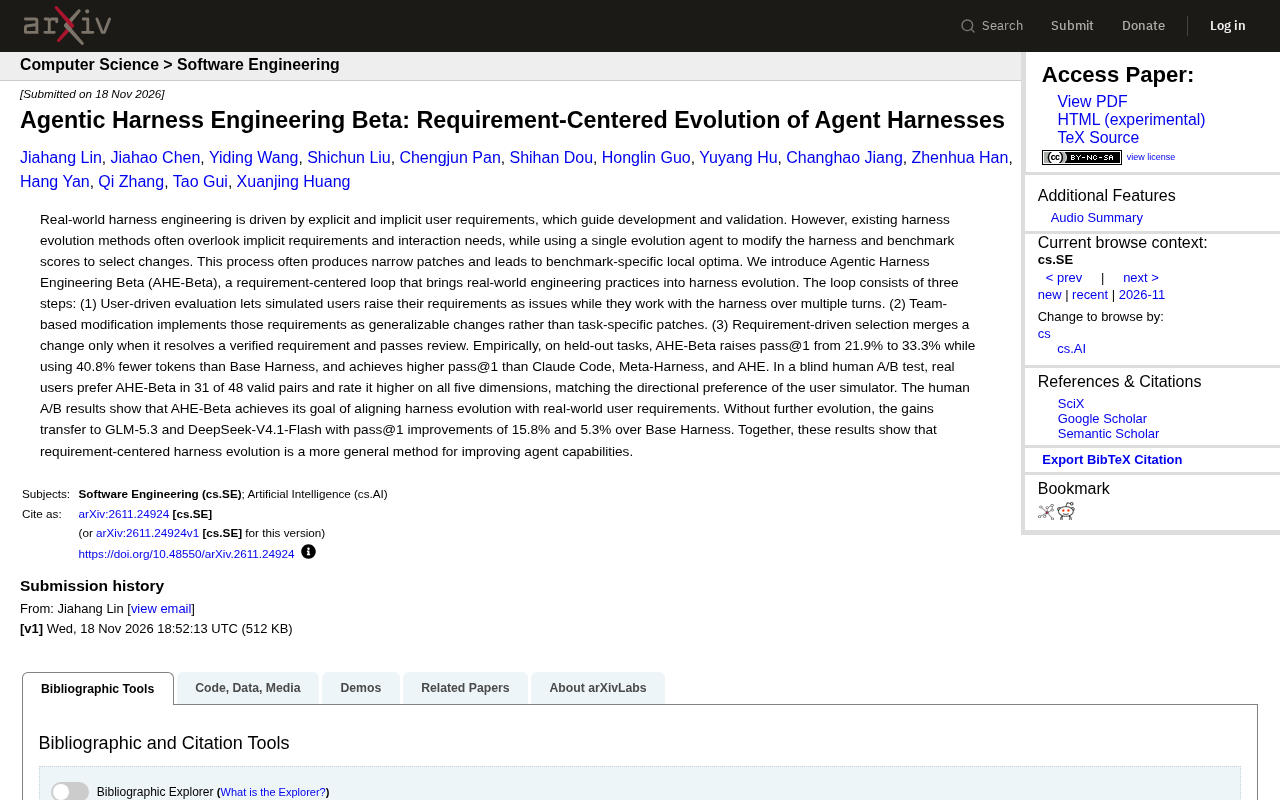
AHE-Beta replaces benchmark scoring with a three-step loop of simulated user requirements, multi-agent team modifications, and requirement-driven screening, achieving higher pass rates and lower token consumption.
The article introduces AHE-Beta (Agentic Harness Engineering Beta), a new paradigm for harness evolution. Traditional methods use a single evolutionary agent to modify the harness and rely solely on benchmark scores for screening, which tends to ignore users' implicit requirements and produce narrow patches targeting the test set. AHE-Beta builds a three-step loop: simulated users raise requirements as issues, a multi-agent team collaborates on generalizable changes, and changes are merged only when they satisfy both "solving a validated requirement" and "passing review." Experiments show held-out pass@1 rising from 21.9% to 33.3% with 40.8% less token consumption, outperforming Claude Code, Meta-Harness, and AHE baselines; in 48 human blind-test pairs, 31 preferred AHE-Beta, consistent with the simulator's direction; results transfer to GLM-5.3 and DeepSeek-V4.1-Flash with gains of 15.8% and 5.3%. The article also notes open questions around long-tail coverage of simulated users, scalability of the review mechanism, and differences in cross-model transfer.
From "Score-Driven" to "Requirement-Driven": A Paradigm Shift in Harness Engineering
In the AI Agent development chain, the harness has long played the role of the "invisible foundation"—it determines how the model invokes tools, how it handles multi-turn interactions, and how it organizes context. Yet there has been a lack of clear methodology for systematically evolving the harness itself.
The prevailing approach is to use a single evolutionary agent to modify the harness, with benchmark scores as the sole screening criterion. This method appears efficient but harbors two structural flaws: first, it ignores the implicit requirements and interaction-level demands that users generate in real usage; second, a single agent tends to produce "narrow patches"—patching only for specific test tasks and ultimately falling into a benchmark-specific local optimum.
AHE-Beta (Agentic Harness Engineering Beta) proposes a requirement-centered evolution loop that seeks to bring real-world software engineering practices into the harness evolution process.
Harness is the engineering layer wrapped around a large language model, responsible for turning model capabilities into executable task workflows. It typically includes tool invocation interfaces (such as function signatures and parameter validation), multi-turn dialogue state management, context window orchestration and compression strategies, and failure retry and error handling mechanisms. The harness does not change model weights, yet it directly determines the upper bound of model performance on real tasks—the same model paired with different harnesses can differ by dozens of percentage points in pass@1. For this reason, harness evolution is regarded as an important lever for improving agent capabilities without relying on larger models, and it is the core subject of this article.
A Three-Step Loop: Making the Simulated User the "Requirement Raiser"
The core of AHE-Beta is a loop consisting of three stages, each corresponding to a step in real engineering.
Step 1: User-Driven Evaluation
In the course of multi-turn interactions with the harness, a simulated user raises requirements in the form of issues, just like a real user. This means the harness no longer faces only the "right/wrong" judgment of static tasks, but must expose interaction-level shortcomings under sustained conversational pressure.
User simulator is a virtual user role played by an LLM, interacting with the harness over multiple turns according to a preset persona, goals, and behavioral strategy. Unlike static benchmarks, a simulated user can proactively follow up, express dissatisfaction, and introduce new constraints, thereby exposing harness deficiencies in clarifying requirements, handling ambiguity, and maintaining contextual consistency during interaction. Its effectiveness depends on whether the simulated user's behavioral distribution closely matches that of real users—if the simulated user is too "accommodating" or too "demanding," the collected requirements will systematically deviate from real scenarios, which is why this method requires human blind testing as external validation.
Step 2: Team-Based Modification
For the collected requirements, a team composed of multiple agents collaborates on implementation, requiring changes that are generalizable rather than temporary patches for a specific task. Team-based division of labor fundamentally suppresses the "whack-a-mole" patching that single agents tend to produce.
Step 3: Requirement-Driven Screening
A change is merged only when two conditions are met simultaneously: it "solves a validated requirement" and it "passes review." This shifts the screening criterion from "did the score go up" to "was the requirement solved," thereby avoiding overfitting to the benchmark.
Empirical Results: Higher Pass Rate, Lower Token Consumption
The data-level performance is noteworthy. On held-out tasks, AHE-Beta raises pass@1 from 21.9% to 33.3% while using 40.8% fewer tokens than the Base Harness. This combination of "better results at lower cost" is quite persuasive from an engineering standpoint—it shows that requirement-driven changes tend to be closer to the essence rather than piling on redundant logic.
In a horizontal comparison, AHE-Beta's pass@1 exceeds three baselines: Claude Code, Meta-Harness, and AHE. This shows that the method's advantage is reflected not only in the gap versus the base harness, but also holds up in direct comparison with similar evolution approaches.
Human Blind Testing: Directional Preference Aligns with the Simulated User
Among 48 valid pairs, real users preferred AHE-Beta in 31, and gave higher ratings on all five evaluation dimensions. More importantly, human preferences align with the directional judgments of the user simulator—providing external validity evidence for the methodology of "using simulated users to drive evolution." If the simulator's preferences systematically diverged from real people, the foundation of the entire loop would be shaky; this result precisely validates the reliability of simulated users as requirement proxies.
pass@1 is a commonly used metric for measuring agent task success rate: for each task, only one execution trajectory is sampled, and the proportion of successful tasks is counted. Compared with pass@k (which allows k samples and counts a pass if any one succeeds), pass@1 is closer to real deployment scenarios—users usually give the agent only one chance. Therefore, an increase in pass@1 from 21.9% to 33.3% means roughly one additional task out of every three can be completed correctly on the first try, a significant leap in actual product experience. Combined with a 40.8% drop in token consumption, this indicates that the improvement comes mainly from more streamlined interaction logic rather than "brute-forcing" results through longer reasoning chains.
Cross-Model Transfer: Gains Do Not Depend on a Single Base Model
The value of a method largely depends on whether its gains can transfer. Without further evolution, AHE-Beta directly transferred its evolution results to GLM-5.3 and DeepSeekAd-V4.1-Flash, achieving pass@1 improvements of 15.8% and 5.3% respectively relative to the Base Harness.
This means harness-level improvements captured some general capability decoupled from a specific model, rather than temporary adaptation to a particular model's characteristics. The difference in transfer magnitude (15.8% vs. 5.3%) suggests that different models have different sensitivities to harness interaction logic, a point worth further decomposition in future research.
Cross-model transfer here refers to: a harness evolved on one base model is directly paired with another base model without any retraining or re-evolution, and whether the performance gain is retained is observed. This is a key experimental design for testing whether harness improvements are "general"—if the gain appears only on the original model, it suggests the change may merely adapt to that model's specific quirks (such as a particular output format preference); if the gain is reproduced across multiple models, it suggests the improvement touches general interaction logic at the harness level. Differences in transfer magnitude (15.8% vs. 5.3%) typically reflect different models' sensitivity to tool invocation formats, instruction-following strength, and context length, requiring model-by-model analysis of coupling points.
Methodological Significance and Open Questions
The core contribution of AHE-Beta is moving the evaluation anchor of harness evolution from benchmark scores back to user requirements, which is in line with the software engineering idea of "driving iterations with user stories." Its three-step loop is in effect an agentized reconstruction of the classic process of "requirement collection—implementation—acceptance."
Of course, the method still has several open questions. Whether the simulated user's requirement distribution can cover the long-tail scenarios of real users determines the ceiling of this loop; how the review mechanism in team-based modification can be scaled also affects its engineering feasibility. In addition, the uneven magnitude of cross-model transfer indicates that the coupling relationship between harness and model is not yet fully understood.
Overall, the signal from AHE-Beta is clear: requirement-driven harness evolution has greater generalization potential than score-driven local search. For teams building agent systems, this offers an engineering path worth learning from—put real users in the loop, rather than placing the benchmark at the center of the loop.
Related articles

500,000 Robots to 'Refreeze' the Arctic? Real Ice's Wild Plan
A startup called Real Ice plans to use 500,000 underwater drones to thicken Arctic ice, with test-area ice already 50 cm thicker. This article breaks down the technology, the 4-million-fold scale gap, the controversial $10 billion annual cost, and the window before an ice-free summer in the 2030s.

T3 Code: One Tool Aggregates All AI Coding Assistants and Models
T3 Code aggregates multiple AI models and coding assistants like Claude and DeepSeek into one interface, enabling mid-conversation switching with automatic context handoff. This article covers its core selling points, hands-on switching flow, and use cases.

Why Did The New York Times Ban Photographers From Using the Latest Version of Photoshop?
The New York Times told photographers not to use the latest Photoshop, a ban that reflects photojournalism's caution toward AI-generated content and authenticity. This article analyzes the logic behind the ban, its impact on photographers' workflows, and the long-term struggle between tools and ethics in the news industry.