AI Agent Automated Vulnerability Discovery: Build Your SRC Pipeline in Five Steps
Bilibili creator shares a step-by-step AI Agent vulnerability discovery tutorial that beginners can complete end to end.
This article presents a tutorial on AI automated vulnerability discovery centered on the Hermes tool, helping zero-background users complete the full flow from environment setup to vulnerability verification in one evening. It explains why people hoard tutorials but can't find vulnerabilities, distinguishes AI Agents from web-based AI, breaks the workflow into six steps with three immediate actions, and details the agent + knowledge base + tool library architecture.
AI automated vulnerability discovery is moving from concept to practice. A Bilibili creator recently shared a step-by-step tutorial centered on the Hermes tool, claiming that users with zero background can complete the entire flow from environment setup to vulnerability verification in a short time with just one computer and one target range. The core of this tutorial is not about teaching people to "get rich overnight," but rather revealing a replicable path: use AI Agents to replace manual work in information gathering, asset mapping, and preliminary analysis, concentrating human effort on vulnerability verification and report writing.
Why You've Hoarded Tutorials but Still Can't Find Vulnerabilities
The creator points out a common dilemma right at the start of the video: many people have bookmarked countless tutorials—enough to fill up their storage—yet can't even submit a single low-severity vulnerability. The reason is summed up as "always hoarding materials, never willing to get hands-on." This isn't a capability issue; it's the lack of a first submission record. The monetization path for vulnerability discovery is actually quite clear—platform bounties, vendor points redemption, and referrals leading to job offers—but the prerequisite is that you must first complete one full cycle.
This tutorial is positioned to break through that barrier. It doesn't dwell on lengthy theory but directly guides hands-on practice, with the goal of completing the loop from environment configuration to vulnerability verification in a single evening. For beginners, the hardest part is often not the technology itself, but not knowing what the first step should be and what level of completion counts as acceptable at each stage.
The Essential Difference Between AI Agents and Traditional Web-Based AI
To understand AI Agent's vulnerability-hunting capabilities, you first need to distinguish it from ordinary web-based AI. Traditional web-based AI can only provide suggestions or generate code based on user requests; users still need to copy the code to a local compiler to run it, and the hands-on phase relies entirely on manual work. AI Agents, on the other hand, have the ability to send network requests—this is the fundamental reason they can automate penetration testing.
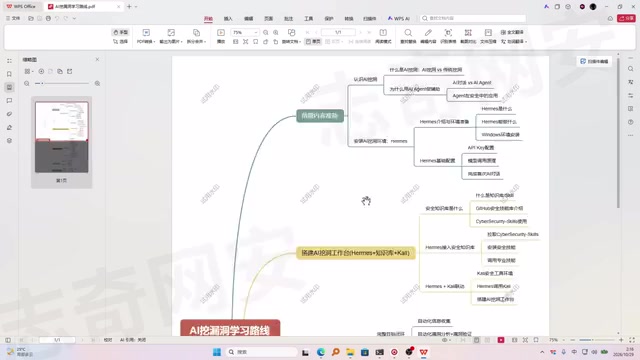
As long as the penetration testing agent is configured in advance and prompts are written well, it can automatically execute the vulnerability discovery workflow. The creator summarizes this process as "giving AI hands"—the agent handles execution, while humans define goals and evaluate results. This division of labor allows beginners to leverage AI to accomplish work that would otherwise require more experience to advance.
AI Agent refers to an AI system capable of perceiving its environment, making autonomous decisions, and taking actions to achieve goals. Unlike conversational AI that can only generate text, Agents typically possess tool use, planning, and memory capabilities. In penetration testing scenarios, Agents interact with target systems by calling network request tools (such as HTTP clients) and can dynamically adjust their next actions based on responses, thereby simulating the workflow of human penetration testers. This "perceive-decide-act" loop is the core of Agent automation and the key distinction from traditional AI-assisted tools.
Five Steps to Complete the Full AI Vulnerability Discovery Workflow
The creator breaks down the fixed workflow of AI vulnerability discovery into six steps: information gathering, asset mapping, AI-assisted analysis, manual verification, report writing, and platform submission. Building on this, he further distills three actions that can be started immediately: lock onto high-value vulnerability targets, solidify AI information-gathering parameters, and configure the vulnerability discovery submission loop.
The design logic of this workflow is to let AI handle highly repetitive, rule-based tasks while humans focus on areas requiring judgment. For example, AI-assisted analysis can quickly screen out suspicious points, but whether a vulnerability actually exists and how severe its impact is still requires manual verification. The creator emphasizes that finding one vulnerability involves luck, finding ten relies on proficiency, and only finding a hundred makes you a master—the value of the process lies in turning偶然 into repeatable.
Asset mapping is a key phase in the information gathering stage of penetration testing, referring to the systematic identification and cataloging of assets that a target organization exposes on the internet, including domains, subdomains, IP addresses, open ports, service fingerprints, web applications, and their component versions. Common techniques include subdomain brute-forcing, certificate transparency log queries, cyberspace search engines (such as FOFA and Shodan), and active scanning. The purpose of asset mapping is to create a panoramic view of the attack surface, providing a target list for subsequent vulnerability analysis. In AI workflows, agents can automate these repetitive collection tasks and output structured results, greatly improving efficiency.
Vulnerability verification is the critical step of confirming whether a suspected vulnerability is actually exploitable, typically requiring manual construction and sending of test payloads in an authorized environment while observing target responses to determine whether the vulnerability exists and its severity. Automated tools (including AI Agents) excel at discovering anomalous signs, but final verification often requires human intervention because it needs to incorporate business context, bypass protection mechanisms, and assess actual impact. Report writing requires clearly describing the vulnerability location, reproduction steps, risk level, and remediation recommendations, and is an important basis for platform review of vulnerability submissions. The dependence of these two phases on the user's systematic understanding and expression skills is precisely the part that AI currently struggles to fully replace.
Agent Architecture: Agent + Knowledge Base + Tool Library
The core architecture of this course can be summarized into three components: the agent, the knowledge base, and the tool library. The creator recommends that beginners adopt an architecture that "approaches predecessors' experience," because zero-background users often cannot give AI clear goals and struggle to assess the harmfulness of AI output. At this point, drawing on real cases and skills accumulated by predecessors becomes especially important.
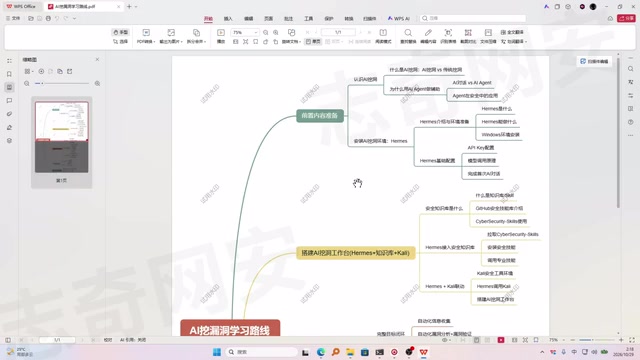
These skills distilled by predecessors can serve as the AI Agent's knowledge base; during each vulnerability hunt, the agent configures tools based on this experience. The tool library is responsible for expanding the agent's capability boundaries. Combined, the three form an iterable system: the agent executes tasks, the knowledge base provides judgment criteria, and the tool library supplies operational means. The creator also mentions that the ultimate ideal state is for every master to have their own playbook and output it as a privately customized skill—essentially a personal exclusive "scale."
Knowledge Base in AI Agent architecture typically refers to a structured collection of experiences, rules, or cases used to enhance the agent's domain judgment. Common implementations include vector databases (storing text embeddings for retrieval), prompt libraries, or fine-tuning datasets. In vulnerability discovery scenarios, the knowledge base can include historical vulnerability patterns, penetration testing techniques, tool usage manuals, etc., and the agent retrieves relevant knowledge to guide its actions during decision-making. Tool Library is the set of external functions that the agent can invoke, such as port scanners, directory brute-forcing tools, vulnerability verification scripts, etc. The agent dynamically selects tools based on task requirements, thereby expanding its capability boundaries. Combined, the two enable the agent to both "know how to do it" (knowledge base) and "actually do it" (tool library).
Course Modules and Future Directions
This tutorial consists of five modules: understanding the architecture of AI Agent vulnerability hunting, clarifying the results the architecture can achieve, deploying your own agent, arming the agent into a penetration testing agent, and using the agent to feed back into your own vulnerability hunting capabilities. The course also shares some simulated target ranges and vulnerability submission platforms (SRC) for learners to practice.
The creator reveals in the video that the next episode will share how to deploy your own AI Agent. For viewers who want to get started immediately, he mentions that related vulnerability hunting tutorials, AI prompts, and target range tools have been organized into documents that can be obtained through a specific code word.
From an industry perspective, the application of AI Agents in security testing is still in its early stages. It lowers the barrier to entry but also places higher demands on users' judgment—AI can accelerate information gathering and preliminary analysis, but the quality of vulnerability verification and report writing still depends on one's understanding of the target system. Treating AI as an executor on the assembly line rather than an all-purpose tool that replaces thinking is perhaps the attitude behind this tutorial that is more worth noting.
One-line Summary
A Bilibili creator shares a step-by-step AI Agent vulnerability discovery tutorial that zero-background users can complete end to end.
Paragraph Summary
This article introduces a tutorial on AI automated vulnerability discovery centered on the Hermes tool, designed to help zero-background users complete the entire flow from environment setup to vulnerability verification in a single evening. The article first identifies the dilemma of many people hoarding tutorials yet being unable to find vulnerabilities, the root cause being a lack of hands-on practice. It then distinguishes AI Agents from traditional web-based AI—the former can proactively send network requests and automatically execute penetration testing. The tutorial breaks vulnerability discovery into a six-step workflow and distills three immediately actionable moves. The core architecture is agent + knowledge base + tool library, with beginners advised to draw on predecessors' experience to build the knowledge base. Finally, it outlines the course's five modules and monetization paths, emphasizing that AI is an executor rather than a replacement for thinking.
Related articles

Gemini 4 Neon Review: Benchmark Scores Rival Carbon, API Pricing and Quota Breakdown
Google Gemini 4 Neon is now live, benchmark scores closely tracking Carbon, API pricing 3/15 at twice Hydrogen's rate. This article compiles Bilibili creator testing: Neon can replace 90% of Carbon scenarios, AntiGravity quota consumption is only one-third of Carbon, plus subscription channel restrictions and 2API ban risks.

Gemini 4 Helium Coming Soon? Signals of Google Loosening Subscription Restrictions
Google team member hints releases will continue; community speculates Gemini 4 Helium (Flash Lite) may be next. Subscription ban controversy gets a response as product lead says "Soon," suggesting restrictions may be lifted. This article covers Gemini developments, OpenAI Coding Agent and risk management, Doubao real-time audio-video API, and compute business dynamics.

AI-Assisted React Development in Practice: Optimizing a Video App and Handling Errors
A 14-year veteran developer demonstrates AI-assisted React video app optimization: compressing video from 80MB to 5MB (~94%) via ImageKit, plus reliable error handling and retry mechanisms. Includes planning, code understanding, and verification methods for working with AI.