AI Agent Explained: Why It's the Next Computing Revolution After the GUI

AI Agent is an autonomous task executor that Bill Gates calls the biggest computing revolution since the GUI.
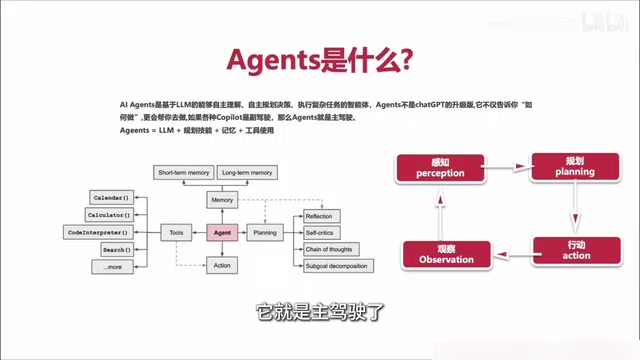
Unlike ChatGPT, which tells you how to do things, AI Agents autonomously plan and execute tasks using the formula LLM + Planning + Memory + Tools. Bill Gates considers this the third major computing revolution after the command line and GUI, with natural language replacing the fragmented "one task, one app" model. Combined with robotics, Agents may also displace physical labor in the next wave of AI disruption.
AI Agent Is Not a Chatbot — It's an Autonomous Executor
If ChatGPT solves the problem of "telling you how to do something," then AI Agent (intelligent agent) solves the problem of "getting things done for you." This is the most critical distinction to understand about Agents.
A helpful analogy: Copilot-style AI assistants are like a passenger in the front seat — they won't drive for you, but they'll say "turn right at the next intersection." An Agent is the driver. It makes its own decisions and takes action. This leap from "assistant" to "agent" is precisely why Agents are generating so much excitement.
By strict definition, an AI Agent is an intelligent system built on a large language model (LLM) that can autonomously understand, plan, make decisions, and execute complex tasks. It's not simply an upgraded ChatGPT — it's a system that bridges the "thinking" capability of large models with the "action" capability of the real world.
Why Bill Gates Calls It the Third Revolution After the Command Line and the GUI
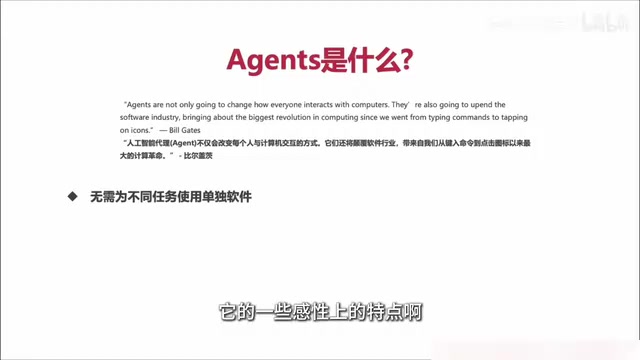
Microsoft founder Bill Gates has written that AI agents represent a major opportunity at the system platform level — one that will upend the entire software industry and is "the biggest computing revolution since we went from typing commands to clicking on icons."
To appreciate the weight of this claim, it helps to revisit two previous evolutionary leaps in software history:
- The first: The command-line era. In the early days, only specialists could use software — you had to type commands to run programs, making the barrier to entry extremely high. Ordinary users simply couldn't manage.
- The second: The GUI era. Pioneered by Microsoft Windows, this transformed command-line operations into visual, clickable icons. This revolution dramatically lowered the barrier for everyday users and gave rise to an entirely new industry: UI design, frontend development, browsers, websites, and more.
Gates believes the impact of Agents will be just as profound. And the vehicle for this revolution is natural language interaction — you simply tell it what you want in plain language, and it understands and executes.
How Agents Will Transform the Way We Use Technology
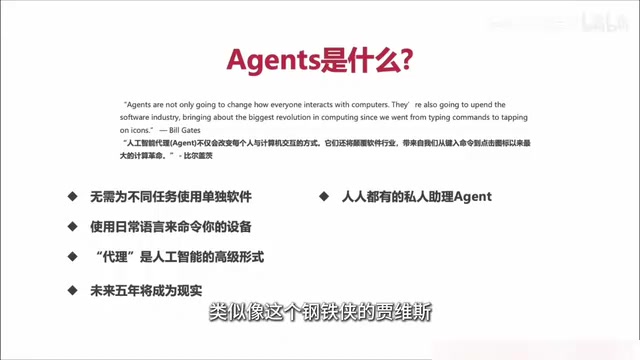
At an intuitive level, the most striking feature of Agents is that you no longer need separate software for every different task.
Today our phones are filled with apps — each one handling a different job. This is fundamentally a "one task, one app" model. The Agent philosophy is an all-in-one solution: a single super-entry-point, a single assistant. You tell it what you want, and it orchestrates the tools and interfaces behind the scenes. Tencent has already launched an Agent product that learns how a user operates their phone and can perform those actions on their behalf — a clear sign of this trend.
This is fundamentally different from the "smart" devices of the past. Previous voice assistants (like Xiao Ai) could respond to voice commands, but their intelligence was limited: say "turn on the light" and it executes, but say "the room feels a bit dim" and it draws a blank. A large model-powered Agent can understand this kind of vague, indirect expression — and with enough sensor data, can even reason autonomously: "The owner is home and the light level is low — should I turn on the lights?" This reasoning capability is what marks it as an advanced form of artificial intelligence.
Gates also predicts that in the future, everyone will have their own personal assistant Agent — like Jarvis in the Iron Man films. This assistant can be configured with different personalities and specializations based on personal preferences and professional needs. Teachers, programmers, and professionals across fields will set their Agents up with different areas of expertise, handing off repetitive tasks to them entirely.
Agent + Robots: The Next Wave That Could Replace Physical Labor
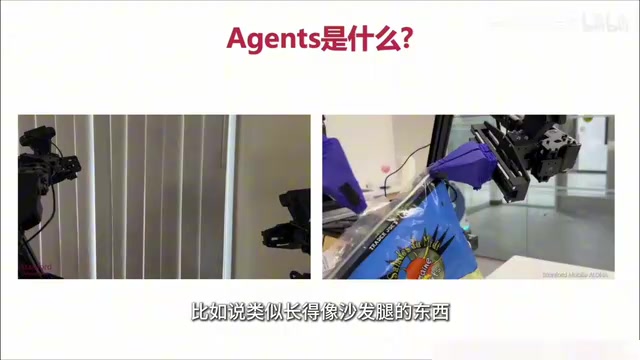
Beyond software applications, the combination of Agents and hardware is opening up new possibilities. Research led by AI scholar Andrew Ng, as well as Google DeepMind's Auto-RT project, are both exploring the integration of large models with robot control.
The limitations of traditional robots are obvious. Take a robot vacuum: its path must be pre-planned, and it relies on simple algorithms to handle obstacles (e.g., if it detects something that might be a table or chair leg, it turns away). Its programming is essentially hardcoded — it can only vacuum. Ask it to wipe a table, and it's helpless. It also frequently gets stuck under beds.
When a large model serves as the robot's "central brain," everything changes. In demonstrations, robots can complete highly complex tasks like cooking Chinese food — a task that's notoriously hard to quantify (Chinese recipes call for "a pinch of salt" or "a few pieces," with no precise gram measurements). The movements closely mimic human actions, showing clear signs of imitation learning. This directly addresses the core problem of low intelligence in traditional robots.
Here's a key observation worth noting: if AI's first wave of disruption mainly displaced knowledge workers, then the "Agent + robot" model may displace large numbers of physical labor jobs in the second wave.
Imitation Learning is one of the core technical approaches for giving robots human-like behavior. Unlike traditional reinforcement learning, which requires extensive trial and error, imitation learning trains robots by having them observe human demonstrations, dramatically reducing training costs. Google DeepMind's Auto-RT (Autonomous Robot Tasks) project uses large language models to automatically generate task descriptions and evaluation criteria for robots, combined with imitation learning data, enabling robots to generalize to new tasks they were never explicitly programmed for. Andrew Ng's related research — such as Stanford's Mobile ALOHA project — has also demonstrated that home robots can learn complex household tasks like stir-frying and cleaning from just a small number of human demonstrations. The significance of this breakthrough: previously, robotic automation required precise programming for every single action. The semantic understanding provided by large models gives robots the potential to "generalize from one example to many" for the very first time.
The Technical Architecture of an Agent: LLM + Planning + Memory + Tools
From a theoretical standpoint, the industry has a classic formula for describing Agents:
Agent = LLM (Large Language Model) + Planning + Memory + Tools
These four components are orchestrated by the Agent, each playing a distinct role:
- Planning: When forming strategies and making decisions, Agents use techniques like self-reflection, self-looping, and Chain of Thought (CoT) — capabilities that are among the most commonly used in frameworks like LangChain.
- Memory: Divided into short-term and long-term memory. Memory participates in decision-making, much like how humans think back to similar situations they've encountered before and how they handled them.
- Tools: Executing actions requires calling on the appropriate tools from a tool library — various APIs and external capabilities.
- Action: The actual execution steps taken based on planning and memory.
For every task, an Agent goes through a cycle of "perceive → plan → act → observe" (which is closely related to the augmented generation process in RAG). This leads to a fundamental conclusion:
At its core, an Agent is an orchestration and execution system for large models. Every task cycle invokes the large model, chaining together planning, memory, and tools to complete decisions and actions.
LangChain is currently one of the most widely used Agent development frameworks, released by Harrison Chase in 2022. Its core value lies in providing a standardized "chain-of-calls" abstraction that lets developers easily connect LLMs with external tools, databases, and APIs into workflows. LangChain has built-in support for multiple memory types (such as conversation buffers and vector database retrieval) and encapsulates common planning patterns — most notably ReAct (Reasoning + Acting), which alternates between model reasoning and tool execution until a task is complete. Chain of Thought (CoT) is a prompt engineering technique that significantly improves accuracy on complex tasks by requiring the model to write out its reasoning step by step before arriving at a final answer. These two techniques form the underlying foundation of the planning module in current Agents — understanding them is key to grasping why Agents can "think."
RAG (Retrieval-Augmented Generation) is an important implementation method for the Agent memory module. It stores external knowledge bases (documents, databases) as vector embeddings, and retrieves relevant fragments at inference time to inject into the prompt — compensating for the knowledge cutoff limitations of LLMs, and serving as a common solution for implementing "long-term memory" in Agents.
Why You Should Learn Agent Development Now
When it comes to AI, a lot of developers worry about being replaced. But that anxiety often stems from a shallow understanding of what AI can actually do. The real opportunity lies in combining traditional software engineering with the capabilities of large models.
Take building an automotive app as an example. In the past, you might need to build out dozens of detailed features: vehicle maintenance tracking, payment processing, navigation, and so on. With an Agent-based approach, you simply expose all the relevant interfaces — payment API, route-query API, etc. — and tell the Agent your intent. It orchestrates everything autonomously, replacing a huge amount of what traditional software had to do explicitly.
This means the development mindset needs to shift. The people most likely to be displaced are those who cling to traditional application development patterns. Those who build competency in AI application development will be far more competitive in the market. Where there's a platform, there are applications — and where there are applications, there are opportunities. Many startups and major tech companies are already moving in this direction. For developers, building Agent development skills as early as possible is the most practical way to navigate this transformation.
Related articles

Random Pruning of the DPO Computation Graph: 1.4x Training Speedup and Lower Peak Memory
DPO training too slow and memory-hungry? This paper proposes a random pruning framework for the DPO computation graph, sampling independently across position, sequence, and branch dimensions; branch pruning achieves a 1.426x step-time speedup and cuts training time by about 30%, with in-depth attribution of memory and time gains.

Why Does JEPA Underperform MLM in Longitudinal EHR Representation Learning?
New study compares JEPA and MLM for longitudinal EHR representation learning on MIMIC-IV: three JEPA variants train stably without collapse but underperform MLM; target size, not heterogeneity, drives prediction error.

Transfer Learning + Visible Light Communication: A New Approach to Energy-Efficient Indoor Positioning
A study proposes a transfer learning-based visible light communication indoor positioning method, achieving 47% accuracy improvement on the BOSCH factory dataset, 67.5% model efficiency under high noise, and introducing the ME composite metric for energy-efficient positioning in energy-constrained industrial IoT scenarios.