AI Agent Failure Attribution: Turning Root-Cause Analysis into a Search Problem
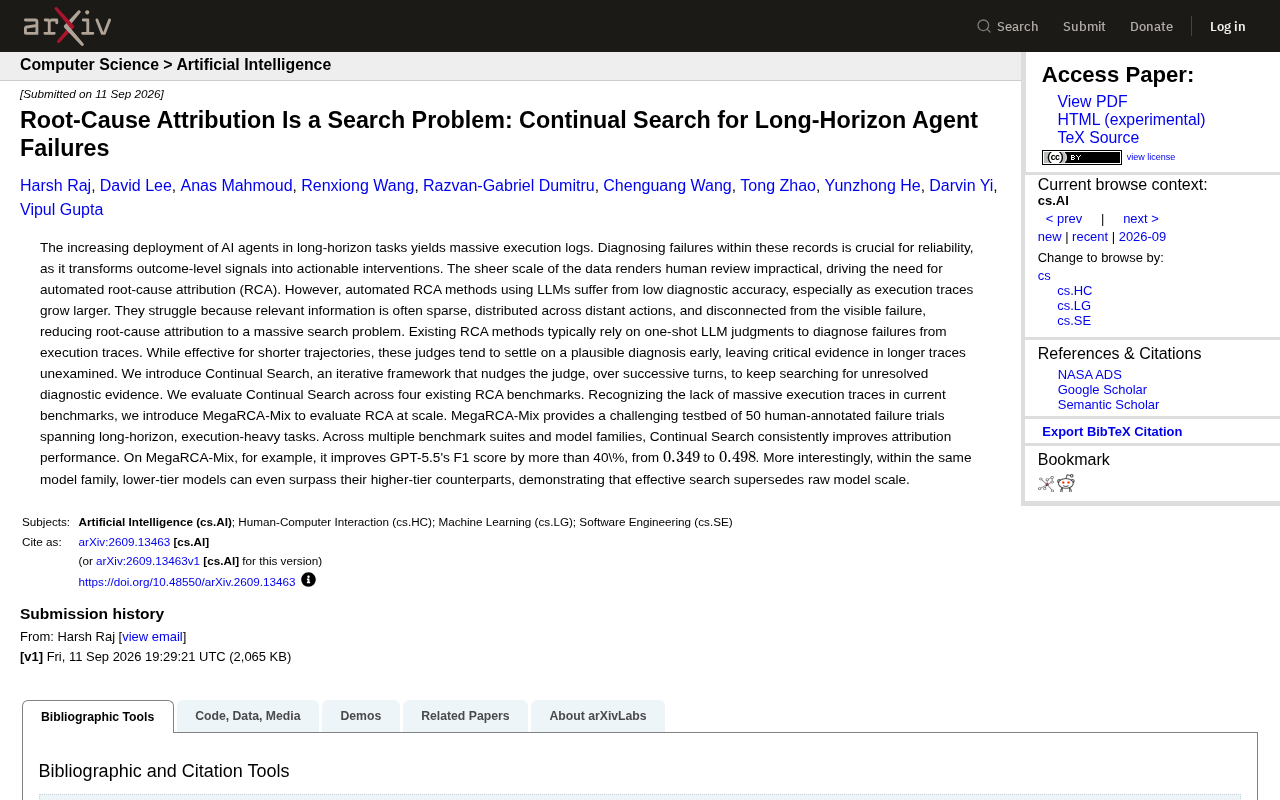
New framework reframes AI agent failure diagnosis as a search problem, boosting F1 scores by over 40%.
A new arXiv paper argues that root-cause attribution (RCA) for long-horizon AI agents is fundamentally a large-scale search problem. Existing one-shot LLM-based methods suffer from anchoring bias on long execution traces, causing premature convergence and missed evidence. The proposed "Continual Search" framework uses multi-round iteration to keep nudging the model toward unresolved diagnostic clues. On the new MegaRCA-Mix benchmark, it raises GPT-5.5's F1 from 0.349 to 0.498 (>40% gain), and smaller models using the strategy can even outperform larger ones — confirming that effective search beats raw model scale.
Long-horizon AI agents generate massive execution logs in real-world deployments. When a task fails, pinpointing the true root cause within these lengthy traces becomes a critical challenge for ensuring system reliability. A newly published arXiv paper presents a thought-provoking perspective: Root-Cause Attribution (RCA) is fundamentally a search problem — and proposes an iterative solution called "Continual Search."
Why Diagnosing Long-Task Failures Is So Hard
As AI agents are increasingly deployed in long-horizon tasks, they produce execution records at an enormous scale. Diagnosing failures in these records transforms "outcome-level" signals (e.g., the task failed) into "actionable interventions" (e.g., exactly which step or decision went wrong). But the sheer volume of data makes manual review impractical, which has created a pressing need for automated RCA.
The paper identifies a clear weakness in existing LLM-based automated RCA approaches: diagnostic accuracy is low and degrades further as execution traces grow longer. The reason is that information truly relevant to a failure is often sparse, scattered across many distant actions, and lacks a direct connection to the surface-level failure symptoms. In other words, finding the root cause is like finding a needle in a haystack — and that is fundamentally a large-scale search problem.
The Limits of One-Shot Judgment
Most current RCA methods rely on "one-shot" LLM judgment — the model reads through the execution trace once and produces a diagnosis. This works reasonably well on shorter traces, but on longer ones it exposes a classic cognitive bias: models tend to lock onto a plausible-sounding diagnosis early on and then stop, leaving much of the critical evidence in long traces unexamined.
This mirrors human expert intuition — when confronted with an overwhelming amount of information, people also tend to anchor on the first explanation that makes sense and stop digging. For short traces, this may be harmless. But when evidence is scattered across hundreds or thousands of steps, a premature conclusion means missing the real root cause.
This "premature convergence" phenomenon corresponds to what cognitive science calls Anchoring Bias — once a reasoner encounters a seemingly plausible explanation, subsequent judgments get pulled toward that "anchor," making it hard to objectively evaluate later contradictory evidence. For LLMs, this problem is also closely tied to attention allocation within the context window: in very long inputs, models naturally assign higher weight to information that appears early or seems conspicuous on the surface, while the true root cause is often buried in an unremarkable step somewhere in the middle and easily "diluted" away. Furthermore, the structural flaw of one-shot generation is that the model has no opportunity to revise early hypotheses based on newly discovered evidence. The entire diagnostic process lacks a feedback loop and cannot converge toward the true cause the way a human expert can through iterative cycles of "propose hypothesis → find evidence → refute/confirm → propose new hypothesis."
Continual Search: Keeping the Model in Persistent Pursuit
To address this pain point, the paper proposes the Continual Search framework. Its core idea is to repeatedly "nudge" the LLM judge through multiple iterative rounds, compelling it to keep searching for unresolved diagnostic evidence across successive conversation turns rather than settling for the first reasonable answer.
This design restructures RCA from a single-pass judgment into a continuous, directed search process. The model is required to keep asking itself: What evidence hasn't been examined yet? Are there still unresolved questions in the current diagnosis? This mechanism effectively counteracts the problem of premature convergence.
Experimental Results: Search Strategy Beats Model Scale
The research team evaluated Continual Search on four existing RCA benchmarks. Noting that current benchmarks generally lack "large-scale execution traces," they also constructed a new evaluation set called MegaRCA-Mix — comprising 50 human-annotated failure cases specifically covering long-horizon, execution-intensive tasks — to serve as a more challenging test platform.
The results are impressive:
- Continual Search consistently improves attribution performance across multiple benchmark suites and different model families.
- On MegaRCA-Mix, it raises GPT-5.5's F1 score from 0.349 to 0.498, an improvement of over 40%.
- More strikingly, within the same model family, smaller models using Continual Search can outperform their larger counterparts.
That last point is especially worth reflecting on: it suggests that an effective search strategy can outperform raw model scale. In other words, rather than simply stacking more parameters or upgrading to a more powerful model, optimizing the reasoning process — making the model "search more thoroughly" — may deliver greater gains than making the model itself "smarter."
Implications for Agent Reliability
The value of this research extends beyond a single concrete method. It clearly reframes the problem of diagnosing failures in long-horizon agents as a search problem, offering a new conceptual lens for future research. As AI agents take on increasingly complex and extended task chains, the ability to perform efficient and accurate post-hoc attribution will directly determine whether these systems can be trusted and deployed at scale.
The "process optimization over scale expansion" philosophy demonstrated by Continual Search also echoes the industry's growing interest in inference-time compute — investing more computation and iteration during the reasoning process often yields significant performance gains at lower cost.
Inference-Time Compute is an important direction in recent AI research. Its core idea is: with model parameters fixed, output quality can be improved by investing more compute during the inference stage (e.g., multi-round iteration, chain-of-thought, self-verification). OpenAI's o-series models and Google's Gemini Thinking mode are representative products of this direction. Continual Search belongs to this same category — it does not modify model weights, but instead changes how the model "thinks" through a multi-turn dialogue protocol, enabling the same parameter-count model to produce deeper diagnostic results. This trend has important implications for AI infrastructure design: optimizing inference orchestration logic is just as important as scaling model size, and in certain tasks may even offer a better cost-performance ratio.
Related articles
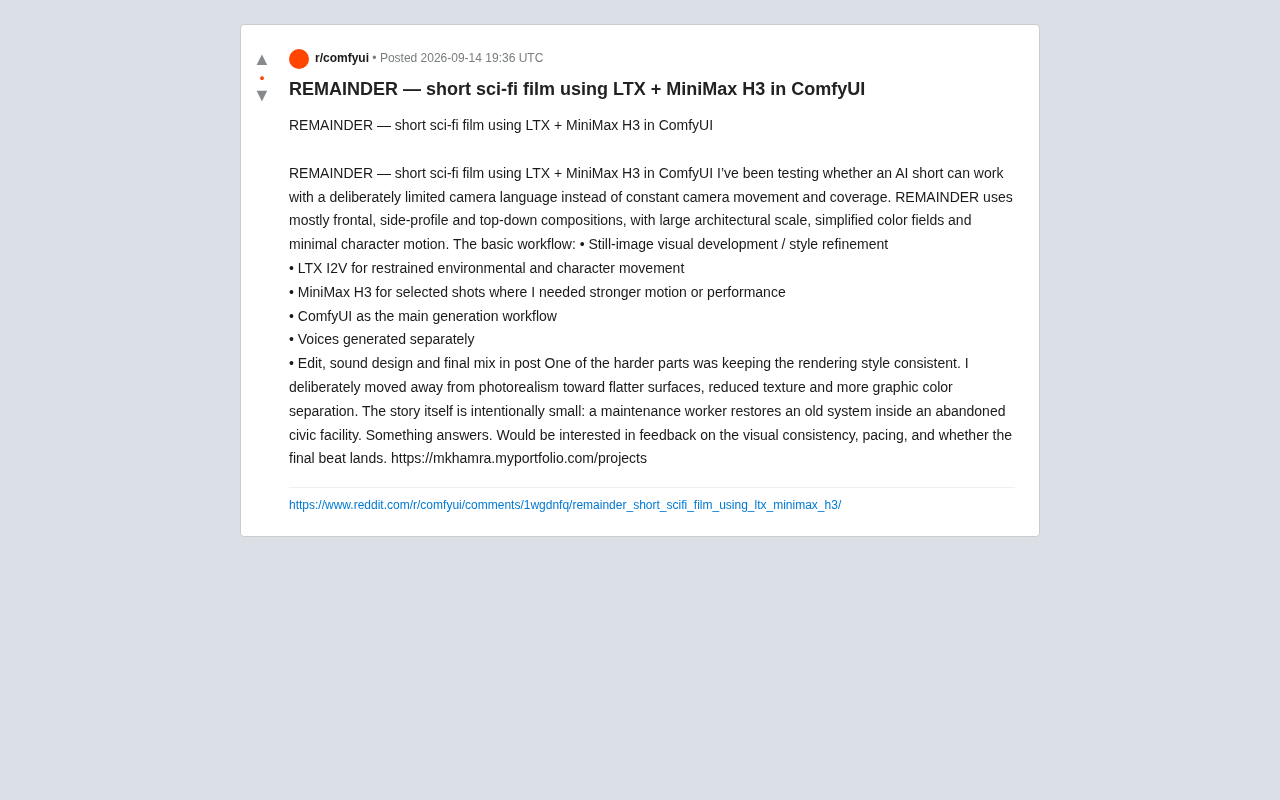
Building an AI Sci-Fi Short with LTX + MiniMax H3: Restrained Cinematography in ComfyUI
Sci-fi short REMAINDER uses LTX, MiniMax H3, and ComfyUI with restrained cinematography and flat aesthetics to solve visual consistency in AI filmmaking.

LangChain Deep Agents vs. MDA: Clearing Up the Confusion for Developers
What's the difference between LangChain's Deep Agents and MDA (Managed Deep Agents)? We break down create_deep_agent vs. define_deep_agent and help developers choose.
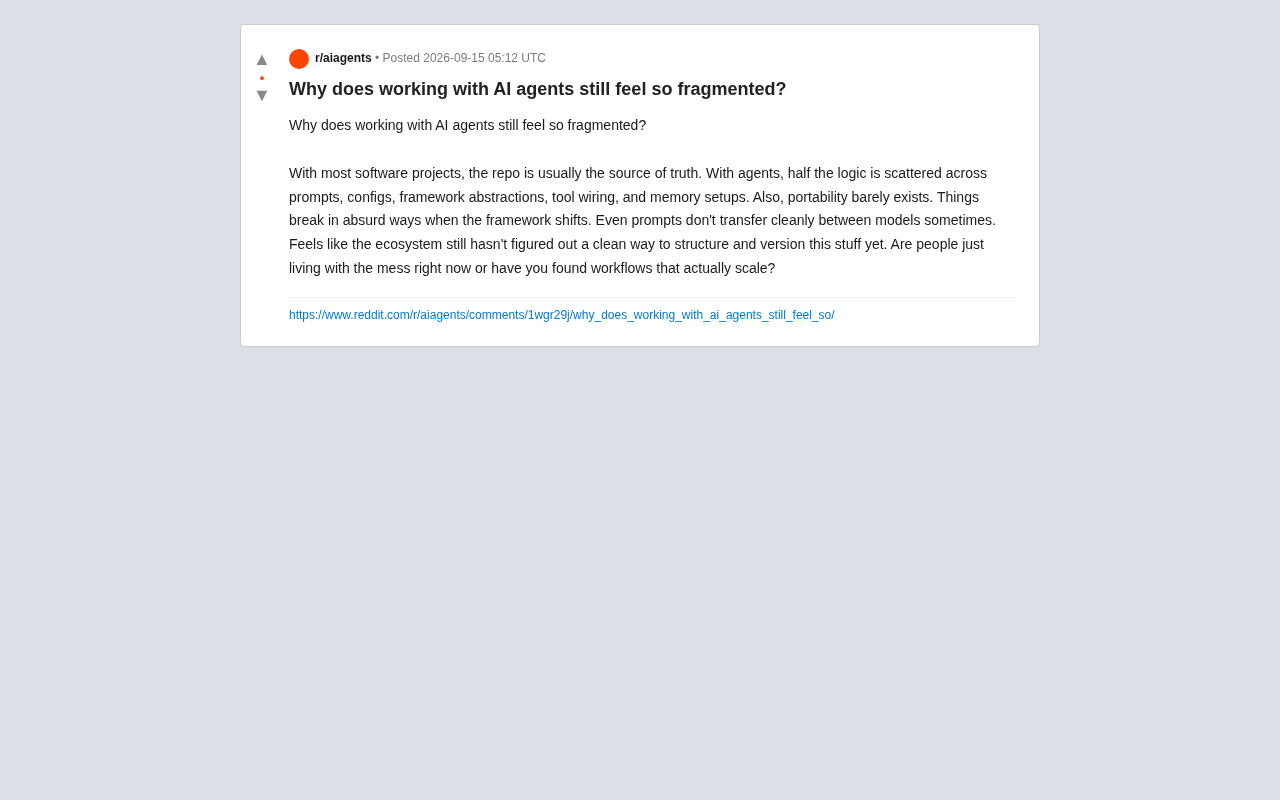
Why Is AI Agent Development So Fragmented? The Real Causes and How to Work Around Them
Why does AI Agent development feel so fragmented? Logic scattered across prompts, configs, and frameworks makes portability nearly impossible. Here's why — and how to cope.