AI Agent From Scratch: The Universal Formula and 5-Step Implementation Guide

Build any AI Agent from scratch using a five-element formula and a clear five-step implementation method.
This article breaks down how to build AI Agents from the ground up. The core architecture has just three parts: an LLM as the brain, tools as the hands, and a memory module for context. Before building, fill in the five-element formula (role, goal, tools, rules, output format), then follow five steps: distill your need into one sentence, let AI generate a delivery checklist, start with the minimum viable version, test with dirty real-world data, and tune using single-variable control. Keep tools focused and memory simple — most tasks need no extra memory at all. Multi-Agent systems are only necessary for skill isolation, deep pipelines, or permission separation.
Many people assume building an AI Agent is something only senior developers can do. In reality, if you can clearly describe what you need in plain language, you can build one today. The real key isn't writing code — it's how you define goals, configure tools, and set boundaries. This article walks through the core architecture of Agents, a universal construction formula, and a practical five-step implementation method.
Don't Be Intimidated by Frameworks: Agent Architecture Comes Down to Three Things
Frameworks like LangChain and CrewAI get a lot of hype, but strip away the packaging and the underlying logic boils down to just three things — and you can get something running in a few dozen lines of code.
The brain is played by a large language model, responsible for reasoning and decision-making. When you say something, it determines internally: should I respond directly, or do I need a tool to help? The hands are the tools. LLMs can't handle complex arithmetic or access real-time data on their own — that's where tools come in for searching, running calculations, and passing results back to the brain. The notepad is the memory module, which simply keeps track of the conversation so context stays coherent.
The whole process is a clean loop: receive input → brain thinks → instructs tools to act → tools return results → brain synthesizes → delivers final output. Once you truly understand this loop, your grasp of Agents will be far more solid than someone who blindly stacks frameworks.
LangChain and CrewAI are the two most frequently mentioned Agent frameworks today. LangChain, launched in 2022, centers on breaking down LLM calls, tool calls, and memory management into standardized "Chain" and "Agent" components that developers can assemble like building blocks. CrewAI focuses more on multi-Agent collaboration, defining each Agent as a "crew member" with a role and goal, with built-in task distribution and result-passing mechanisms. Both add substantial engineering scaffolding on top of these three core elements (brain, hands, notepad) to save developers from repetitive code. Once you understand this underlying loop, you'll see that these frameworks are essentially simplifying the same process — not introducing any fundamentally new operating mechanism.
The Universal Formula: Fill In Five Things and Your Skeleton Is Set
Before you start building anything, memorize one universal formula. For any Agent, fill in five things: role, goal, tools, rules, and output format. Think of it like briefing a real-world assistant on a specific task.
- Role: e.g., "E-commerce Competitor Analysis Assistant"
- Goal: Crawl and summarize the latest developments on similar products in the market
- Tools: Web search plus a calculator
- Rules (safety boundaries): Must cite the source link for every price and data point — no fabrication under any circumstances
- Output format: Structured as "Product Overview, Price Comparison, Pros & Cons Analysis, Final Conclusion"
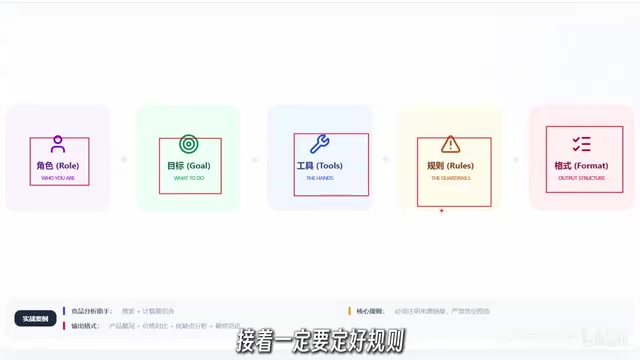
Once you've listed these five items, the Agent's skeleton is in place and everything that follows will go much more smoothly.
The 5-Step Implementation Method: From Planning to Tuning
With the skeleton ready, here's how to bring it to life in five clear steps.
Step 1: Distill Your Core Need Into One Sentence
This sentence must be specific. Don't write vague things like "help me get stuff done" — an LLM will be completely lost. Instead, write something precise: "Research competitor data in a specific product category and produce a report with price comparisons and risk analysis."
Step 2: Let AI Help You Flesh Out the Plan
You don't need to build everything from scratch yourself. Feed that sentence to an LLM, tell it the role, goal, tools, and rules, and ask it to produce three things: a complete system prompt, a tool inventory, and ten test cases for acceptance testing. What started as a rough idea in your head becomes an executable delivery checklist.
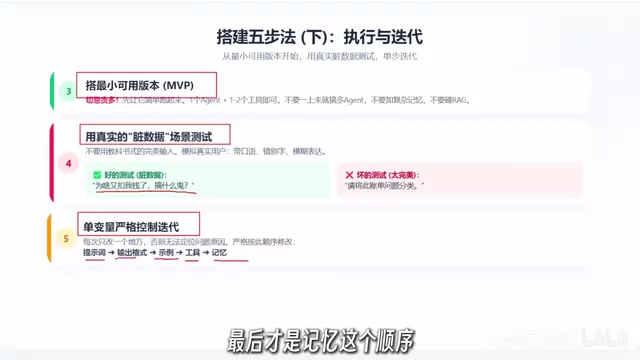
Step 3: Start With the Minimum Viable Version
Don't be greedy. Start with a single Agent and just one or two of the most essential tools. Skip multi-Agent coordination for now, and stay away from complex memory systems and vector databases. Get the full loop working in the shortest possible time.
Step 4: Test With Real "Dirty Data"
Absolutely do not use perfect, textbook-style inputs. Many people test with prompts like "Please categorize this billing information," but real users don't talk like that. Real users send things like "why did you charge me again wtf," complete with typos, slang, and frustration. Testing with this kind of messy input is what actually validates your Agent's capabilities.
Step 5: Strictly Follow Single-Variable Control
If results aren't satisfactory, change only one thing at a time, working through this order: prompt → output format → few-shot examples → tool descriptions → memory. If you change multiple things at once, even if things improve, you'll never know which change actually made the difference.
Don't Agonize Over Framework Selection: Just Pick One That Feels Natural
Many people spend a long time agonizing over which framework to use — but there's really no need. Regardless of the ecosystem, the core mechanism is the same: assign tools to tasks, then run the loop.
The two main options each have their strengths. The Anthropic ecosystem leans toward lower-level, technically-oriented use cases. If you regularly need LLMs to operate local files, run terminal commands, or automate programming tasks via the increasingly popular MCP protocol, writing in this ecosystem feels very natural. OpenAI's Agent SDK takes a cleaner, more engineering-friendly approach, with a particularly smooth native hand-off mechanism between Agents and built-in safety guardrails — making it more reliable when moving from prototype to production.
Don't overthink it. Pick the one that fits your existing stack and start writing. Taking action is always more valuable than standing still comparing options.
MCP (Model Context Protocol) is an open protocol Anthropic released in late 2024, aimed at providing LLMs with a standardized "tool-calling interface." In traditional setups, integrating each external tool requires developers to define their own call format. MCP attempts to unify this — tool developers write an "MCP Server" once, and any LLM client supporting the protocol can call it directly. Think of it as the USB standard for AI tool integration: devices (tools) and hosts (models) no longer need custom adapters for each other. Claude, some IDE plugins (like Cursor), and various automation tools already natively support MCP, making it a protocol worth paying attention to when building Agents in the Anthropic ecosystem.
Tool and Memory Design: Where Success Is Really Decided
The details that truly determine how useful an Agent is come down to tool and memory design.
The core principle of tool design is: fewer, sharper tools. Each tool should do exactly one thing. Don't take shortcuts by creating a bloated "universal file management tool" stuffed with seven or eight parameters — the LLM will easily miscall it. Instead, break it into read-file, write-file, and delete-file, each with a clear responsibility. Usage conditions also need to be spelled out clearly. Don't just write "calculator" — write "use this when precise mathematical calculation is required; the LLM must not guess the answer on its own." Good tools make an Agent smarter, and fewer tools actually make the whole pipeline more stable.
The memory module is the easiest place to over-engineer. In most real-world scenarios, tasks don't need any additional memory configuration at all. Short-term memory through the built-in conversation context history is sufficient. Long-term memory via RAG should only be considered when you genuinely need to retrieve content from large volumes of documents or PDFs. A useful rule of thumb: if a task runs fine without extra memory, don't add complexity.
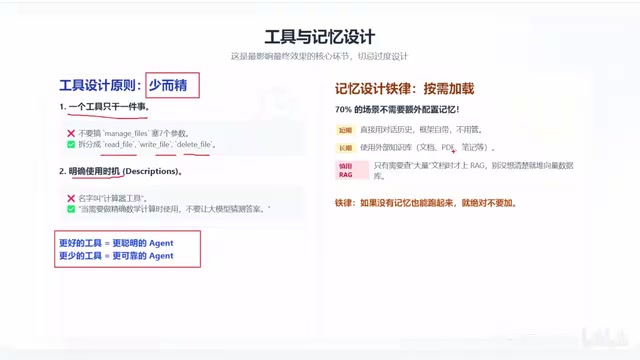
RAG (Retrieval-Augmented Generation) is the most common implementation of long-term memory modules. The basic idea: break large volumes of documents into small chunks, convert each chunk into a numerical vector using an embedding model, and store them in a vector database (such as Chroma, Pinecone, or Qdrant). When the Agent needs to query, the user's question is also converted to a vector, and the semantically closest chunks are retrieved from the database and fed into the prompt for the LLM to answer. RAG solves the core problem of "context window overflow" — when you need an Agent to process hundreds of PDFs or tens of thousands of records, feeding everything in at once exceeds context limits and wastes compute. RAG lets the model fetch only the "most relevant right now" passages. That's why this article recommends introducing RAG only when you genuinely need to retrieve from massive document collections — for everyday conversation, native context history is more than sufficient.
Five Advanced Workflow Patterns and When to Use Multi-Agent Systems
Once your single Agent is running smoothly, it's worth understanding the five common advanced workflow patterns in the field. In practice, most business tasks can be solved entirely with the first two.
- Sequential Processing: Like an assembly line — A finishes and hands off to B, B finishes and hands off to C. Ideal for tasks with fixed steps and clear ordering.
- Routing and Dispatch: Like a reception desk — classify the input first, then route it precisely to the right specialist.
- Parallel Processing: Several tasks run simultaneously, then results are aggregated for comprehensive evaluation — useful for multi-dimensional background checks, for example.
- Hub-and-Spoke Orchestration: The LLM acts as a central commander, dynamically dispatching based on real-time conditions. Only suitable for complex tasks where fixed steps can't be planned in advance.
- Generation and Review: One Agent writes the draft, another reviews it, and anything subpar gets sent back for revision. Ideal for scenarios with very high quality requirements for code or copy.
Never start by aiming for fully autonomous dynamic orchestration. When a simple, fixed pipeline can solve the problem, resist the urge to hand full control over to the LLM.
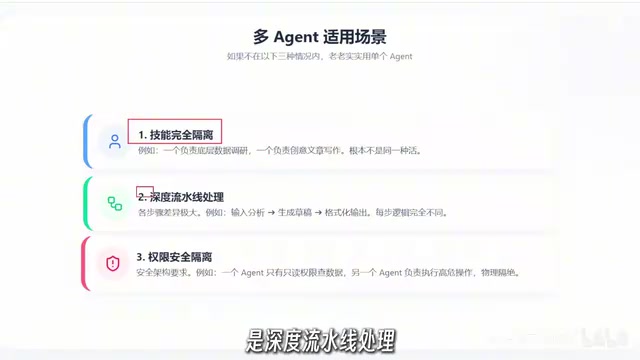
As for when you actually need multiple Agents — only in these three situations: complete skill isolation (e.g., data mining and copywriting are fundamentally different disciplines; cramming them together causes prompt conflicts), deep pipeline processing (each stage has significantly different inputs and outputs, so separating them improves clarity and debugging), and permission and security isolation (one Agent has read-only database access, another has high-privilege write/execute access — physically separating them prevents accidental misuse). If none of these three apply, stick with a single Agent — it's far easier to maintain and the pipeline is more stable.
Three Core Principles: Review Before You Act
Finally, distill the entire construction philosophy into three principles. Run through these before you start to avoid the most common pitfalls.
First, write the underlying logic from scratch before anything else. Don't import complex frameworks right away. Manually write the "request → call tool → return result" loop yourself in a few dozen lines of basic code. You'll come away with a much more solid foundational understanding.
Second, always start with the simplest pattern. The vast majority of requirements can be handled beautifully with basic sequential processing and routing.
Third, invest your effort heavily in tool design and test cases. Spending time writing clear tool responsibilities and descriptions will take you further than constantly switching models or frameworks. Having twenty dirty-data test cases that reflect real-world typos and casual speech will tell you more about system stability than manually testing a hundred times.
At the end of the day, Agents aren't mysterious. They're just a way of turning the tedious thinking and legwork we do every day into an automated loop. Pick one small thing from your work that you'd most like to automate, fill in the universal formula, and just run it.
Related articles

Random Pruning of the DPO Computation Graph: 1.4x Training Speedup and Lower Peak Memory
DPO training too slow and memory-hungry? This paper proposes a random pruning framework for the DPO computation graph, sampling independently across position, sequence, and branch dimensions; branch pruning achieves a 1.426x step-time speedup and cuts training time by about 30%, with in-depth attribution of memory and time gains.

Why Does JEPA Underperform MLM in Longitudinal EHR Representation Learning?
New study compares JEPA and MLM for longitudinal EHR representation learning on MIMIC-IV: three JEPA variants train stably without collapse but underperform MLM; target size, not heterogeneity, drives prediction error.

Transfer Learning + Visible Light Communication: A New Approach to Energy-Efficient Indoor Positioning
A study proposes a transfer learning-based visible light communication indoor positioning method, achieving 47% accuracy improvement on the BOSCH factory dataset, 67.5% model efficiency under high noise, and introducing the ME composite metric for energy-efficient positioning in energy-constrained industrial IoT scenarios.