AI Agent from Theory to Production: A Dual-Track Practical Guide for Low-Code and Code Frameworks

Give LLMs arms and legs: a dual-track guide to deploying AI Agents in real enterprise workflows.
Large models are brilliant brains with no hands or feet — capable of generating content but unable to close the loop on real work. This course teaches you to build AI Agents using a dual-track methodology: low-code platforms (Coze/Dify/n8n) for rapid validation, and code frameworks (LangChain/LangGraph/CrewAI) for deep customization. It uses the MCP protocol to bridge enterprise data silos, grounds every technique in nine core job-role scenarios (marketing, finance, R&D, PR, and more), and wraps up with four production-ready capstone projects — building the "business AI-fication" mindset that turns AI into real productivity.
Why Large Language Models Haven't Actually Lightened Your Workload
ChatGPT and DeepSeekAd are everywhere, yet most people return to the office and find their workload unchanged — still copy-pasting AI-generated content, still spending time cleaning up outputs before they're usable. This Bilibili AI Agent course cuts straight to the heart of the problem: a large language model is essentially a brilliant brain with no arms or legs.
It can write copy and analyze data, but it can't close the loop on actual work. It won't automatically format your WeChat Official Account posts, query orders in your CRM, or proactively chase follow-ups in DingTalk. What AI Agent sets out to do is give that brain a body — transforming it from a question-answering machine into a digital employee that can invoke tools, execute workflows, and actually get things done.
This framing is the central logic of the entire course: the value of learning Agent development isn't in memorizing a list of tool names — it's in mastering the underlying logic of "business AI-fication."
The concept of AI Agent can be traced back to the viral explosion of AutoGPT in 2023, which first demonstrated to a broad audience the possibility of having an LLM autonomously decompose tasks and iteratively call tools to accomplish complex goals. An Agent's core architecture typically consists of four modules: Perception (receiving user input or external events), Planning (the LLM breaks down goals and sequences actions), Tool Invocation (executing concrete operations like search, file read/write, or API calls), and Memory (managing short-term context and long-term knowledge bases). Unlike simple question-answering LLMs, the defining characteristic of an Agent is "closed-loop execution": it dynamically adjusts its next action based on tool outputs rather than generating a one-shot response. It is precisely this Perception → Planning → Execution → Feedback loop that gives Agents the capacity to handle real business tasks spanning multiple systems and steps.
The Dual-Track Approach: Low-Code and Code Frameworks in Parallel
The most instructive design principle of this course is its dual-track approach running low-code and code frameworks in parallel — a methodology refined through years of the author's hands-on enterprise experience.
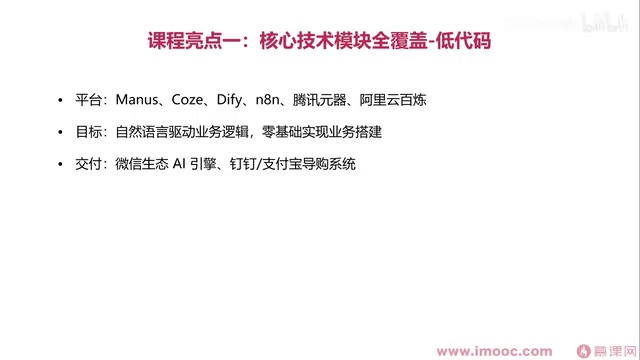
Low-Code: Rapid Validation and Efficiency Gains
If your goal is to quickly validate ideas or boost day-to-day productivity, platforms like Coze, Dify, and n8n are the right starting point. They work like LEGO bricks — using prompt engineering and drag-and-drop nodes, you can spin up an automated short-video production pipeline for a business unit within a week. The course covers a broad range of platforms, including Manus, Coze, Dify, n8n, Tencent Yuanqi, and Alibaba Cloud Bailian.
The core advantage of this track is its low barrier to entry — even without a technical background, anyone who can clearly articulate requirements in natural language can build functional business workflows.
Code Frameworks: Deep Customization for Complex Scenarios
But when an enterprise needs to handle core business processes, highly confidential data, or intricate approval workflows — such as cross-department data integration, sensitive customer data handling, or multi-agent collaborative customer service — code development becomes the only viable option. It breaks through the limitations of low-code platforms and enables complete customization.
This is where you need to go deep with frameworks like LangChain, LangGraph, LlamaIndex, AutoGen, CrewAI, and MetaGPT, mastering inter-agent communication, state management, and enterprise knowledge base construction.
In a nutshell: Low-code handles rapid validation and efficiency gains; code frameworks handle deep customization and high-value complex problems.
LangGraph is a state-machine orchestration framework released by the LangChain team, designed specifically for complex Agent scenarios requiring multi-step, multi-branch decision-making. Unlike traditional linear Chains, LangGraph models an Agent's execution as a directed graph: each node represents a processing step, edges represent conditional transition logic, and the framework handles passing and persisting "State" between nodes. This allows an Agent to pause, backtrack, branch in parallel, or even resume after a human review — making it a natural fit for enterprise approval flows and multi-turn interaction scenarios. CrewAI focuses on multi-agent collaboration, organizing agents with different responsibilities into "role-based teams" that simulate real team dynamics through task division and result handoffs. AutoGen (from Microsoft) and MetaGPT are also multi-agent frameworks, each with distinct strengths. Understanding the core differences between these frameworks helps you select the right tool for a given project rather than blindly stacking them.
MCP Protocol: Breaking Down Enterprise Data Silos
The course dedicates special attention to the value of the MCP protocol — a technical point well worth noting.
The real-world problem is that most companies' data is locked inside on-premises databases and internal APIs that AI simply cannot access. Mastering the MCP protocol is like obtaining a master key — it enables Agents to securely read local files and call internal interfaces, completely bridging the information silos within an enterprise.
For anyone looking to deploy Agents in a real enterprise environment, connecting to internal data sources is nearly unavoidable, and MCP is precisely designed to solve this pain point.
MCP (Model Context Protocol) is an open standard released by Anthropic in late 2024 to address the connectivity problem between large models and external data sources and tools. Before MCP, every Agent framework that needed to integrate with a new external system (such as a database, file system, or internal API) had to build a custom adapter layer from scratch — an extremely high maintenance burden. MCP standardizes this connectivity: it defines a unified "server-client" communication spec so that any MCP-compatible Agent framework can call any data source that has implemented an MCP Server, with no redundant development required. From an enterprise deployment perspective, MCP's significance lies in allowing Agents to access local files, private databases, and intranet interfaces under controlled permissions — without uploading sensitive data to the cloud — striking a balance between capability expansion and data security. Major AI products including Claude and Cursor have already adopted MCP, and the ecosystem is rapidly taking shape.
Technology Grounded in Business: Nine Core Intelligent Job Roles
The biggest differentiator of this course is that it doesn't stop at "how to write code" — it grounds every case study in nine core intelligent job roles that operate within real enterprises.
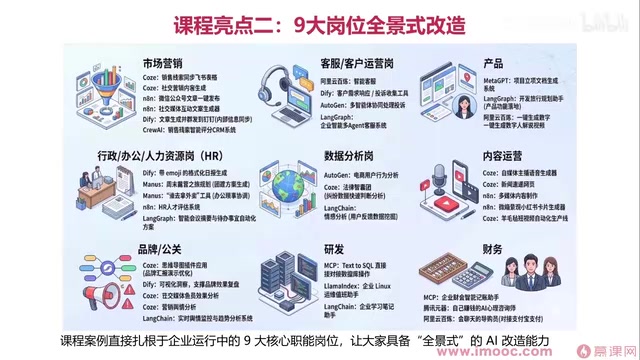
The author makes a sharp observation: once you're on the job, you'll find that the hardest part isn't writing code — it's not knowing where the business pain points and pitfalls are. The course therefore follows the principle of "go where it hurts," mapping technology to concrete scenarios:
- Marketing: Automatic lead syncing and deduplication, so high-value prospects no longer slip through the cracks
- Finance: Intelligent bookkeeping assistant that compresses account processing from hours down to seconds
- R&D: Text to SQL — letting Agents query databases directly using natural language
- PR & Operations: Real-time public sentiment monitoring that automatically triggers alerts and pushes response plans the moment an issue flares up
- And more: HR resume screening, multi-turn customer complaint handling, product manager data analysis, content operations automation
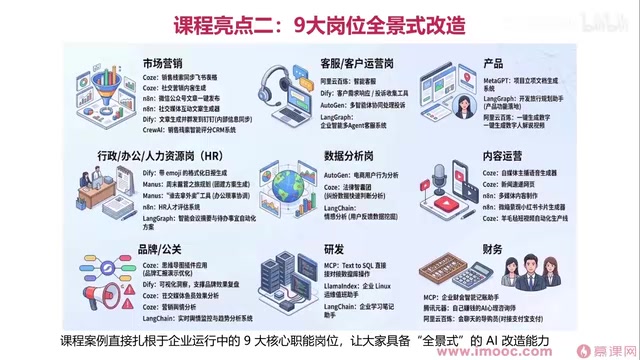
This approach of training a "business AI eye" delivers far more long-term value than simply piling up tool knowledge. Once developed, you can walk into any organization, quickly identify which repetitive tasks are wasting time, and deploy an Agent to solve them.
Four Enterprise-Grade Capstone Projects
The course ties together scattered techniques into complete systems through four comprehensive projects, with the goal of delivering solutions ready for direct deployment — not just isolated code snippets.
Project 1: CrewAI-Based Intelligent Sales Lead Scoring CRM System. Simulates a complete sales team: one Agent scours the web for intelligence, while another applies business logic to score leads accurately. The key challenge is transforming unstructured customer lead data into quantifiable scores through a rigorous evaluation framework.
Project 2: LangGraph-Based Enterprise Intelligent Meeting Summary and Action Item Tracking System. This is a real-world implementation of LangGraph's state machine — the hottest architecture at major tech companies right now. The goal isn't to "summarize a paragraph" but to "get something done": from ingesting meeting recordings and automatically identifying owners, to dispatching tasks via email and to-do systems for genuine business closure. Along the way, you master Agent memory and state management under complex logic.
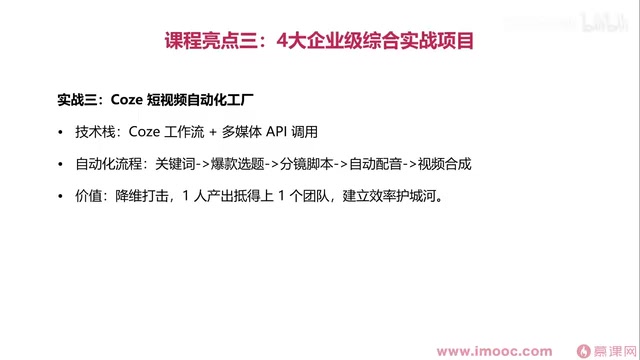
Project 3: Coze-Based Automated Short-Video Production Pipeline for Content Creators. Input a single keyword and the system handles everything — topic selection, shot-by-shot scripting, automatic voiceover, and video synthesis — making one person's output equivalent to an entire team's.
Project 4: n8n-Based Global Industry News Intelligence Gathering System. Leverages n8n's connectivity to build an intelligence system with genuine reasoning capabilities. It autonomously navigates global news sources, structures content, distills key insights, and distributes them with precision — turning you into a "Chief Intelligence Officer" rather than running a rigid crawler.
Closing Thoughts: What's Scarce Isn't People Who Can Chat with AI
The core message this course delivers is worth every working professional's consideration: the workplace doesn't lack people who know how to chat with AI — what's scarce are people who can turn AI into a genuine productivity tool.
From a technical standpoint, the dual-track methodology of "low-code for agile deployment + code frameworks for deep customization," combined with MCP for data connectivity, nine job-role scenario breakdowns, and four capstone projects, forms a relatively complete Agent learning path. Its true value lies not in the tool checklist, but in the architectural thinking and design logic underneath — learning to wield Agents like a scalpel to precisely cut into a business's pain points is the core competitive edge that transforms you into someone enterprises genuinely cannot do without.
Related articles

How Big Can Stars Really Get? The Physical Limits of the Largest Stars
Red supergiants are the largest stars by volume, with radii up to 2,000 times the Sun, engulfing the inner solar system. But there is no precise upper limit on stellar size—models predict up to 15,000 solar radii. The most massive blue stars are far smaller than red supergiants—biggest and heaviest are two different things.

Apple HomeView Smart Display Full Feature Breakdown: Wall-Mount or Desktop, $299
Apple launches HomeView, a $299 smart display with wall-mount and desktop options, 12MP camera for facial recognition, smart home control, music playback, and recipe step-by-step cooking. Full breakdown of watch faces, apps, privacy, and cooking integration.

Where Did the Promised New Studio Go? Craft Computing Answers After Five Years
Craft Computing's host responds to viewer questions: the new studio promised five years ago was shelved as construction costs soared from $30,000 to $75,000, and was replaced by a 168-square-foot garage conversion.