AI Agent Full实战 Workflow: From Environment Setup to LangChain Development

A systematic intro to AI Agents, from environment setup to LangChain practice and framework selection
The article outlines the design logic and content structure of a hands-on AI Agent course on YouTube. The course follows a progressive path of environment setup → Python basics → Agent concepts → LLM principles → LangChain practice → framework comparison, targeting beginners and developers building real applications. The core hands-on work focuses on tool calling and the ReAct reasoning framework in LangChain. The framework section compares LangChain, LangGraph, CrewAI, AutoGen, LlamaIndex, Langflow, Agno, and n8n, distinguishing code-first, low-code, and no-code paradigms. The article also notes caveats such as broad coverage with limited depth per topic and the fast iteration of the LangChain ecosystem.
AI Agents are moving from concept to real-world deployment, but most learners get stuck at the same point: they don't know where to start, or which tools to use at each step. A hands-on course on YouTube offers a complete path—from environment configuration and Python fundamentals, to LLM principles and LangChain development, all the way to a side-by-side comparison of mainstream frameworks. It covers the full chain from beginner to production.
Course Design Philosophy: Lay the Foundation First, Then Build
According to the course introduction, the overall structure follows a progressive logic of "environment → language → concepts → frameworks → hands-on practice." The author, Mala, explicitly states that the course targets two groups: beginners who want to understand AI Agents from scratch, and developers who want to build real applications with mainstream frameworks.
One trade-off worth noting in this design: the course doesn't jump straight into Agents. Instead, it spends considerable time on the development environment and Python fundamentals. Experienced developers can skip this part quickly, but for career changers or learners without a computer science background, this is the key step that reduces the dropout rate.
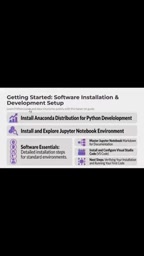
The environment section covers Anaconda installation, Jupyter Notebook usage, Markdown documentation writing, and VS Code and Google Colab configuration. This toolset is the current mainstream configuration for data science and AI development, and after completing it, learners can transition seamlessly into real projects.
Python Fundamentals: Just Enough, No Need for Everything
The course treats Python as a "review + fill in the gaps" process rather than systematic teaching. Topics include variables, data types, package management, control flow, loops, functions, and core data structures such as lists, tuples, strings, sets, and dictionaries.
This "just enough" strategy makes sense in a hands-on course. The Python knowledge needed for AI Agent development is relatively concentrated and doesn't require covering advanced features like decorators or metaclasses. Leaving limited time for Agent architecture and framework practice offers a better return on investment.
The Essence of AI Agents: The Boundary Between Capability and Hype
Once into the main topic, the course first answers a fundamental question: what exactly is an AI Agent? The author mentions helping learners distinguish "real capabilities" from "hype," and dives into Agent architecture and levels of autonomy.
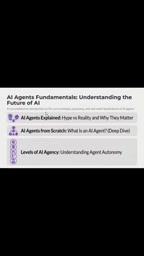
Levels of autonomy are a key framework for understanding Agents. From simple rule-based responses, to assistive systems that can call tools, to intelligent agents that can autonomously plan, execute, and reflect—different levels correspond to different technical complexity and application scenarios. The value of the course here lies in building judgment—knowing which requirements are suitable for Agents and which are adequately served by traditional automation.
Levels of autonomy are typically divided by the degree to which humans need to intervene in the Agent's decision chain: L0 is pure rule-based response with no learning or planning; L1 is tool-augmented, where the model can call external APIs but humans specify when to call them; L2 is supervised autonomous execution, where the Agent can plan multi-step tasks on its own but requires human confirmation at key points; L3 and above allow the Agent to autonomously loop through reasoning, execution, and reflection after a goal is set, reporting only on exceptions. The higher the level, the greater the demands on model reasoning capability, tool reliability, observability, and safety guardrails. In practice, most production systems remain at L1-L2, because higher autonomy amplifies error accumulation and uncontrollable risk.
LLMs: How the Agent's "Brain" Works
An Agent's reasoning capability comes from large language models. The course explains the definition of LLMs, what "large" means, their evolution, the significance of parameter count, and how models are trained on massive data to become systems with reasoning capabilities.
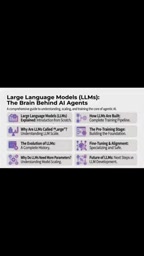
Understanding the significance of parameter count directly relates to model selection: models with more parameters have stronger reasoning but higher cost, while smaller models suit specific tasks and local deployment. This knowledge is used repeatedly when building Agents later—for example, deciding which model to use for planning and which for execution.
Parameter count refers to the number of trainable weights inside a model, usually measured in billions (B). Parameter count determines the model's capacity ceiling—more parameters mean the model can memorize more world knowledge and capture more complex language patterns, but inference cost, GPU memory usage, and latency also rise. Note that parameter count is not the only factor determining performance: training data quality, training strategies (such as instruction fine-tuning, RLHF), and context length at inference time are equally critical. A common layered strategy in current practice is to use larger models for planning and complex reasoning, and smaller models (or distilled models) for execution subtasks such as format conversion and information extraction, striking a balance between quality and cost.
LangChain in Practice: Teaching Agents to Reason and Act
The core hands-on segment of the course is building AI Agents with LangChain. Specifically: creating your first Agent, understanding how tool calling lets Agents interact with external systems, learning the ReAct reasoning framework, and building intelligent agents that can reason, plan, and act step by step.
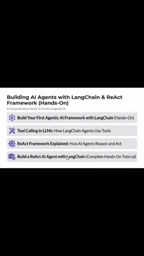
The ReAct framework is the technical centerpiece of this course. It combines Reasoning and Acting, letting the model first think about what to do next, then call a tool to execute, and then continue reasoning based on the result. This is the underlying paradigm of most current Agent systems, and once mastered, migrating to other frameworks isn't difficult.
ReAct (Reasoning + Acting) was proposed by Shunyu Yao et al. in 2022. Its core is to explicitly write the model's thinking process as a "Thought → Action → Observation" loop: the model first outputs reasoning explaining its current intent, then selects a tool and parameters (Action), and after the system executes it, the result is fed back into the context as an Observation, based on which the model continues to the next round of reasoning. Compared with having the model give a final answer all at once, ReAct's advantage is incorporating external feedback into the reasoning chain, significantly reducing hallucinations and supporting multi-step tasks. The cost is that each loop adds a model call, and latency and token consumption grow linearly with the number of steps, so real systems usually set a maximum iteration count and early termination conditions.
Framework Landscape: Code-First vs Low-Code vs No-Code
Before diving into specific tools, the course includes a tour of the AI Agent ecosystem, comparing mainstream platforms such as LangChain, LangGraph, CrewAI, AutoGen, LlamaIndex, Langflow, Agno, and n8n, and discussing where code-first, low-code, and no-code development paradigms each fit.
The practical value of this comparison is helping learners build a selection logic: LangGraph suits complex workflows that require fine-grained control over state transitions, CrewAI excels at multi-role collaboration scenarios, and n8n lowers the barrier for non-developers. The #n8n and #crypto tags in the original title also suggest the course may touch on automation workflows and crypto-domain application scenarios, though the available material has limited detail on this part.
LangGraph is a graph-structured orchestration framework launched by the LangChain team. It models Agent workflows as nodes (processing steps) and edges (state transitions), supporting loops, conditional branching, pause and resume (human-in-the-loop), and persistent checkpoints. Compared with LangChain's more linear Chain abstraction, LangGraph is better suited to production scenarios that require fine-grained control over state transitions, multi-Agent collaboration, or long-running tasks. CrewAI adopts abstractions of role, task, and crew, letting multiple Agents with different personas and tools collaborate according to a workflow. Its learning curve is gentler and it's suitable for quickly building multi-role workflows, but it's less flexible than LangGraph in low-level state control.
Who It's For, and a Few Caveats
This course suits beginners and intermediate developers who want a systematic introduction to AI Agent development, especially learners who prefer a "learn by doing" style. A few caveats: the course covers a wide range, so depth in any single segment may be limited; the LangChain ecosystem iterates quickly, so some API usage may need to be updated against official documentation; and the framework comparison is more of a selection reference—true mastery still requires hands-on practice.
For developers with existing programming backgrounds, it's recommended to jump directly into the Agent architecture and LangChain practice sections, treating environment setup and Python review as reference material.
One-line Summary
A systematic introduction to AI Agents, from environment setup to LangChain practice and framework selection
Paragraph Summary
The article outlines the design logic and content structure of a hands-on AI Agent course on YouTube. The course follows a progressive path of "environment setup → Python fundamentals → Agent concepts → LLM principles → LangChain practice → framework comparison," targeting beginners with no background and developers who want to build real applications. The core hands-on work focuses on tool calling and the ReAct reasoning framework in LangChain, the technical paradigm that enables Agents to reason, plan, and act. The framework section compares LangChain, LangGraph, CrewAI, AutoGen, LlamaIndex, Langflow, Agno, and n8n side by side, and distinguishes the applicable scenarios of code-first, low-code, and no-code paradigms. The article also notes caveats such as the course's broad coverage but limited depth per topic, and the fast iteration of the LangChain ecosystem.
Related articles

Chain of Thought Isn't Just for AI: How Humans Can Use CoT to Improve Thinking Quality
Chain of Thought isn't just a prompt trick for large models. Starting from a Hacker News discussion, this article analyzes why CoT works for human thinking too, breaks down actionable ways to transfer it, and highlights the key differences between human CoT and machine CoT.
Cloudflare Teams Up with OpenAI: Closi…
Cloudflare Teams Up with OpenAI: Closing the Loop from Vulnerability Discovery to Defense with AI
Cloudflare uses OpenAI Daybreak to investigate security vulnerabilities and generate reviewable remediation plans, while developers use Codex to boost coding efficiency and quality.

Orca Multi-Agent Orchestration in Practice: A Guide to Parallel Collaboration with Claude and Codex
Orca is Stable AI's free open-source agent workbench supporting 34 agents like Claude Code and Codex in parallel. Learn its Git worktree isolation, multi-model orchestration, and mobile management.