AI Agent Fundamentals: From Traditional Programs to the Perception-Decision-Action Loop
A beginner's guide to AI Agents: perception, decision, action, and the tech stack behind them.
This article starts from the limitations of traditional "fixed input, fixed output" programs to explain what an AI Agent truly is: an intelligent system capable of dynamically perceiving ambiguous requests, reasoning autonomously, and taking action. It breaks down the agent's core capabilities into three layers — perception engine, decision brain, and executor — then traces the evolution from rule-based Generation 1 systems through NLP-powered Generation 2 to today's LLM + tool calling + memory Generation 3. It also covers RAG as a key component of the modern stack, with practical scenarios including customer service, data analysis, and personal productivity.
What Is an Agent: From "Artificial Stupidity" to Genuine Intelligence
As artificial intelligence technology advances, we're surrounded by more and more "smart" products — intelligent chatbots, self-driving cars, smart healthcare systems, and so on. But user experiences with these products tend to be polarized: some are impressive enough to make you think "now that's AI," while others are so frustrating they get mocked as "artificial stupidity."
How useful a product actually is comes down to the technology powering it. Products built on older techniques — some years or even decades old — are unlikely to impress. Products built on cutting-edge approaches developed in recent years deliver a noticeably better experience. The AI Agent is one of the core technologies that has made products genuinely "smarter" in recent years.
This article helps readers with no prior background understand four key questions: the fundamental difference between traditional programs and agents, the core capability loop of an agent, the modern agent technology stack, and typical application scenarios and directions of technical evolution.
Traditional Programs vs. Agents: Fixed Outputs vs. Dynamic Thinking
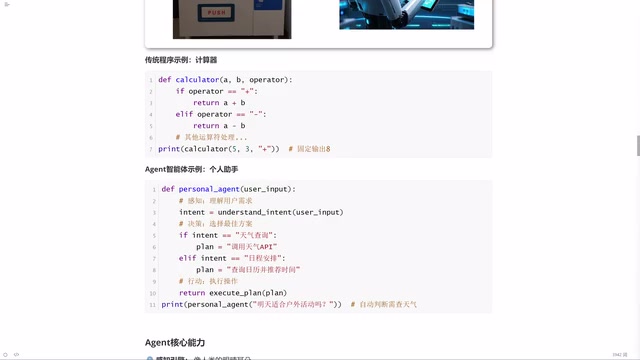
Traditional programs share one defining characteristic: give them a fixed instruction, get a fixed result. Think of a vending machine — you pick a cola, insert your money, and out comes the cola. Nothing changes, because all the logic is pre-programmed.
Take a calculator program as an example: pass in parameters A and B along with an operator, and the program computes the result. The output is exactly what you'd expect, because the program only ever executes hard-coded logic.
An agent, by contrast, is more like an assistant who can actually think. The instructions you give it can be vague or ambiguous, and it can figure out what you actually want. Say you tell it "I want to travel somewhere on May 1st" — it will automatically factor in your current city and travel conditions, then recommend suitable destinations.
At the code level, an agent function only needs to receive a "request." It first interprets the user's intent, then decides how to respond. The key difference: the input isn't a fixed field. It might be "what's the weather like today," "is it a good day to go out the day after tomorrow," or any number of other phrasings — and the agent recognizes that all of these point to "weather inquiry," then calls the appropriate tool to return a result. This dynamic responsiveness is what fundamentally sets agents apart from traditional programs.
The Three Core Capabilities of an Agent: Perception, Decision, Action
An agent's core capabilities can be summarized as a closed loop — perceive, decide, act — corresponding to the human senses, brain, and limbs.
The Perception Engine works like human eyes and ears, interpreting inputs from the outside world. When you say "book me a cheap hotel," it extracts three elements: action (book), object (hotel), and condition (low price). Critically, the perception engine isn't limited to text — it also handles voice, images, and other input types. This is what's meant by multimodal input: the ability to process multiple types of content.
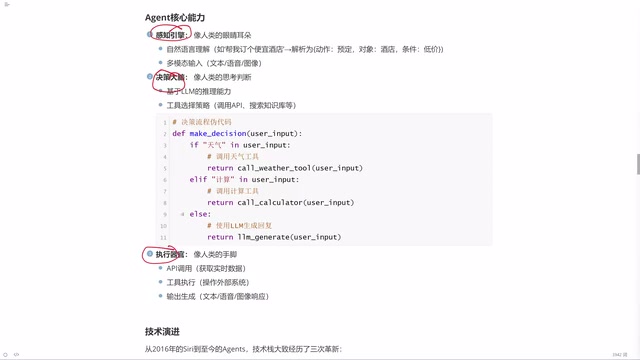
The Decision Brain functions like human judgment, powered by the reasoning capabilities of a Large Language Model (LLM). Popular models today — GPT, DeepSeek, Qwen, and others — all fall into this category. After the user's input arrives, the agent relies on the LLM to determine how to respond and which functions to invoke to handle the result.
The Executor corresponds to human hands and feet. Once the decision layer determines what needs to be returned, the execution layer gets to work — calling functions, APIs, or even hardware devices. Together, these three components form the agent's complete loop: perceive the need → decide what to do → execute and output.
Technical Evolution: From Fixed Templates to LLMs + Memory Systems
From early systems like Siri and Xiao Ai to today's agents, the technology has gone through roughly three generations of evolution.
Generation 1 was built on rule engines and fixed templates. Ask Siri "what time is it?" and it could answer — but rephrase the question or ask it to change the time in a different way, and it would simply reply "I don't understand your command." Many smart speakers on the market today are still stuck at this generation, recognizing only pre-defined commands.
Generation 2 introduced NLP models with intent recognition, enabling a basic understanding of user needs — even with varied phrasing. But it lacked a memory system. Ask "what's the weather like today?" and then follow up with "is today a good day to go out?" and it couldn't connect the two turns of conversation — each query was treated as a brand-new session.
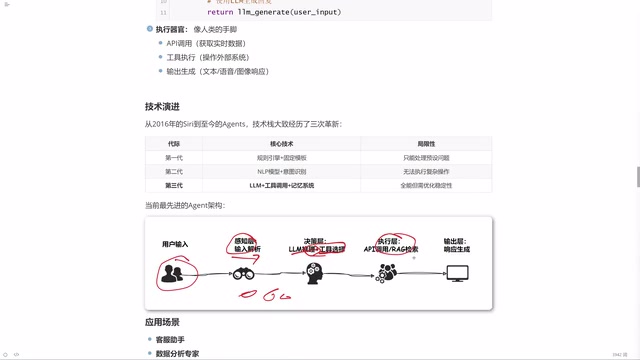
Generation 3 combines large language models, tool calling, and memory systems — the current mainstream approach. No matter how vague or tricky the question, the LLM can analyze the true intent behind it, then call the appropriate tools (not just custom-written code, but potentially databases, cameras, or other external resources). And because of the memory system, it can carry context from step one into step two, making interactions far more coherent and complete.
NLP (Natural Language Processing) is the core technology of Generation 2 systems — it refers to methods that enable computers to understand and process human language. Intent recognition is a key subtask: the system uses statistical models or neural networks to map various user expressions (e.g., "check the weather," "is it hot today," "should I bring an umbrella") to predefined intent categories (e.g., "weather inquiry"). Compared to rule engines, NLP intent recognition handles synonymous expressions more robustly. However, it still depends on large amounts of manually labeled training data, and every new intent category requires collecting new samples and retraining — making it costly to scale. This is why Generation 2 systems still struggle with open-domain, complex questions: their "understanding" is fundamentally classification, not genuine semantic reasoning.
The Modern Agent Technology Stack and Workflow
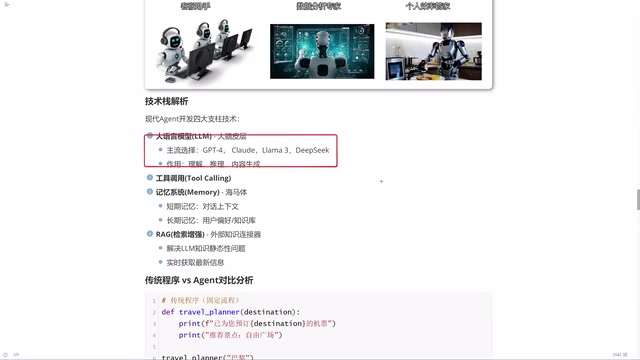
Building an agent requires understanding several key technologies:
- Large Language Model (LLM): The equivalent of the cerebral cortex — responsible for understanding, reasoning, and content generation. Examples include GPT-4, Claude, and DeepSeek.
- Tool Calling: Once the LLM determines what needs to be done, it fulfills the task by calling tools, without needing to write new code from scratch.
- Memory System: The equivalent of the hippocampus, divided into short-term and long-term memory, allowing the agent to remember previous interactions.
- Retrieval-Augmented Generation (RAG): Optional but recommended. Since LLMs are trained on historical data, their knowledge has a cutoff date. RAG supplements the model with up-to-date information to address this limitation.
The complete workflow looks like this: user submits a request → agent perceives and extracts key information → LLM reasons and determines which tools to call → execution layer calls APIs or queries the RAG database → result is generated and returned. The entire process shifts from a static "fixed pipeline" to a dynamic "on-demand response."
RAG (Retrieval-Augmented Generation) is worth explaining in more detail. An LLM's knowledge comes from its training data, meaning it has a "knowledge cutoff date" — it knows nothing about events after training, and cannot access an organization's private internal documents. RAG addresses this by retrieving the most relevant text passages from an external database (real-time news feeds, enterprise knowledge bases, product manuals, etc.) before the model generates a response, then passing those passages along with the user's question into the model. This lets the model generate answers grounded in the most current and accurate context. RAG preserves the LLM's language understanding and generation strengths while compensating for its outdated knowledge and lack of access to private domain information — making it one of the most widely used technology combinations for deploying agents in enterprise settings.
Typical Application Scenarios
Agents have a broad range of real-world applications:
Customer Service Assistants are the most common. Early chatbots gave robotic, formulaic responses. Platforms powered by high-quality agents respond in a way that feels far more natural — almost like talking to a real person.
Data Analysis Experts can automatically analyze data, surface common analytical insights without being explicitly prompted, and also support customized analysis based on specific requirements.
Personal Productivity Managers are closer to everyday life. Tell the agent "remind me to submit my report at 9 AM tomorrow and suggest a commute route" — it will break this down into two tasks: creating a calendar event and querying real-time traffic conditions, then execute both.
Summary
Returning to the learning goals we started with: traditional programs operate on "fixed input, fixed output," while agents work on "dynamic perception, dynamic decision-making, dynamic action" — and their inputs are not fixed. The core loop is perceive, decide, act; the technology stack includes large language models, tool calling, memory systems, and retrieval-augmented generation. A solid grasp of these foundational concepts is what prepares you to actually start building agents yourself.
Related articles
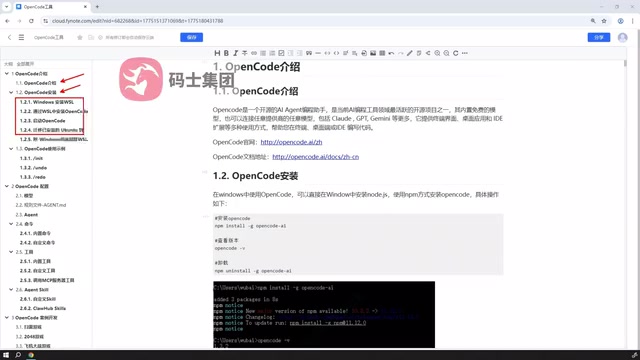
OpenCode Complete Guide: Installation, Configuration & Practical Usage
A complete guide to OpenCode, an open-source AI coding tool: desktop and WSL installation, model and rule configuration, agent types, custom commands, MCP integration, and Agent SQL reuse.
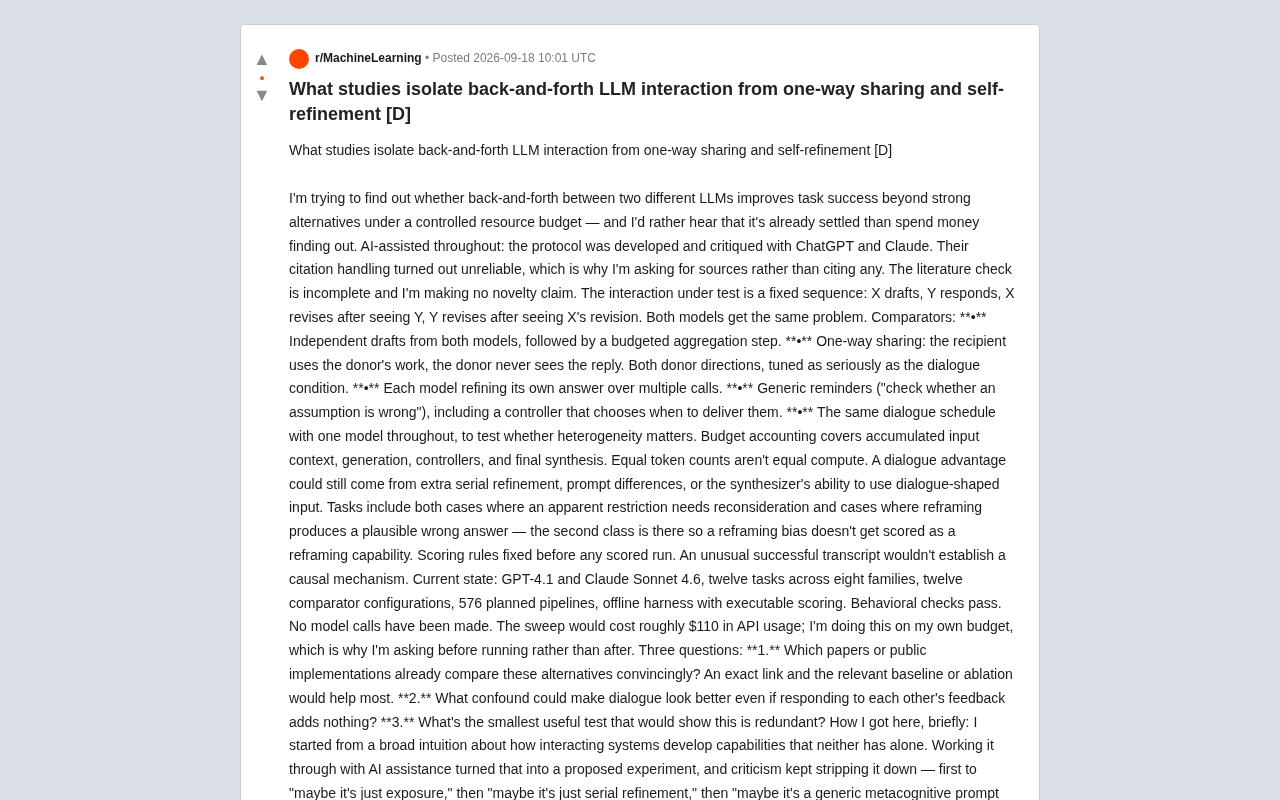
Can Multi-LLM Dialogue Really Improve Task Performance? Lessons from a Rigorous Experimental Design
A researcher designed rigorous controlled experiments to isolate whether multi-LLM back-and-forth dialogue genuinely outperforms simpler baselines like self-refinement and one-way sharing.
Which $10 AI Coding Plan Should You Choose? Go vs. Code Credit Breakdown
After DeepSeek's price hike, should you pick Go or Code for your $10 AI coding plan? We break down credit allocations for Mimo, Qwen, DeepSeek V4, Kimi, and more.