AI Agent in Practice: Understanding the Value and Real-World Applications of Intelligent Agents Through the Evolution of LLMs
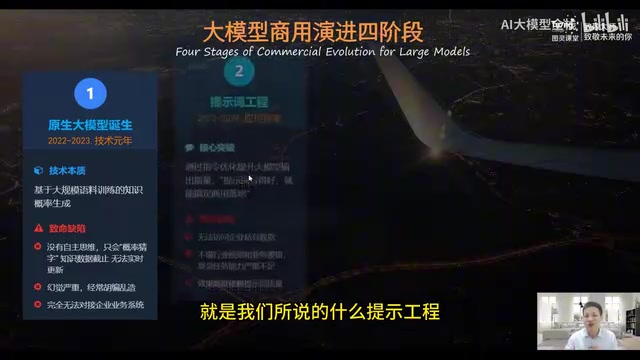
From native LLMs to AI Agents: a four-stage framework and three-project hands-on roadmap for enterprise deployment.
This article traces the four progressive stages of LLM enterprise deployment: native LLMs can generate but lack reasoning and business integration; prompt engineering improves output but has become a baseline skill; RAG enables private data access but only supports passive Q&A; Agents add autonomous planning, tool-calling, memory, and task orchestration. The author defines Agents as a proxy layer between users and LLMs with four roles: translator, tool expert, memory manager, and task manager. For those entering the field, three real-world projects — a daily report Agent, a document Q&A chatbot, and a data processing Agent — are recommended to build substantive, interview-ready experience.
Why Learn AI Agent Now
Prompt engineering and RAG both address the same fundamental challenge: helping large language models answer questions better. But AI Agents tackle an entirely different problem — can we enable LLMs to think autonomously, plan proactively, and solve real-world problems? This marks a clear dividing line between "passive response" and "active execution."
For enterprises undergoing digital transformation, the core demands are reducing costs, improving efficiency, and automating complete business workflows. Relying solely on model-based Q&A or knowledge retrieval isn't enough to genuinely integrate with complex business pipelines. That's precisely why Agent technology has been receiving so much attention lately: it upgrades LLMs from a "question-answering tool" into an "execution unit" capable of calling tools and orchestrating tasks.
From a policy perspective, the integration of AI with industry has become a clear strategic direction. As cited by the video's author, official documents have set phased targets for the adoption rate of next-generation intelligent agents, spanning industry, research, and consumer sectors. The author draws a parallel to the "Internet+" wave of over a decade ago, emphasizing that entering this field requires aligning with policy direction and building real project experience as a competitive advantage — not memorizing interview scripts.
The Four Stages of LLM Commercial Deployment
The video breaks down the journey from LLMs to enterprise deployment into four progressive stages — a clear and useful framework worth walking through.
Stage 1: Native LLMs
Native LLMs are trained on public data and can write copy and generate code, making them seem like generalists. But they have several critical weaknesses: no autonomous reasoning ability, only probabilistic generation based on learned knowledge; a knowledge cutoff date that makes them prone to confidently fabricating information about recent events; and no ability to interface with real enterprise business processes. These limitations mean native LLMs remain far from commercial deployment on their own.
Stage 2: Prompt Engineering
To squeeze more capability out of models, the industry went through a period of obsession with prompting techniques and chain-of-thought strategies — "master prompting and you can deploy commercially" became a popular mantra. But prompt engineering has three major limitations: it can't access enterprise business data, can't handle complex business workflows, and output quality is highly dependent on manual tuning. The author's assessment is straightforward: by 2026, prompt engineering has been downgraded from a "core competency" to a baseline skill for LLM application engineers — much like how using a computer requires typing, but knowing how to type doesn't make you an engineer.
Stage 3: RAG (Retrieval-Augmented Generation)
RAG works by storing enterprise documents in a vector database, allowing the model to retrieve relevant content before generating an answer. This solves the problem of accessing private data, and many enterprise intelligent document systems and knowledge bases today are built on RAG.
But RAG's limitations are equally apparent: it can only retrieve passively and cannot think proactively; it only supports a "one question, one answer" interaction model — it won't act unless prompted; and for the diverse, complex real-world scenarios found in banking, manufacturing, law, energy, and other industries, pure RAG falls short.
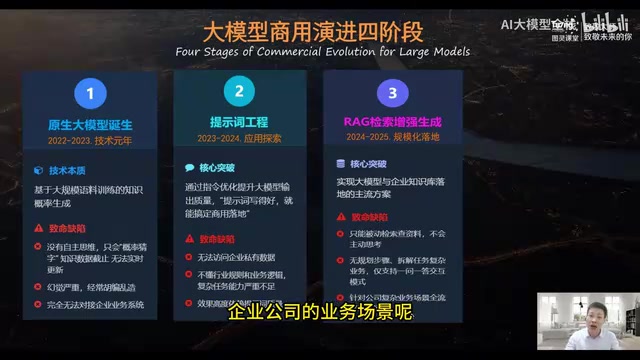
The core mechanism of RAG (Retrieval-Augmented Generation) is to decouple external knowledge from the generative model: documents are chunked and converted into high-dimensional vectors via an embedding model, then stored in a vector database (such as Pinecone, Chroma, or Milvus). When a user asks a question, the system vectorizes the query and uses algorithms like cosine similarity to retrieve the most relevant document chunks, which are then injected into the prompt as context for the LLM to generate an answer. The advantage of this design is that private or real-time data can be incorporated without retraining the model, while citation of original sources helps reduce hallucination risk. Typical engineering challenges include: how to chunk documents while preserving semantic integrity, how to improve both precision and recall, and how to handle complex reasoning across multiple documents or paragraphs — these are precisely the reasons why pure RAG struggles with complex business scenarios.
Stage 4: Agent
At the Agent stage, LLMs gain the ability to plan and execute autonomously — upgrading from a Q&A tool to an execution unit that can call various tools, complete complex task flows, and support multi-agent collaboration for concurrent problems. This is the current primary focus for real-world deployment.

From a technical architecture perspective, an Agent typically consists of four core modules: the Planner decomposes complex goals into executable sub-task sequences, with common implementations including ReAct (Reasoning + Acting) and CoT (Chain-of-Thought); the Tool Set serves as the interface between the Agent and the external world, covering API calls, code executors, browser control, and more; the Memory System is divided into short-term memory (current conversation context) and long-term memory (persistently stored user preferences or historical task results); and the Executor sequentially calls tools according to the plan and feeds results back to the Planner to determine whether to continue iterating. Multi-agent frameworks (such as AutoGen and CrewAI) add role specialization on top of this, allowing multiple Agents to invoke each other and collaborate on more complex task flows — which is the mainstream direction for enterprise-grade Agent deployment today.
What Is an Agent, and What Problem Does It Actually Solve
The author uses a simple analogy: an Agent is a "proxy" in the age of LLMs — a bridge in the middle. Just as a translator is needed for a Chinese speaker and an English speaker to communicate, an intermediary layer is needed between users and native LLMs to coordinate the interaction.
The limitations of native LLMs make this intermediary layer necessary: they have no memory, forgetting previous context by the second turn of a conversation; they have a knowledge cutoff and can't look up live weather or stock prices; and they can't operate a computer, access email, or call tools. Yet nearly all real business tasks require multi-step operations and real-time data.
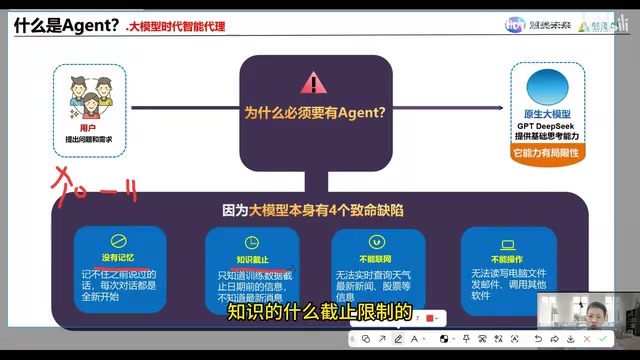
Agents fill exactly these gaps. The author summarizes this as four roles:
- Translator: Converts natural language requests into instructions the model can understand, and translates model outputs back into natural language.
- Tool Expert: Helps the model call various APIs and tools — web search, data queries, file operations, system integrations — transforming the model from "all talk" to "capable of action."
- Memory Manager: Keeps track of context, user preferences, and conversation history to support coherent multi-turn interactions and prevent "amnesia."
- Task Manager: Breaks complex problems into multiple steps, plans the execution flow, adapts when issues arise, and proactively solves problems like a human would.
We're already using Agents in everyday life. When you ask Doubao a question, your query isn't sent directly to the underlying LLM — it first passes through Doubao's Agent layer, which calls the model and returns the result. AI coding assistants that remember your project structure, invoke the compiler, and help debug errors are powered by exactly this kind of Agent tool-calling and memory capability.
A One-Month Hands-On Roadmap: Three Projects
The author pushes back against "30-day checklist" style learning plans, arguing they're neither memorable nor achievable. Instead, the recommendation is to focus on three projects drawn from real work scenarios — complete them in a month and they're ready for your resume.
Project 1: Daily Report Agent. Have it automatically pull work data every day and generate a report with conclusions. This trains tool-calling and task orchestration — how to break down steps, query data, and summarize results. The core logic of Agents lives inside this one project.
Project 2: Document Q&A Chatbot. Feed it industry materials and build a queryable knowledge base. This trains the full RAG pipeline: chunking, retrieval, recall, and generation. It's the foundation of enterprise-grade Agents and a staple of technical interviews.
Project 3: Data Processing Agent. Give it a pile of messy spreadsheets and have it automatically clean, categorize, and visualize the data. This trains structured output and error handling — how to ensure stable, usable model outputs and how to fail gracefully when something goes wrong.
All three projects share a common trait: they come from real business scenarios, so after completing them you can speak to specifics in an interview rather than talking in abstractions. The author suggests spending the remaining two months going deeper on evaluation and optimization.
On the topic of tooling, the mainstream Agent development frameworks today include LangChain, LlamaIndex, and Microsoft's Semantic Kernel. LangChain provides a complete Chain, Agent, and Tool abstraction with the richest ecosystem, making it a common starting point for beginners. LlamaIndex is more focused on RAG pipeline construction and is well-suited for document Q&A-centric projects. Semantic Kernel is deeply integrated with the Azure ecosystem and leans toward enterprise scenarios. For beginners, it's recommended to start with LangChain or its lightweight alternative LangGraph — the latter describes task flows using a graph structure, making Agent planning and branching logic more intuitive and closer to real production deployment needs. The three hands-on projects cover tool-calling, the full RAG pipeline, and structured output — corresponding neatly to the core capability zones of the frameworks mentioned above.
Summary
The value of this content lies in clearly articulating the evolution of LLM deployment: native models solve "can generate," prompt engineering solves "answers well," RAG solves "accessing private data," and Agents solve "think proactively and execute." Understanding this throughline makes it clear why intelligent agent development has become the current focal point. For those looking to enter the field, rather than memorizing interview answers, start with three real projects and build the kind of hands-on experience you can actually speak to in detail.
Related articles
MCPA Certification Study Guide: Mastering the Security and Governance Domain
Security & Governance makes up 24% of the MCPA exam. Learn what each competency tests — authentication, data protection, governance — and clear up the concepts candidates most often confuse.
Beware of 'Model Welfare': The Debate Over Whether AI Deserves Moral Consideration
"Model Welfare" sparks fierce AI ethics debate. We examine both sides of whether AI systems deserve moral consideration, and the tension between anthropomorphism and scientific rigor.
PS5 Linux Maintainer Quits: Are LLMs Eroding the Foundation of Open Source Collaboration?
The PS5 Linux port's core maintainer quit over a flood of LLM-generated, low-quality contributions. We examine how AI-assisted coding is straining open source trust and collaboration.