AI Agent Learning Path Breakdown: A Complete Framework from Principles to Practice

A structured breakdown of the AI Agent learning path, from core principles to real-world project delivery across three progressive modules.
This article uses a structured AI Agent course for beginners to analyze why most agent tutorials leave learners unable to build anything — the root cause being fragmented knowledge with no clear chain from principles to engineering. The course is divided into three modules: Fundamentals (Agent principles, Prompt engineering, workflow design), Advanced (RAG, multi-agent collaboration, tool invocation, and framework practice), and Hands-On Practice (personal knowledge base assistant, intelligent customer service agent, automated office assistant). The article also advises learners to build while they learn, validate concepts with real projects, and maintain realistic expectations about "speed-run" marketing claims.
AI Agents are rapidly becoming the core paradigm for deploying large language models in real-world applications. Unlike simple conversational Q&A, agents can autonomously plan tasks, invoke tools, access external knowledge bases, and accomplish complex goals through multi-turn interactions. For learners who want a systematic introduction, the biggest frustration is rarely a lack of resources — it's that resources are plentiful but fragmented. After studying them, most people still can't independently build a complete agent from scratch.
This article is based on a structured AI Agent course designed for beginners. It breaks down the underlying learning path logic so you can understand exactly which knowledge components need to click into place before you can truly build capable agents.
Why Most Agent Tutorials Leave You Unable to Actually Build Anything
The course creator noted that during the research phase, they reviewed a large number of Agent tutorials on Bilibili — including viral hits with tens of millions of views as well as obscure niche content. A common problem emerged across the board: knowledge points were scattered and unsystematic, leaving learners stuck at "I understood it" rather than "I can build it."
This is actually a universal pain point in learning about agents. Agents span multiple layers — prompt engineering, retrieval augmentation, architecture design, tool invocation, and more. No single knowledge point alone can support a working project. A genuinely valuable learning path should connect these scattered dots into a continuous chain from principles to practice, not pile up concepts in disconnected fragments.

Three Modules: The Progression Logic from Fundamentals to Practice
The course divides its content into three modules — Fundamentals, Advanced, and Hands-On Practice — a tiered design that mirrors the natural learning curve from beginner to deployment-ready.
Fundamentals: Building the Right Mental Model
The fundamentals module focuses on Agent principles, Prompt engineering, and workflow design. These three areas form the foundation for understanding intelligent agents:
- Agent principles answer the fundamental question of "what is an agent and how does it make decisions?"
- Prompt engineering determines whether you can reliably guide a large model to produce the outputs you expect.
- Workflow design is about how to decompose a complex task into an executable chain of steps.
Without this foundational layer, even the most advanced frameworks downstream become black-box operations.
Prompt Engineering refers to the practice of carefully crafting text instructions fed to a large language model in order to reliably and predictably control the quality and format of its outputs. Common techniques include: role definition (System Prompt), few-shot examples, Chain-of-Thought guidance, and output format constraints. In agent scenarios, prompt engineering matters far more than in ordinary conversational applications — because an agent relies on its prompts to decide "which tool to call next" and "whether the task is complete." Even subtle wording differences in a prompt can cause the entire behavior chain to diverge. This is exactly why the course treats it as a required fundamentals topic rather than an advanced technique you can skip.
Advanced: Building Core Capabilities
The advanced module enters the critical territory that separates "knowing how to use" from "knowing how to build." It covers RAG knowledge bases, Agent architecture, multi-agent collaboration, and tool invocation — all implemented using mainstream frameworks.
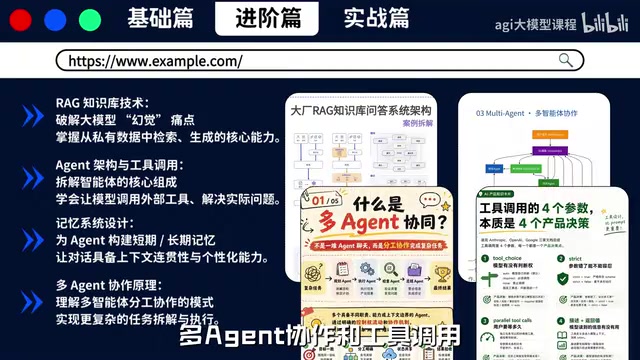
RAG (Retrieval-Augmented Generation) is the core technology that gives agents specialized knowledge and reduces hallucinations. Multi-agent collaboration represents the current frontier of agent development — using multiple agents in specialized roles to cooperatively handle complex tasks that a single agent struggles with. Tool invocation allows agents to break out of the pure-text boundary and truly connect to real-world APIs and services. This module is the watershed moment between theoretical understanding and engineering capability.
RAG (Retrieval-Augmented Generation) works as follows: before sending a user's question to a large language model, relevant passages are first retrieved from an external knowledge base (such as company documents, PDFs, or databases). These passages are then provided alongside the question as context, so the model generates its answer based on actual source material. This mechanism effectively addresses two fundamental weaknesses of large models: first, training data has a knowledge cutoff date, making models unaware of recent developments; second, models tend to "hallucinate" beyond the edges of their knowledge, fabricating plausible-sounding but incorrect answers. The typical RAG tech stack involves four stages: text chunking, vector embedding, vector database storage, and similarity-based retrieval. Learners need to understand the role of each stage in order to diagnose retrieval quality issues in real projects.
Multi-agent collaboration draws on a conceptual model similar to microservices architecture in software engineering: a complex task is decomposed and distributed across multiple specialized agents working in parallel or in sequence. Each agent handles only the sub-task it's best suited for (e.g., information gathering, code execution, result validation), while an "orchestrator" agent coordinates the overall workflow. This pattern significantly outperforms a single-agent approach for long, cross-domain tasks — but it also introduces new engineering challenges around inter-agent communication protocols, state synchronization, and error propagation.
Hands-On Practice: Converting Knowledge into Deliverable Projects
The value of the hands-on module lies in grounding the knowledge from the first two modules into concrete projects, including a personal knowledge base assistant, an intelligent customer service agent, and an automated office assistant.
These project choices are highly representative:
- The personal knowledge base assistant is the most classic application of RAG technology.
- The intelligent customer service agent tests integrated capabilities around conversation management and tool invocation.
- The automated office assistant demonstrates the practical value of agents in workflow automation.
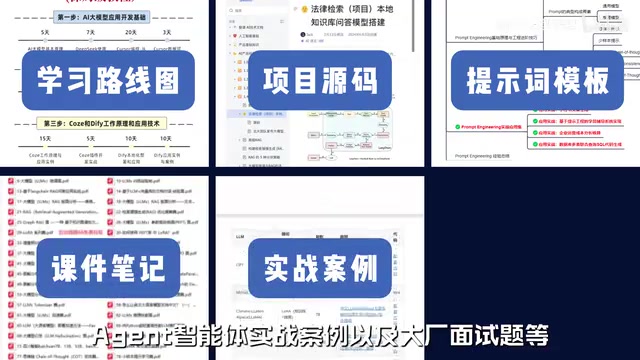
For learners, the ability to independently complete projects like these is the direct benchmark for whether you've truly mastered agent development. The course also bundles a learning roadmap, prompt templates, deployment tools, lecture notes, and hands-on case studies — forming a complete support system from learning through to job readiness.
Advice for Beginners Starting from Zero
Regardless of which tutorial series you choose, the key quality indicator isn't the number of episodes or view count — it's whether the course genuinely connects the chain from principles → technology → project. When learning about agents, stick to the learn-while-building principle: after finishing each technical concept, try to validate it with a small project rather than just watching more videos.
It's worth noting that marketing language like "go from zero to expert in seven days" or "job-ready upon completion" is common in this category of courses and should be taken as promotional copy. Actually mastering agent development requires sustained hands-on practice and accumulated project experience. Approach learning with realistic expectations, back it up with real project work, and you'll be able to turn scattered knowledge points into genuine engineering capability.
Related articles
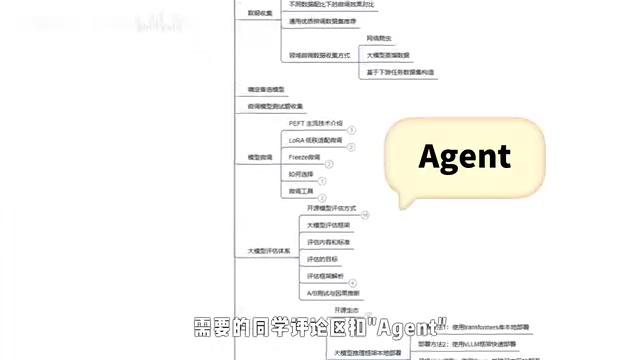
AI Agent Learning Roadmap: A Four-Stage Guide for Complete Beginners
A four-stage AI Agent learning roadmap for beginners: from core concepts and model deployment to RAG, LangChain, LoRA, and interview-ready projects.
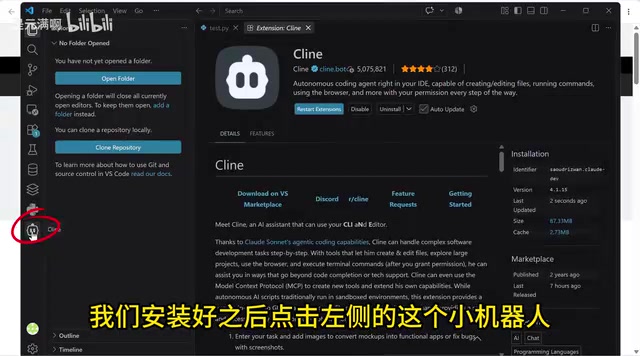
Free Access to Mystery Model & DeepSeek V4 via Cline: Complete Setup Tutorial
Learn how to use DeepSeek V4 and the mystery "Niumai" model for free on Cline — covering IDE extension and CLI installation, account setup, and model selection.
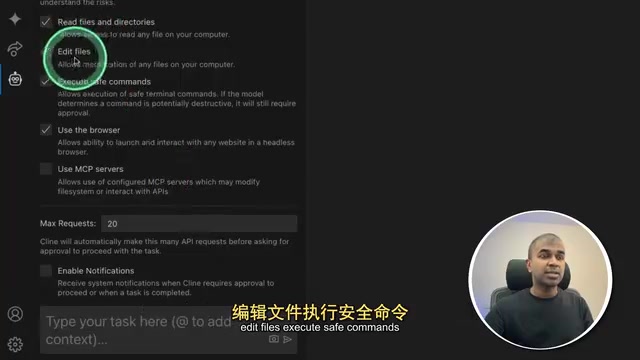
Cline + VS Code in Practice: Generate a To-Do App from a Single Prompt
Cline is an autonomous coding agent inside VS Code. This hands-on guide shows how to generate a to-do app from one prompt and compares Claude, Ollama, and Groq integrations.