AI Agent Learning Path for Beginners: Breaking Down the Four Core Modules from Zero to Job-Ready

A structured AI Agent learning roadmap covering RAG, tool calling, and multi-Agent collaboration from zero to job-ready.
This article examines a structured AI Agent course framework to address a core pain point in the field: scattered tutorials that leave learners unable to build real agents independently. It breaks down four modules — Fundamentals (principles and Prompt engineering), Advanced (RAG, multi-Agent collaboration, tool calling), Hands-On Projects (three representative builds), and Career Preparation (job alignment and interview prep) — highlighting RAG and tool calling as the critical threshold between using and building. The article concludes that courses are scaffolding, not shortcuts, and that lasting competency comes from understanding core logic and continuous practice.
AI Agent development is rapidly becoming one of the hottest directions in tech education — but the quality of available tutorials varies wildly. One Bilibili content creator, after reviewing a large number of existing Agent tutorials, identified a common problem: most courses present knowledge in a fragmented way, leaving learners unable to independently build a working agent even after finishing the material. This pain point reveals the central contradiction in the Agent learning landscape today — it's not that content is scarce, it's that structured learning paths are.
This article uses that creator's systematic course framework as a starting point to break down a relatively complete AI Agent learning roadmap and analyze the core competencies each phase should develop.
The Common Flaw in Scattered Tutorials: Learning Without Being Able to Build
According to the creator, he spent a month researching Agent tutorials on Bilibili before producing his own course — reviewing everything from viral hits with millions of views to niche, low-traffic content. His conclusion: most courses present knowledge as isolated fragments, lacking the coherent logic needed to connect principles to practical application.

This is the classic trap of beginner tech tutorials. Many videos do a great job covering individual topics — how to write a Prompt, how to call a specific API — but viewers are left helpless when facing a complete, real-world requirement. The reason is that independently developing an Agent requires systems thinking: understanding the underlying principles, designing workflows, organizing architecture, and handling deployment. These capabilities can't be built by stacking isolated knowledge points.
From a learning methodology perspective, this observation holds up: effective technical learning requires a continuous through-line, not a collection of disconnected tricks.
Four Modules: A Complete Competency Progression
The course divides its content into four modules — Fundamentals, Advanced, Hands-On Projects, and Career Preparation — a layered design that mirrors the natural progression of skill acquisition.
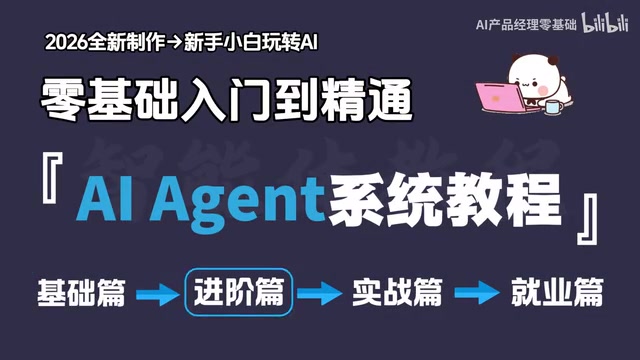
The Fundamentals module focuses on the underlying principles of Agents, Prompt engineering, and workflow design. This is the foundation — understanding what an Agent actually is, how to control large model behavior through Prompts, and how to break a task down into executable steps. Without this layer, everything that follows is built on sand.
The Advanced module covers RAG (Retrieval-Augmented Generation) knowledge bases, Agent architecture design, multi-Agent collaboration, and tool calling — all applied through hands-on development with mainstream frameworks. This phase marks the inflection point between "knowing how to use" and "knowing how to build." RAG enables Agents to answer questions based on private knowledge bases; multi-Agent collaboration handles more complex task orchestration; and tool calling is what gives Agents the ability to actually take action.
Why RAG and Tool Calling Are Core Competencies
In real Agent applications, relying solely on a large model's built-in knowledge is rarely sufficient. RAG addresses the problems of knowledge freshness and domain specificity, allowing Agents to connect to external document libraries. Tool calling (Function Calling) upgrades an Agent from "knows how to chat" to "can actually get things done" — checking the weather, sending emails, querying databases all depend on this capability. Mastering these two skills essentially clears the core technical hurdle of Agent development.
RAG (Retrieval-Augmented Generation) works like this: when a user asks a question, the system first retrieves relevant document snippets from an external knowledge base, then feeds those snippets along with the original question into the large model, which generates an answer grounded in the retrieved context. This mechanism effectively addresses two major limitations of large models — knowledge becoming outdated after the training data cutoff, and the inability to access proprietary enterprise information. The typical implementation involves chunking documents, converting them into vector embeddings for storage, and using vector similarity search at query time to surface the most relevant snippets.
Tool calling (Function Calling / Tool Use) is the mechanism that allows large models to actively trigger external functions or APIs. Developers define tools with names, descriptions, and parameter schemas upfront; during inference, the model decides whether a tool call is needed and generates a structured invocation instruction, which the host application executes before returning the result to the model. This transforms Agents from passive question-answerers into autonomous systems capable of taking action — the fundamental difference between "can chat" and "can work."
Multi-Agent collaboration is the conceptually most demanding topic in the Advanced module. A single Agent handles linear, clearly bounded tasks well, but struggles with complex workflows that require simultaneous web search, code execution, and document summarization, for example. Multi-Agent systems address this by introducing an Orchestrator Agent that decomposes tasks, dispatches subtasks to specialized Agents, and aggregates results — enabling genuine division of labor. Mainstream frameworks like LangGraph, AutoGen, and CrewAI each offer different paradigms for multi-Agent orchestration. Understanding the design philosophy behind these frameworks has more long-term value than simply learning their APIs.
Hands-On Projects: Converting Knowledge into Capability
The value of the Hands-On Projects module lies in assembling previously scattered pieces into complete, working products through real projects. The course highlights three representative project types: a personal knowledge base assistant, an intelligent customer service Agent, and an automated office productivity assistant.
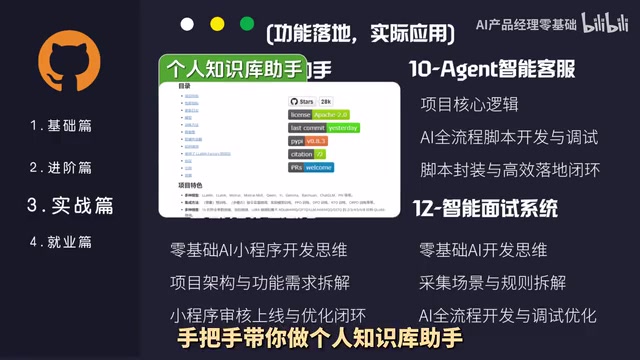
These three projects are well chosen. The personal knowledge base assistant directly applies RAG skills; the intelligent customer service Agent tests multi-turn dialogue handling and business logic design; the automated office assistant emphasizes tool calling and workflow orchestration. Together, they cover the major application scenarios for Agents — and they map closely to the use cases companies most commonly hire for.
For learners, completing these projects isn't just skill validation. More importantly, it produces concrete deliverables that can go on a résumé and into a portfolio. In a nascent field like Agent development, one real working project is often more persuasive than a stack of certificates.
Career Focus: Bridging the Gap from Skills to Job Offer
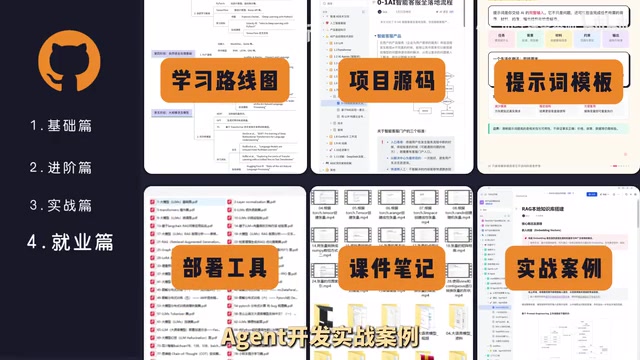
The Career Preparation module is the most pragmatically oriented section of the course, covering role landscape analysis, hiring criteria, résumé and portfolio development, and breakdowns of frequently asked interview questions.
Dedicating an entire module to career readiness signals that the creator recognizes the gap between technical learning and professional landing. Many people develop solid technical skills but miss out on opportunities because they don't understand job requirements, can't package their work effectively, or go into interviews underprepared. Understanding what employers actually look for allows learners to study with purpose — rather than discovering mid-job-search that they've been going in the wrong direction.
That said, it's worth keeping a realistic perspective: "finish the course and land a job" is more marketing language than a guarantee. Agent development roles demand well-rounded capabilities. What the course can provide is structured knowledge and project experience; actual career outcomes still depend on the depth of individual investment and sustained practice.
How to Evaluate This Kind of Structured Course
The learning path this course outlines is sound: principles → architecture → hands-on projects → career readiness, each phase building on the last in a way that aligns with how skills are actually acquired. Supplementary materials — learning roadmaps, project source code, Prompt templates, and interview question banks — genuinely lower the barrier to entry for complete beginners.
But a clear head is still essential: any course is only scaffolding. Agent technology evolves at a rapid pace, and frameworks and tools are updated constantly. Real competitive advantage comes from understanding the underlying logic well enough to learn independently and build things hands-on. Treat the course as a starting point for building a knowledge system — not as a one-and-done answer — and you'll get far more out of it.
For anyone looking to get started with AI Agent development, choosing a structurally clear learning path is far more efficient than blindly collecting a pile of scattered tutorials. That's precisely the core problem this kind of course is designed to solve.
Related articles
Run Claude Code for Free: DeepSeek V3 & Gemini API Integration Guide
Learn to use a one-click Windows installer to switch Claude Code's backend to DeepSeek V3, Gemini, or free OpenRouter APIs—zero-cost terminal AI coding, with full setup and limitations.
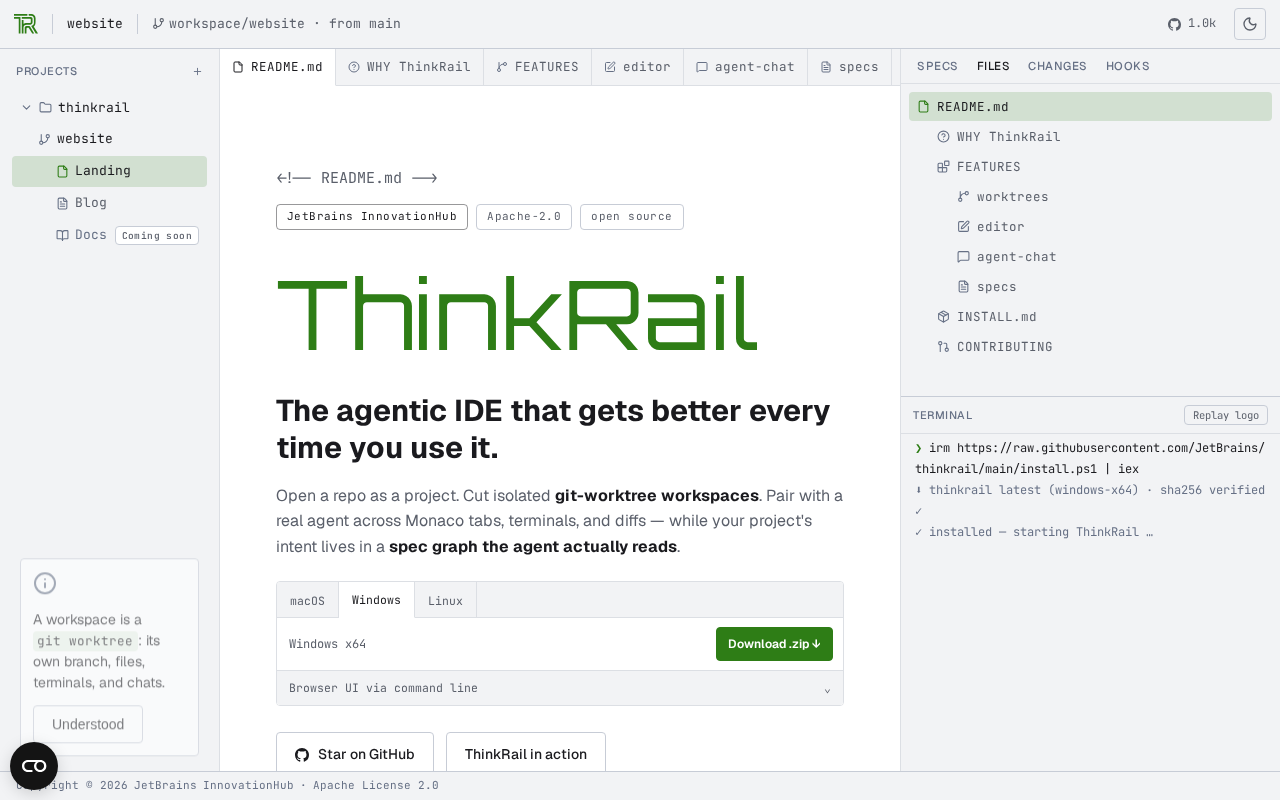
JetBrains Launches ThinkRail: A New Tool for Developer Productivity
JetBrains' new project ThinkRail surfaces on Hacker News, drawing developer community attention. Here's what we know, how the community reacted, and what it could mean for developer workflows.

Getting Started with Gemini 4 Argonne: A Hands-On Guide from Building Sites to Agents
Complete Gemini 4 Argonne tutorial: build a calorie tracker app with one prompt in Google AI Studio, review 10-page technical documents with long context, develop a browser game as a coding Agent in Anti-Gravity, plus API Key setup, pricing, and subscription requirements.