AI Agent One-Click Extraction of Group Chat To-Dos and Conclusions

A Bilibili creator envisions a group chat summarization Agent that automatically filters small talk and extracts to-dos, conclusions, and points of contention, generating a structured summary with one tap on a phone.
The article addresses the pain point of group chat information overload and introduces a Bilibili creator's concept for a group chat summarization Agent. The Agent aims to automatically filter small talk and emoji, separate to-dos, time nodes, conclusions, and points of contention from thousands of messages, and generate a structured summary with one tap on mobile, clearly presenting owners and deadlines. The article breaks down four key stages: information noise reduction, to-do separation, conclusion summarization, and mobile output, and notes that the creator plans to develop and implement this skill live at StepX Studio in the next episode. Currently, the solution is still in the concept stage, with technical implementation and actual results unverified, but its approach of starting from a pain point and using an Agent to decompose tasks offers reference value for AI application implementation.
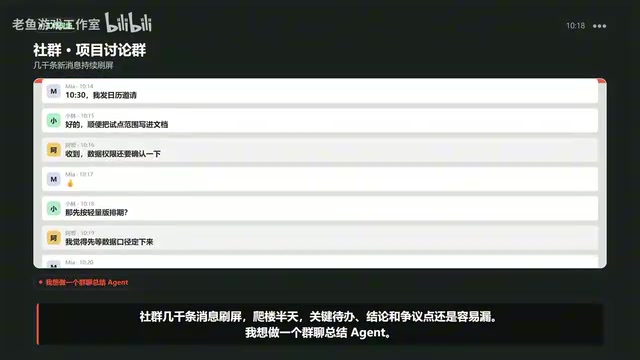
Community group chats can flood you with thousands of messages, and after half an hour of scrolling you may still miss key to-dos, conclusions, and points of disagreement—a daily struggle for many heavy group chat users. In his latest video, a Bilibili creator proposed a solution: build a group chat summarization Agent that automatically filters out small talk and emoji, separates to-dos, time nodes, conclusions, and points of contention, and generates a structured summary with one tap on a phone.
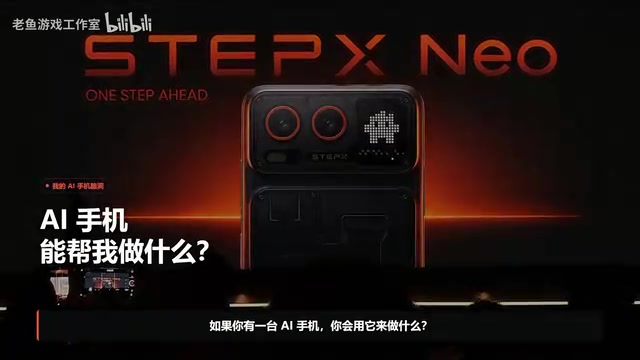
The Pain of Group Chat Information Overload and the AI Solution
According to the Bilibili creator, when facing thousands of group chat messages, manually scrolling is not only time-consuming but also prone to missing key information. The group chat summarization Agent he envisions has core capabilities including: automatically filtering out small talk and emoji, separating to-do items, extracting time nodes, and summarizing conclusions and points of contention. Users only need to operate on their phone to get a structured summary, with owners and deadlines clear at a glance.
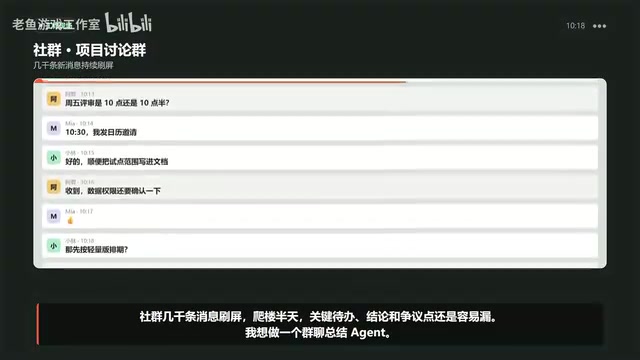
The practical value of this approach lies in transforming an unstructured chat stream into an actionable task list, reducing information loss. Unlike general-purpose chatbots, it places more emphasis on adapting to the group chat context, such as identifying "who needs to do what and when," and distinguishing consensus from disagreement in the discussion.
Agent is a common concept in current AI applications, referring to a system that can autonomously perceive its environment, plan steps, and call tools to accomplish goals. Unlike traditional chatbots, Agents typically have task decomposition, memory, and action capabilities, and can chain together multiple processing steps. In the group chat summarization scenario, the Agent needs to first determine the message type (small talk, task, conclusion), then extract key information according to a preset workflow, and finally organize it into a structured output. This "perceive—plan—execute" loop is the core characteristic that distinguishes an Agent from a single-turn question-answering model.
Breaking Down the Key Features of the Group Chat Summarization Agent
Based on the information revealed by the creator, the Agent's design revolves around four stages.
Information Filtering and Noise Reduction
Automatically filtering out small talk and emoji is the first step. A large number of messages in group chats are unrelated to work, and summarizing without filtering would dilute the summary quality. This feature is equivalent to providing clean input for subsequent extraction.
Information noise reduction in natural language processing generally refers to the process of removing irrelevant, repetitive, and low-value content through rules or models. Sources of noise in group chat text include emoji, greetings, message flooding, and repeated confirmations. Common approaches include filtering based on keywords or classification models, using conversation structure to identify main posts and replies, and removing duplicate messages through clustering. The quality of noise reduction directly affects the accuracy of subsequent summaries, because the cleaner the input, the easier it is for the model to focus on tasks and conclusions.
Separating To-Dos and Time Nodes
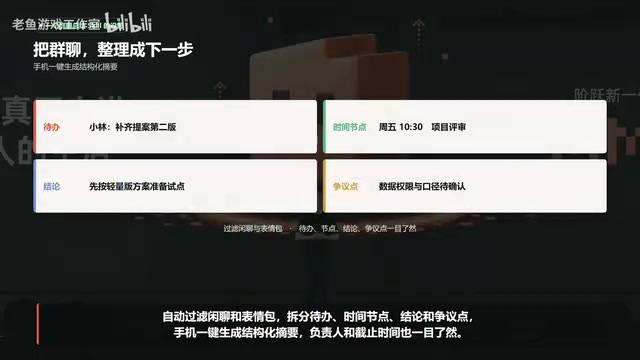
The Agent needs to identify to-do items from the conversation and associate them with owners and deadlines. This is the core of structured summarization and what distinguishes it from ordinary summarization tools.
Structured summarization differs from traditional extractive or generative summarization in that it emphasizes organizing information by fixed fields, such as tasks, owners, deadlines, conclusions, and points of contention. This format makes it easy to directly convert into to-do lists or calendar events later. Implementation typically requires information extraction models to identify entities and relationships, then fill in templates. Compared with free-text summaries, structured summaries are better suited to action-oriented scenarios, but they also place higher demands on extraction accuracy, especially in Chinese group chats with colloquial expressions and omitted subjects.
Summarizing Conclusions and Points of Contention
In addition to tasks, conclusions and points of contention in group chats are equally important. The creator specifically mentioned that these two types of information are the easiest to miss when scrolling through messages. The Agent extracts them separately, helping users quickly grasp the direction of the discussion.
One-Tap Structured Summary Generation on Mobile
The final output is a structured summary generated with one tap on a phone, with owners and deadlines clearly presented. The mobile-first design fits the group chat usage scenario and lowers the barrier to use.
Implementation Path: Live Development at StepX Studio
The creator said that the next episode will go into StepX Studio to build this skill on Amazon Store, carrying out live development and implementation. This means the Agent is not停留在 the concept stage but has a clear implementation plan. However, the video currently only shows the concept and feature breakdown; the specific technical implementation, model selection, and effect validation have not yet been disclosed, and actual performance remains to be verified in the next episode.
For readers interested in AI application implementation, the value of this case lies in demonstrating an approach: start from a specific pain point, use Agent capabilities to decompose tasks, and then leverage a development platform to quickly implement. Whether group chat summarization will become a typical application of AI phones is worth continued observation.
(This article is based on the content of a Bilibili creator's video; some feature descriptions are the creator's ideas, and actual results are subject to implementation.)
StepX Studio is the development platform mentioned in the video, where the creator plans to implement the group chat summarization Agent as a runnable skill. In the context of AI application development, a skill usually refers to a reusable module that encapsulates a specific capability, such as a function or a workflow node, which can be called by a larger Agent. With low-code or visual development platforms, developers can quickly chain together model calls, data processing, and interface display, shortening the time from concept to prototype. However, the platform's specific capability boundaries and model selection still need to be based on actual development.
One-line Summary
A Bilibili creator envisions a group chat summarization Agent that automatically filters small talk and extracts to-dos, conclusions, and points of contention, generating a structured summary with one tap on a phone.
Paragraph Summary
The article addresses the pain point of group chat information overload and introduces a Bilibili creator's concept for a group chat summarization Agent. The Agent aims to automatically filter out small talk and emoji, separate to-do items, time nodes, conclusions, and points of contention from thousands of messages, and generate a structured summary with one tap on mobile, clearly presenting owners and deadlines. The article breaks down four key stages: information noise reduction, to-do separation, conclusion summarization, and mobile output, and notes that the creator plans to develop and implement this skill live at StepX Studio in the next episode. Currently, the solution is still in the concept stage, with technical implementation and actual results unverified, but its approach of starting from a pain point and using an Agent to decompose tasks offers reference value for AI application implementation.
Related articles

Cursor AI Programming in Practice: Build a Student Management System from Scratch in 30 Minutes
A Bilibili creator demonstrates Cursor AI programming: generating a student management system in 30 minutes with natural language. Details on Agent mode, Claude selection, prompt techniques, and thresholds.

Top 20 AI Coding Tools Ranking: From Rock-Solid to Lackluster, a Scored Matrix
Bilibili creator releases top 20 AI coding tools ranking, tiered T0–T4 from rock-solid to lackluster, with Claude Code and Codex tied at T0. This article details the scoring dimensions (capability, reliability, robustness, durability, cost, domestic availability) and tool performances to help developers choose the right AI coding assistant.

Vibe Coding Systematic Tutorial: Master AI-Assisted Programming from Zero
A three-month Vibe Coding tutorial from a Bilibili creator covering Codex, ClaudeCode, and Cursor, from core logic to commercial project practice for beginners.