AI Agent Practical Guide: A Technical Roadmap from RAG to Intelligent Agents
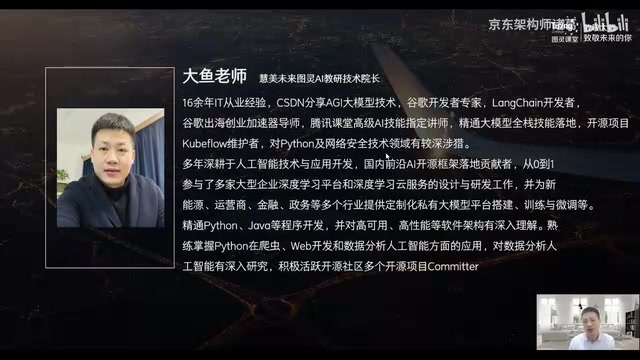
A practical roadmap from RAG to AI Agents, covering LLM engineer skills, deployment stages, and Agent categories.
This article systematically outlines the skill requirements and commercial deployment journey for LLM application development, based on a technical practitioner's live session. The engineer skill set covers Python/PyTorch fundamentals and four modules: small model engineering, LLM fine-tuning (with LoRA as the key technique), Agent development, and foundational knowledge. Commercial deployment has evolved through four stages — native LLMs, prompt engineering, RAG, and Agents — each addressing the limitations of the previous. Agents upgrade LLMs from Q&A tools to capable "digital employees" through four roles: interpreter, tool expert, memory manager, and task manager. The four main Agent categories are Enterprise, Persona, Tool, and Industry Agents, with Industry Agents offering the highest deployment value and career relevance.
The dividing line in LLM application development is becoming increasingly clear: on one side are beginners who can only write prompts, and on the other are engineers who can actually deploy models into real business systems. This article is based on a live session by an experienced technical practitioner (who goes by "Teacher Dayu"), outlining a complete technical roadmap from foundational skills to Agent development — helping you chart a path into LLM application engineering.
What Skill Set Does an LLM Application Engineer Need?
To work on LLM deployment in industry, you need a well-defined skill set. There are three hard prerequisites at the foundation: solid Python proficiency; the ability to hand-code key PyTorch modules; and a deep understanding of neural networks, deep learning, and the underlying mechanics of Transformers — not just knowing how to call libraries. You need to be able to explain how forward passes work and how Tensors are computed. If you can't, two interview questions will expose you.
Beyond the basics, enterprise-level capabilities break down into four areas. The first is small model engineering — with models like BERT and T5, the emphasis isn't just on knowing how to use them, but on whether you can integrate them into a business workflow, wrap them as APIs, and deploy them as stable services. Packaging a text classification model as an HTTP endpoint that handles a certain QPS — that's real engineering capability.
The second is LLM fine-tuning. Enterprises don't want people who only know how to call general-purpose LLMs; they want engineers who can adapt models on vertical domain datasets. Parameter-efficient fine-tuning methods like LoRA are essential, and you also need to know how to quantize, compress, and optimize the model for inference before deployment. The third is Agent development — workflow orchestration with LangChain and LangGraph is a must-have skill. The fourth is foundational knowledge: reinforcement learning principles, model parallelism, and inference acceleration mechanisms (vLLM, Flash Attention, and similar keywords will definitely come up in interviews). The first three are the most critical; the fourth is a bonus.
LoRA (Low-Rank Adaptation) is currently the most mainstream parameter-efficient fine-tuning approach for LLMs in industry, and understanding its principles is crucial for estimating fine-tuning costs. Full fine-tuning a 7-billion-parameter model requires hundreds of gigabytes of VRAM — impractical for most companies. The core idea behind LoRA is: freeze all original model parameters, inject two low-rank matrices A and B alongside the weight matrices that need updating (rank r is typically set between 4 and 64), and only train these two small matrices. Once training is complete, they are merged back into the original weights with virtually no impact on inference performance. This reduces trainable parameters to roughly 0.1%–1% of the original, dramatically cutting VRAM requirements. Combined with quantization techniques (such as QLoRA, which uses 4-bit quantization on the base model), even consumer-grade GPUs can fine-tune billion-parameter models — making this the dominant technical path for vertical domain model adaptation today.
The Four Stages of Commercial LLM Deployment
To understand the value of Agents, you first need to see how commercial LLM deployment has evolved through four stages.
Stage 1: Native LLMs. These are trained on massive public internet data and generate content based on learned knowledge. When ChatGPT exploded onto the scene, many were amazed it could write copy and code — but critical limitations quickly surfaced: no autonomous reasoning capability, knowledge limited to training data, hallucinations when asked about post-cutoff content, and no ability to interface with enterprise systems.
Stage 2: Prompt Engineering. Optimizing prompts to improve output quality — chain-of-thought, tree-of-thought, and similar techniques were widely studied. But prompt engineering has three core flaws: it can't access private enterprise data, can't handle complex business problems, and output quality heavily depends on manual tuning. By 2026, prompt engineering has become the most basic skill for LLM application engineers — like being able to type before using a computer, but knowing how to type doesn't make you an IT engineer.
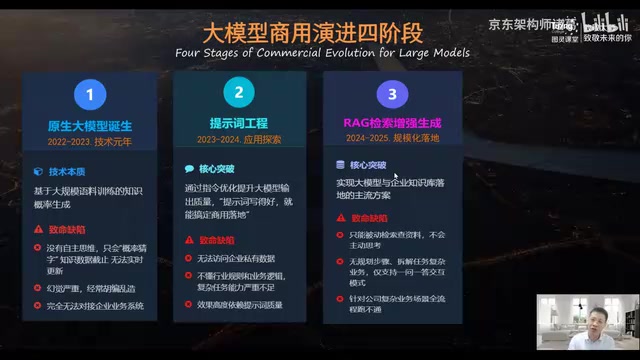
Stage 3: RAG (Retrieval-Augmented Generation). This is currently the go-to approach for many traditional enterprises undergoing digital transformation. Company spreadsheets, documents, images, audio, and other data are processed and stored in a knowledge base, which the LLM queries before answering. Many enterprise intelligent customer service and knowledge Q&A systems are built with RAG. But RAG has inherent limitations: it can only passively retrieve information, lacks active reasoning, can't handle complex business processes, and only supports single-turn question-and-answer.
Stage 4: The Agent Explosion. LLMs have gained the ability to autonomously plan and execute reasoning, evolving from a "Q&A tool" into a "digital employee" capable of invoking multiple tools to complete complex tasks. This is now one of the mainstream approaches for enterprise LLM transformation projects.
RAG's underlying mechanics are worth unpacking. The workflow has two phases: an offline phase where enterprise documents are chunked, vectorized, and stored in a vector database (such as Faiss, Milvus, or Chroma); and an online phase where a user's query is also vectorized, the most semantically relevant text chunks are retrieved from the database using cosine similarity or similar algorithms, and those chunks are injected into the prompt as context to guide the LLM to generate answers based on those "reference materials." This mechanism effectively addresses both the knowledge cutoff problem and the inability to access private domain data, while also reducing hallucination risk by anchoring responses to source documents. RAG's weakness is that retrieval quality directly determines output quality — if the semantic match between the question and documents is poor, or if answering requires reasoning across multiple document sections, RAG breaks down. This is the fundamental reason Agents can handle more complex tasks than RAG.
What Problem Does Agent Actually Solve?
An Agent can be understood as a "proxy for the LLM era" — like an interpreter facilitating communication between a Chinese and an English speaker. The user asks a question, the Agent interprets the need, invokes various tools to perform complex processing, and returns the result.
Native LLMs have several hard limitations: no memory (every conversation starts fresh), a knowledge cutoff date, no internet access, and no ability to operate tools or computers. Agents specifically address four of these problems:
- Interpreter: Translates the user's natural language needs into instructions the model understands, then converts the output back into results humans can act on;
- Tool Expert: Helps the LLM call APIs, browse the web, manipulate files, and interface with systems — transforming the model from "able to talk" into "able to do";
- Memory Manager: Retains context and conversation history to enable coherent multi-turn interactions;
- Task Manager: Breaks complex problems into multiple steps, plans the execution flow, and adjusts plans when obstacles arise.
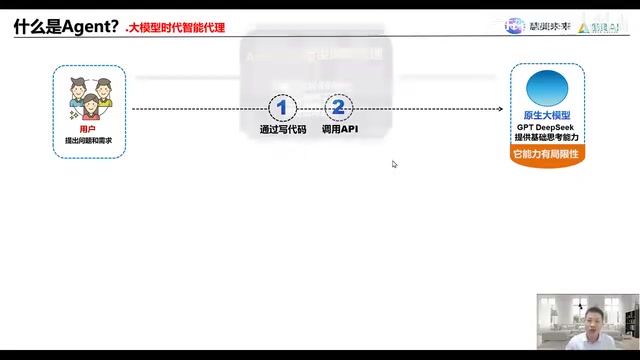
Everyday tools like Doubao and DeepSeek, as well as developer tools like Claude Code and Cursor, are all Agents at their core. Take Claude Code as an example: it can understand an entire project structure and invoke the compiler to debug code — capabilities that directly reflect the "Tool Expert" and "Memory Manager" roles within an Agent.
LangChain and LangGraph are the two most widely used open-source frameworks for building Agent applications, each with a distinct purpose. LangChain provides a chain-based abstraction layer that encapsulates prompt templates, model calls, tool calls, and memory modules into standardized components — well-suited for building relatively linear workflows. LangGraph builds on LangChain by introducing graph-based orchestration, allowing you to define nodes (processing units) and edges (transition conditions), and supporting loops, branches, and multi-agent collaboration. It's better suited for complex Agent scenarios that require a "think–act–observe–rethink" feedback loop. The core execution paradigm for Agents is commonly called ReAct (Reasoning + Acting): the model reasons about the current state, selects and invokes a tool, observes the result, reasons again, and repeats until the task is complete or a maximum iteration count is reached. Understanding this loop is the key leap from "knowing how to use LangChain" to "being able to design complex Agent workflows."
The Four Main Categories of Production Agents
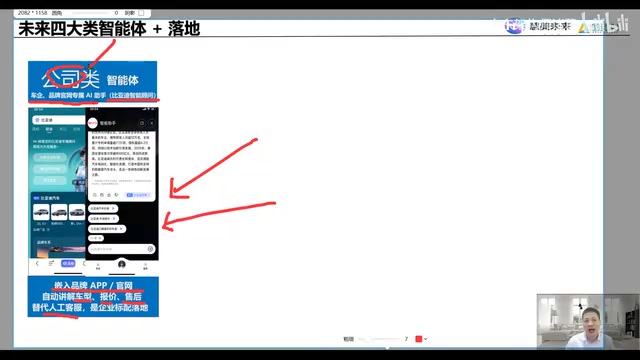
Agents that actually deliver commercial value in production environments fall into four major categories. Whether you're aiming for Agent development, LLM testing and ops, or AI product management, you can find your niche here.
Enterprise Agents: Branded intelligent assistants embedded in company websites and apps — for example, BYD's smart advisor, which provides 24/7 automated explanations of vehicle models and configurations. Any mid-sized traditional enterprise is either building one of these or planning to.
Persona Agents: Digital humans — AI virtual streamers and e-commerce live-streaming hosts, for instance. Technically, these combine Agent capabilities with a digital avatar. Short-video and e-commerce companies are already deploying them at scale.
Tool Agents: Focused on solving a single functional pain point extremely well — AI writing tools, resume generators, and similar products. These are relatively accessible to build and work well as paid or traffic-generating products tied to a specific industry pain point.
Industry Agents: Deep B2B integrations for traditional enterprise digital transformation, spanning entire business workflows. In an e-commerce context, for example, an agent might handle everything from customer inquiry to inventory lookup to automatic order completion. Industrial Agents, legal Agents, and similar verticals also fall here. These have the longest development cycles and highest costs, but are considered the most valuable category — and should be the primary focus for anyone making a career transition.
Learning Direction from a Technology Trends Perspective
The presenter described the rhythm of LLM development as follows: the "Year of LLMs" was about raw compute power and model intelligence — but that's just atomic capability. Agents went through an "early adopter phase" of moving from concept to small-scale deployment, and are now entering a phase of scaled application in the "hundred-billion-agent era." Based on industry interview clips shared during the session, growth in AI Agent-related business can exceed 100%, and enterprise demand for intelligent agents is shifting from "nice to have" to "business-critical" — with more and more clients requesting custom Agents built around their own business processes.
One important caveat: this content comes from a livestream that included course promotion, interspersed with considerable marketing language and engagement prompts. The frameworks around skill structure, the four stages of commercial deployment, and the four Agent categories have real reference value. However, specific policy figures, adoption rate statistics, and similar claims have not been independently verified. Readers should apply critical judgment and treat this as a reference for mapping out a learning path — not as authoritative conclusions.
Related articles
The Truth About Open-Source AI: You Got the Cake, Not the Recipe
Open-source AI exposed: what you download is weights (the cake), not training data or code (the recipe). A deep dive into open weights vs. true open source, Meta/Alibaba/DeepSeek business strategies, and how US/China/EU governments are redrawing the boundaries of openness.
Free DeepSeek V4.1 Flash via DSH: Bulk Point Collection & International WorkBuddy Tested
DSH project update tested: WorkBuddy now offers 100 points per claim, rate limits raised beyond 80M tokens with faster resets, and international WorkBuddy supports free Hunyuan 4 and DeepSeek V4.1 Flash.
Capsule: Pack Web Apps and Data into a Single SQLite File
Capsule is a Rust/Tauri 2.0 tool that packs HTML web apps and data into a single SQLite file — privacy-first, local storage, portable sharing, with AI support.