AI Agent Session Export Tool: Would You Pay for Reliable Archiving?
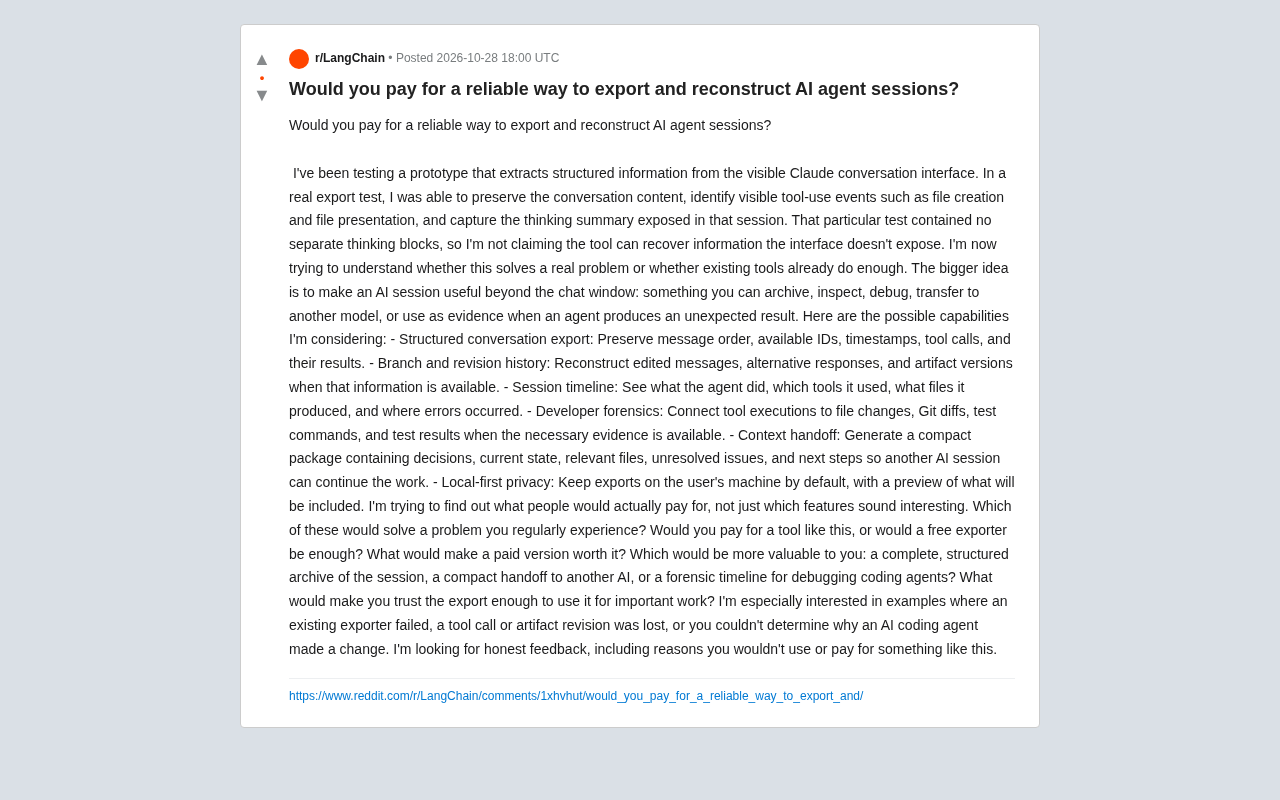
A developer explores the prototype capabilities, paid use cases, and trust barriers of an AI agent session export tool.
A developer built an AI agent session export prototype based on Claude's visible interface. It can preserve conversations, tool-call events, and thinking summaries, but explicitly does not claim to recover information the interface does not expose. He lists six candidate capabilities—structured export, branch revision history, session timeline, developer forensics, context handoff, and local-first privacy—and asks which are real paid needs. The analysis notes that archiving, handoff, and forensics serve different audiences, free exporters pose a substitution threat, and trust is the core contradiction—the export tool itself may err, and errors get amplified when used for forensics. The conclusion: pure export is hard to charge for independently, but the "handoff packet + forensic timeline" combination is tied to real workflows and could become an audit layer for agent behavior.
AI Agents are moving from demos to production environments, but an awkward reality remains: most conversation records are still trapped inside chat windows. A developer posted on Reddit asking whether anyone would pay for a tool that "reliably exports and reconstructs AI agent sessions," and shared the results of his prototype testing.
What the prototype can and cannot do
The prototype this developer tested extracts structured information from the visible portion of the Claude conversation interface. In one real export test, it successfully preserved the conversation content, identified visible tool-call events such as file creation and file display, and captured the thinking summaries exposed in the session.
But he explicitly drew the boundaries: that test did not include standalone thinking blocks, so the tool does not claim to recover information the interface does not expose. This disclaimer itself is worth noting—in an environment where AI tool marketing is routinely exaggerated, proactively stating capability limits actually increases credibility.
Thinking blocks and the visible interface: In chat interfaces for large models such as Claude, "thinking" (or "extended thinking") refers to the internal reasoning summary the model generates before producing its final response. Some products display a summarized version of this reasoning to users in a collapsible panel, but the full chain of thought is usually not exposed externally and may also be truncated during transmission or rendering. Therefore, the upper bound of a tool that extracts information from the "visible interface" is what the page actually renders—it can capture the displayed thinking summary, but it cannot reconstruct unrendered reasoning processes, hidden system prompts, or collapsed intermediate steps. This also explains why the prototype emphasizes that it "does not claim to recover information the interface does not expose": the reliability of an export tool depends on the visibility boundary of the data source, not on the tool's own parsing capability.
Six candidate capabilities—which is a real need?
The developer listed the features he is considering:
- Structured conversation export: preserve message order, available IDs, timestamps, tool calls, and their results
- Branch and revision history: reconstruct edited messages, alternative responses, and artifact versions when the information is available
- Session timeline: see what the agent did, which tools it used, what files it produced, and where it went wrong
- Developer forensics: when sufficient evidence exists, correlate tool execution with file changes, Git diffs, test commands, and test results
- Context handoff: generate a compact package containing decisions, current state, relevant files, open issues, and next steps so another AI session can continue the work
- Local-first privacy: exports stay on the user's machine by default, with a content preview included
This list reveals a judgment: the value of an AI session goes beyond "chat history"—it is a work trace that can be archived, inspected, debugged, migrated, and used as evidence.
Artifacts and session branches: In products such as Claude that support Artifacts, an artifact refers to a versionable content block generated during a conversation (such as a code file, webpage, or document), with each modification creating a new version. At the same time, the session itself may branch: after a user edits an already-sent message, the system regenerates a response from that point, forming an alternative branch parallel to the original path. These branches and artifact versions are usually stored only inside the product, and ordinary exports often preserve only the currently visible main line, causing the trace of "what changed and why" to be lost. For developers, reconstructing branch and revision history means being able to map the final output to its evolution path—something that simply copying chat text cannot provide.
The three thresholds of willingness to pay
The developer's questions were direct: which features solve problems you encounter frequently? Would you pay, or is a free exporter enough? What makes a paid version worth it?
These questions hit three thresholds.
First, archiving vs. handoff vs. forensics—which is more valuable? Full structured archiving suits compliance and knowledge management scenarios; compact handoff packets suit developers collaborating across multiple models; forensic timelines target engineers debugging coding agents. The three have different audiences and different willingness to pay.
Second, the substitution threat from free exporters. If users only occasionally export a few conversations, a browser extension or script is enough. Paying presupposes that the tool can handle scenarios free solutions cannot—such as lost tool calls, scrambled artifact versions, or broken cross-session context.
Third, the trust barrier. The developer specifically asked, "What would make you trust the export result enough to use it for important work?" This touches the core contradiction: the export tool itself may make mistakes, and when users rely on it for forensics or handoff, those mistakes get amplified. To inspire confidence, the tool needs verifiable output, clear statements of coverage, and a local-first privacy design.
Context handoff packet: In development workflows involving multi-model and multi-session collaboration, context windows are limited and sessions are isolated from one another, so a new session cannot automatically inherit the decision background of an old one. A handoff packet is a compact summary designed for this purpose, typically containing established decisions, current task state, relevant file paths, open issues, and next-step plans. Its value lies in compressing lengthy raw conversations into structured input that another agent can directly consume, avoiding repeated explanations of background. Unlike a full archive, a handoff packet pursues information density and actionability, so its quality depends on accurately distinguishing "settled" from "pending" content.
An underrated pain point: explainability of agent behavior
The post ends by soliciting failure cases: existing exporters breaking, tool calls or artifact revisions being lost, and the inability to determine why an AI coding agent made a certain change.
These scenarios point to the same pain point: after an agent autonomously performs multi-step operations, it is very difficult for humans to reconstruct "why it did this." If an export tool can string tool execution, file changes, and test results into a traceable chain, it is no longer just an archiving tool but an audit layer for agent behavior. For teams putting agents into CI/CD or production workflows, this value may far exceed "chat history backup."
Agent forensics and traceable chains: Forensics in this context refers to the ability to reconstruct an agent's sequence of operations after the fact, similar to audit logs in software engineering. A traceable chain needs to align three types of evidence in chronological order: tool calls (what was called and with what arguments), filesystem changes (which files were created, modified, or deleted, mappable to Git diffs), and verification results (test commands and their output). When an agent makes an error after autonomously performing multi-step operations, this chain can answer "which step introduced the problem" rather than inferring solely from the final conversation. The difficulty lies in the completeness of evidence and consistency of timestamps—if there is no linking identifier between tool calls and file changes, the chain breaks and attribution becomes impossible.
Editorial view
The technical difficulty of this prototype is not high; what is hard is product positioning. From the post, the developer already recognizes that "features that sound interesting" and "someone is willing to pay" are two different things—a restraint that is rare in AI tool startups.
My judgment is: pure session export will be hard to charge for independently, but the combination of "handoff packet + forensic timeline" has promise—the former solves context breaks in multi-agent collaboration, and the latter solves the attribution problem after an agent makes a mistake. Both are tied to real workflows rather than being nice-to-have features. As for trust, local-first design and output verifiability will be unavoidable thresholds.
If you are using Claude or another AI agent for coding work, ask yourself: the last time an agent modified the wrong file, how long did it take you to reconstruct what it did and why? If the answer is more than ten minutes, this tool has a reason to exist.
Related articles

74M-Parameter Open-Source Model Partially Outperforms Jev AI in Testing
Fastino AI's Glider 2.5 models, with just 74M–300M parameters, reportedly outperform Jev AI in some guardrail benchmarks per YouTube testing, run on consumer hardware, and even play Doom. We analyze small models' competitiveness and deployment value on specific tasks.

Gemini 4 Argon Hands-On: Aggressive Pricing, 3D Capabilities Need Coaching
Gemini 4 Argon hands-on: limited-time $2/$10 pricing, million-token output, strong 3D and reverse-engineering work, but weak front-end aesthetics and zero-shot ability need coaching.

Build Your Own ChatGPT with Flutter and Gemini API: Streaming Chat in 200 Lines of Code
Learn to build a ChatGPT-like AI chat app with Flutter and the Gemini API: secure API keys via Firebase AI Logic, stream replies with sendMessageStream, maintain memory with chat sessions—all in under 200 lines of code.