AI Agents Explained: The Intelligence Revolution from Passive Q&A to Autonomous Action

AI Agents give large models hands and feet — enabling autonomous planning, tool use, and real-world task execution.
Large language models are knowledgeable but structurally limited: no autonomous action, no long-term memory, no planning ability. AI Agents address these gaps by building a perception–reasoning–action loop on top of LLMs, enabling them to interact with the real world, break down complex goals, invoke tools, and self-correct until a task is complete. Unlike rule-based Chatbots, Agents are true autonomous collaborators. As AI advances from perceptual and cognitive intelligence toward action intelligence, Agents represent the critical leap from 'able to chat' to 'able to act' — with growing impact across education, enterprise productivity, e-commerce, finance, and healthcare.
Large Models Are Smart — So Why Aren't They Enough?
If a large language model is a brain, then an Agent is that brain equipped with hands and feet. This analogy captures the core turning point in AI's current development. The models we use every day — ChatGPT, Qwen, DeepSeekAd — are genuinely impressive. They generate text effortlessly, answer knowledge questions with remarkable accuracy, summarize and translate fifty-page PDFs without breaking a sweat, and can even handle mathematical reasoning.
But that's precisely where the problem lies: they behave more like passive, reactive question-answering machines. You ask, they answer, and then they clock out. If you actually want something done, you still have to direct every single step yourself.
Two typical scenarios illustrate this clearly. Say you tell a large model, "Book me the cheapest flight from Beijing to Shanghai next Friday." It will tell you to go to Ctrip or Qunar, walk you through what to click and what to enter — and that's it. It won't actually check prices, compare flights, or complete the booking.
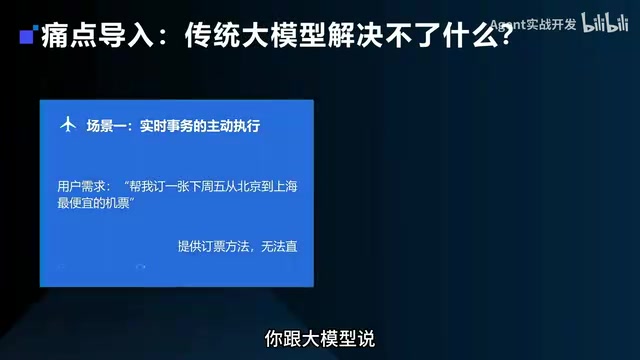
Or suppose you ask it to organize last week's meeting notes and list the action items. It will say, "Please paste the meeting transcript here" — it won't go into Feishu or DingTalk and pull the records itself. It knows everything, but it can do nothing. It's like a brilliant strategist who's paralyzed in a chair: full of ideas, but unable to stand up and act.
Three Fundamental Limitations of Traditional Large Models
Breaking the problem down, traditional large language models have three structural shortcomings.
No autonomous action capability: Unless you prompt it, it won't move; unless you feed it data, it won't go fetch it. It can only converse within a chat window — it cannot interact with the real world.
No long-term memory: After half an hour of conversation, switching pages may cause it to forget what was said earlier, let alone track a task over multiple days.
No planning ability: Given a complex task like "put together a quarterly report," it won't automatically break that down into steps — "collect data first, then build charts, then write the analysis." It just writes as it goes.
These three limitations ensure that large models are forever stuck at the "offer suggestions" stage, while actual execution remains your problem. The solution is fairly straightforward: give this intelligent brain hands and feet, memory, and planning capabilities. That new form is what we call an Agent.
These limitations have deep technical roots. A large model is fundamentally a "stateless" function — every conversation starts from scratch, and once the context window exceeds its length limit, earlier content is truncated; there's no way to accumulate long-term experience the way humans do. The absence of autonomous action stems from how these models are trained: they generate text by predicting the next token, with no interactive loop of "issue a command → wait for execution → observe the result." Weak planning ability is partly due to the fact that models generate answers through a single forward pass, without any mechanism for iterative self-correction. These aren't engineering limitations — they're ceilings imposed by the fundamental architecture. That's precisely why a new system layer needs to be built on top of large models to compensate.
Agent, Large Model, Chatbot: Drawing Clear Boundaries
Many people conflate Agents with the other two concepts. Some even claim they've "built an Agent" when they've really just wrapped a Chatbot interface around a model. The three are fundamentally different.
Traditional large models (like GPT or Qwen) are foundation models trained on massive datasets, with core capabilities in text generation and knowledge Q&A. Think of them as a universal encyclopedia — vast and knowledgeable, but a book is still a book; it won't proactively open itself to help you get things done.
Ordinary Chatbots (like the customer service bots on websites) are either rule-based systems or thin wrappers around large models, capable only of responding according to preset scripts. They're like a bank ATM — inserting a card, entering a PIN, and withdrawing cash are fine, but say "I want to apply for a loan" and it won't engage, because that's not in the preset flow.
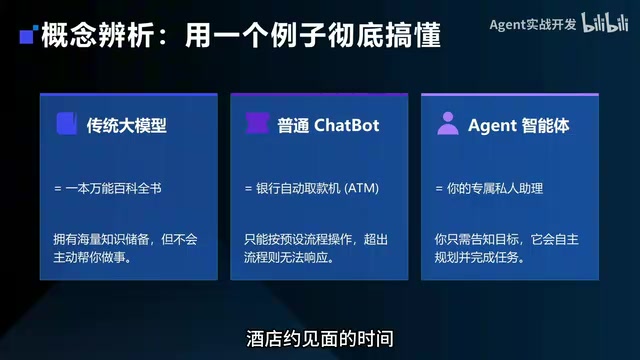
Agents (intelligent agents) possess complete perception, reasoning, and action capabilities. They can plan independently, execute autonomously, and deliver results. Think of an Agent as a personal assistant: you just say "arrange my business trip to Shanghai next week," and it searches for flights, books a hotel, schedules meetings, handles problems along the way on its own, and reports back when everything is done.
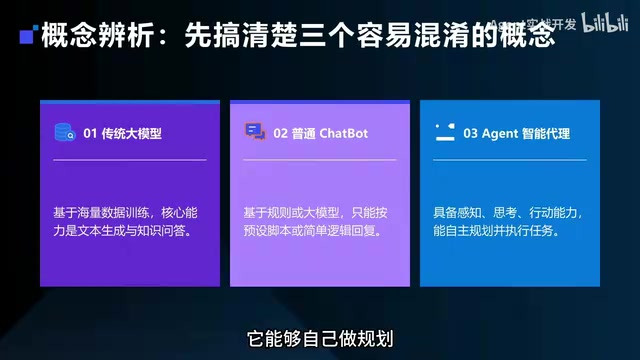
A three-dimension comparison makes this clearer: in terms of core capability, large models handle conversational Q&A, Chatbots follow rules to respond, and Agents complete tasks. In terms of interactive action, large models operate on a one-question-one-answer basis with no tool use, Chatbots rigidly follow scripts, and Agents proactively invoke tools to move tasks forward. In terms of task type, large models handle single-step tasks, Chatbots handle fixed workflows, and Agents handle complex multi-step tasks spanning planning, execution, and error correction.
The Agent's Operating Core: The Perception–Reasoning–Action Loop
How does an Agent work internally? It comes down to three stages — and they form a continuous loop.
Perception is its eyes and ears. The Agent first needs to understand what's happening: what instructions you gave, where the task currently stands, whether the last execution threw an error, where the required data lives. This is its entry point to the outside world.
Reasoning is its brain — and the most critical component. Once it has information, it deliberates: this goal is too large, it needs to be broken into steps; what comes first, what tool should be used; what's the backup plan if this approach doesn't work. Like a person approaching a problem, it doesn't just dive in — it thinks things through first.
Action is its hands and feet. Need to find something? Call a search API. Need to crunch numbers? Write and run code. Need to send a message? Call the appropriate interface. Need to read or write a file? Hit the disk.
The key insight is this: once an action is completed, the result feeds back into the perception layer, closing the loop. For example, if the Agent discovers during a flight booking that the chosen flight is sold out, it perceives that error, returns to the reasoning stage to select a different flight, and keeps going until the task is done. This is the fundamental reason it can solve problems autonomously.
The technical core driving the "reasoning" stage is the widely adopted ReAct (Reasoning + Acting) framework. It prompts the large model to alternate between outputting "reasoning steps" and "action instructions," rather than producing a single final answer. Concretely: the model first writes its current analysis (Thought), then specifies the tool to call and its parameters (Action), waits for the tool's return value (Observation), then updates its reasoning based on that result and decides whether to continue acting or output a final answer. This "think one step — take one step — observe results — think again" loop is the underlying mechanism that enables Agents to handle complex multi-step tasks and self-correct mid-execution. The complementary Function Calling / Tool Use capability allows large models to integrate external operations — search, code execution, database reads and writes — directly into their reasoning flow.
Why Agent Is AI's Inevitable Direction
Looking back at AI's development over the past decade or so, it has broadly progressed through three phases.
The first was perceptual intelligence — solving the problem of making AI "able to see and hear." Image recognition, speech recognition: AI could identify cats and dogs, understand spoken language. But AI at that stage was essentially a sophisticated sensor; it couldn't comprehend the meaning of what it perceived.
The second was cognitive intelligence. With the explosion of large models, AI gained the ability to understand language, reason, hold conversations, and produce written content. This is the stage we're currently in.
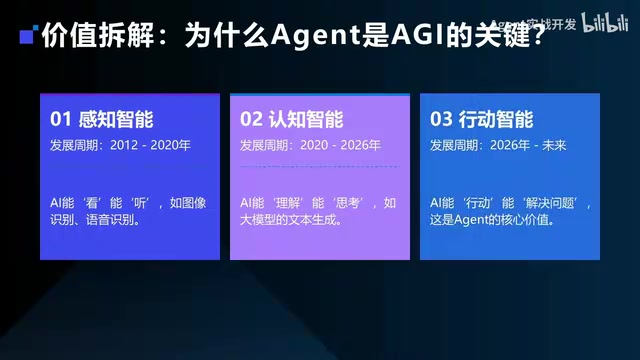
But cognition alone isn't enough. No matter how intelligent a person is, lying in bed and doing nothing creates no value. So the third phase is action intelligence — enabling AI not just to think, but to actually do things and solve real-world problems. That's exactly what Agents are built for.
In other words, Agent isn't a minor patch or add-on feature for large models — it's the critical leap that takes AI from "able to chat" to "able to act," an unavoidable milestone on the road to AGI.
AGI (Artificial General Intelligence) refers to a system capable of performing human-level intelligent tasks across any domain. It is widely regarded by both researchers and industry as the long-term goal of AI development, though there remains significant disagreement on how to define "general" and when it might be achieved. Agents are seen as a key pathway toward AGI, and the core logic is straightforward: for a system to accomplish open-ended goals the way humans do, it must simultaneously understand language, formulate plans, operate tools, learn from feedback, and continuously adapt — which maps precisely onto the complete Agent architecture. OpenAI, Google DeepMind, and other leading organizations have noted in recent research reports that giving models "agency" is one of the central directions for breaking through current capability ceilings.
Where Agents Are Being Deployed: From Education to Every Industry
The value of Agents only becomes real when grounded in specific use cases.
In education, personalized learning planning lets an Agent continuously track what you've mastered, schedule content targeting your weak spots, and automatically surface similar practice problems for questions you got wrong — delivering genuinely individualized instruction. Intelligent homework grading doesn't just mark answers right or wrong; it identifies exactly where a student went astray — whether a concept was misunderstood or a calculation was careless — and generates a tailored remediation plan, freeing teachers from repetitive grading so they can focus on the students themselves.
The applications extend far beyond education. In smart office settings, Agents sit in on meetings, automatically compile key points, and assign action items directly to the relevant people. In e-commerce customer service, Agents go beyond mechanical Q&A — they act like a top-performing sales associate who knows your preferences and budget and makes tailored recommendations, while handling post-sale issues directly. In financial advisory, Agents monitor markets around the clock and provide recommendations aligned with your risk profile. In medical assistance, they organize case histories, handle preliminary patient intake, and support diagnostic imaging review, improving overall clinical efficiency.
Across every industry, the Agent's value proposition is consistent: it's no longer a tool that only moves when pushed. It's a collaborative partner that proactively identifies needs, devises solutions, and drives problems to resolution on its own. That's why it's widely regarded as the next major wave in AI applications.
Related articles

Free Unlimited Claude Code Solution: Agnes AI + CC Switch Setup Guide
No paid subscription needed — pair the free AI platform Agnes AI with the open-source tool CC Switch to provide a backend for Claude Code, enabling unlimited free calls to text, image, and video models. This guide covers the full setup, test results, and usage boundaries.

A Complete Zero-Cost Guide to Getting Started with Claude Code for Beginners in China
A beginner's guide to Claude Code for users in China: two installation methods (command line and IDE plugin), full configuration steps for replacing the official API with the free domestic LongCat model, and a hands-on demo of building a small tool with natural language, plus tips.

When the NSA Gets Involved: The AI Supply Chain Crisis Behind Open-Source CVEs and API Key Hijacking
Multiple open-source projects disclosed severe CVEs in one day, PHP flaws alarmed the FBI, and Railway and OpenCode were breached with API keys stolen. This article breaks down the vulnerability window, AI-accelerated exploitation, and the AI supply chain crisis behind the API key black market, with a developer defense checklist.