AI Agents: The New Heterogeneous Workload Challenge Facing DevOps
AI Agents challenge DevOps with non-deterministic behavior, demanding new observability and governance approaches.
AI Agents introduce a fundamentally new type of workload for DevOps — one that is non-deterministic, autonomous, and capable of invoking external tools with real-world consequences. This article examines why Agents are "weird" workloads, explores the core debate between reusing Kubernetes infrastructure and building dedicated operations layers, and discusses the paradigm shift in observability from system metrics to behavioral tracking. It concludes with practical recommendations for DevOps teams preparing for this emerging challenge.
A New Operational Challenge Hiding in Plain Sight
Over the past decade, the DevOps community has poured enormous effort into building deployment and observability systems for applications. These practices rest on a key premise: application behavior is largely deterministic — the same input produces the same output, failures are reproducible, and behavior is predictable. CI/CD pipelines, Kubernetes orchestration, Prometheus monitoring — all of them are built on this assumption.
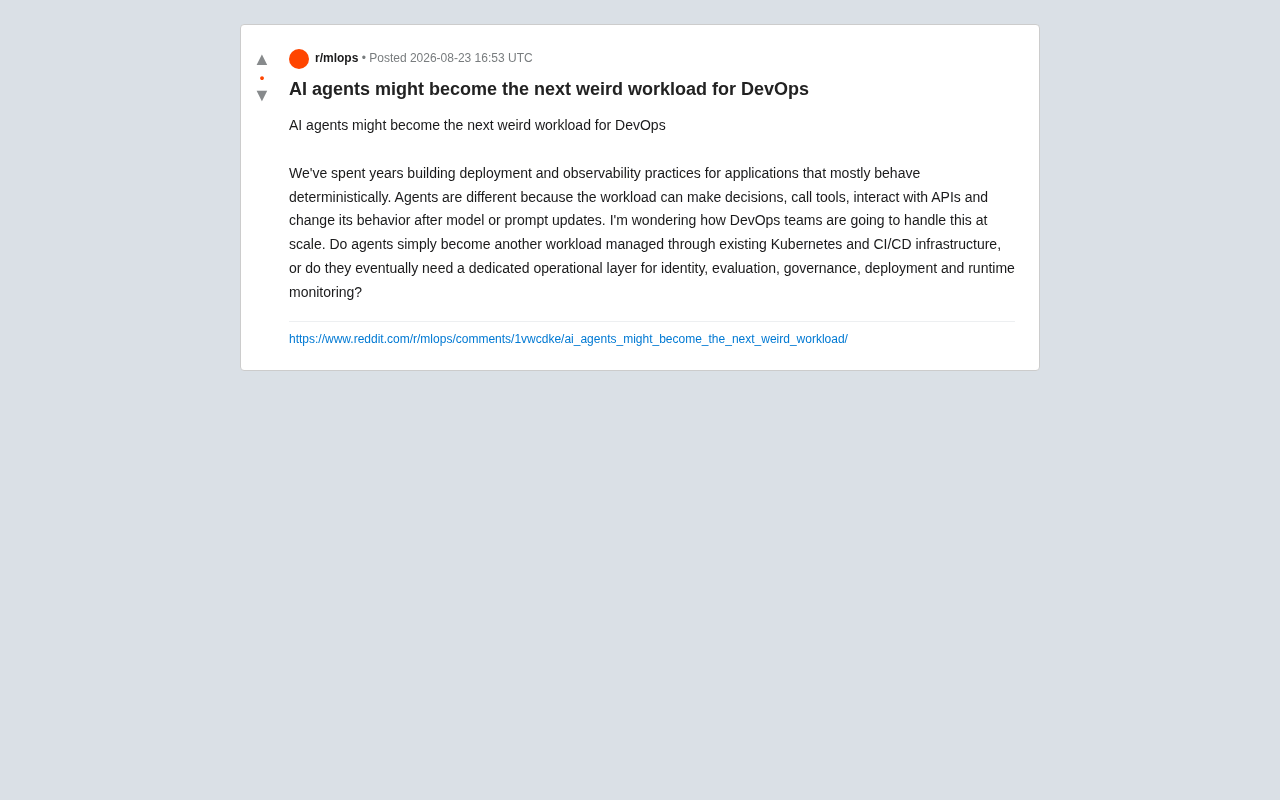
However, the rise of AI Agents is shaking this foundation. A recent Reddit discussion struck a chord with many: AI agents might become the next weird workload for DevOps. The word "weird" captures the essence of the problem perfectly.
Unlike traditional applications, Agent workloads can make autonomous decisions, invoke tools, and interact with APIs — and they can change their own behavior after a model or prompt update. This means the familiar "build-deploy-monitor" paradigm may no longer fully apply.
Why Agents Are a "Weird" Workload
The Operational Challenges of Non-Determinism
In traditional applications, a bug can usually be pinpointed through a fixed reproduction path. But Agent behavior is influenced by probabilistic model outputs — the same user request might follow entirely different execution paths due to subtle differences in temperature parameters, context windows, or model versions.
This gives rise to a series of thorny operational challenges:
- Regression testing breaks down: You can't validate a system that "thinks" using fixed assertions.
- Failures are hard to reproduce: An anomalous decision made by an Agent in production may never be reproducible in a test environment.
- Cascading effects of version updates: Upgrading the underlying model or modifying a single system prompt can cause unpredictable behavioral drift across the entire Agent.
The Complexity of Tool Calls and External Dependencies
An Agent isn't just an inference engine — it actively invokes external tools, accesses databases, and triggers APIs. This makes it more like an autonomous service orchestrator than a passively responding application. Its "side effect" boundaries are blurry: a single erroneous tool call can have real-world consequences — sending the wrong email, executing a dangerous database operation, or even calling a paid API and racking up unexpected charges.
The Core Debate: Reuse Kubernetes or Build a New Operations Layer
The original post raised a question well worth debating: Is an Agent just another workload to be managed through existing Kubernetes and CI/CD infrastructure, or will it ultimately require a dedicated operations layer?
The Case for Reusing Existing Infrastructure
Proponents of reuse argue that Agents are fundamentally still processes running inside containers. The resource scheduling, auto-scaling, and service discovery capabilities they need are all things Kubernetes already provides. From this perspective, an Agent is just another microservice that needs to be deployed and monitored, and existing CI/CD pipelines can handle it with minor modifications.
The advantage of this view is that it reduces organizational cost — teams don't have to throw out their existing toolchains and accumulated knowledge.
The Case for Building a Dedicated Operations Layer
The other camp argues that the unique nature of Agents demands a dedicated operations layer covering at least the following dimensions:
- Identity Management: Each Agent needs its own credentials for accessing tools and APIs, subject to fine-grained permission constraints.
- Quality Evaluation: You can't just check whether "the service is alive" — you also need to assess the quality of an Agent's decisions, output accuracy, and whether it's drifting from its intended goals.
- Behavioral Governance: Guardrails must be placed around Agent behavior to prevent unauthorized actions and harmful outputs.
- Multi-Dimensional Deployment: Version management for models, prompts, and tool configurations is far more complex than traditional code deployment.
- Runtime Monitoring: The focus of monitoring shifts from "resource metrics" to "behavioral traces," requiring you to track every reasoning step and tool invocation an Agent makes.
A Paradigm Shift in Observability: From System Metrics to Behavior Tracking
The operational demands of Agents are giving rise to an entirely new observability paradigm. The traditional three pillars — Metrics, Logs, and Traces — remain important but need to be extended to the semantic layer.
Behavioral Metrics Matter More Than System Metrics
For Agents, CPU and memory utilization are only the most basic information. The truly critical monitoring dimensions include:
- Which tools did the Agent invoke during this execution?
- What was the rationale behind each reasoning step?
- Was the decision chain reasonable, or did it fall into a meaningless loop?
- Does the output meet security and compliance requirements?
This requires observability tools that can track behavior at the semantic level, rather than merely staying at the technical metrics layer. The recently emerging LLM observability platforms — specialized tools for tracking prompts, token consumption, and tool call chains — are a direct product of this trend.
Continuous Evaluation Becomes an Operational Necessity
In traditional DevOps, testing primarily happens before deployment. But for Agents, evaluation needs to be continuous throughout the entire runtime. Due to behavioral non-determinism, an Agent that performs well at launch may gradually reveal problems under real traffic. Building an automated online evaluation mechanism (evals) will very likely become standard practice in Agent operations.
Practical Recommendations for DevOps Teams
As this field takes shape, DevOps teams can start preparing in the following areas:
- Reuse first, then evolve: There's no need to build a full-blown dedicated platform from the start. Begin by running Agents on your existing K8s and CI/CD infrastructure, and gradually identify which areas need specialized tooling.
- Prioritize identity and permissions: An Agent's autonomy means that permission sprawl poses the highest risk. Establishing a least-privilege identity system for each Agent should be the top priority.
- Invest in behavioral observability: Introduce observability tools capable of tracing reasoning chains and tool invocations as early as possible — don't let Agents become operational black boxes.
- Establish evaluation baselines: Define quantifiable behavioral quality metrics so that determining "whether an Agent is working correctly" is evidence-based rather than a gut feeling.
Conclusion
AI Agents are pushing DevOps into unfamiliar territory. They are neither purely applications nor purely models, but rather a hybrid workload that sits between the two and possesses autonomy.
In the short term, existing Kubernetes and CI/CD infrastructure is sufficient to support Agent operations. But as Agents scale up and grow more autonomous, a dedicated operations layer built around identity, evaluation, governance, deployment, and runtime monitoring will very likely take shape. This isn't about replacing existing DevOps practices — it's about adding a new capability layer on top of them, one specifically designed to handle "non-deterministic intelligent agents."
For engineering teams on the front lines, now is the best time to start thinking and experimenting — because this "weird" workload is about to become the new normal.
Related articles
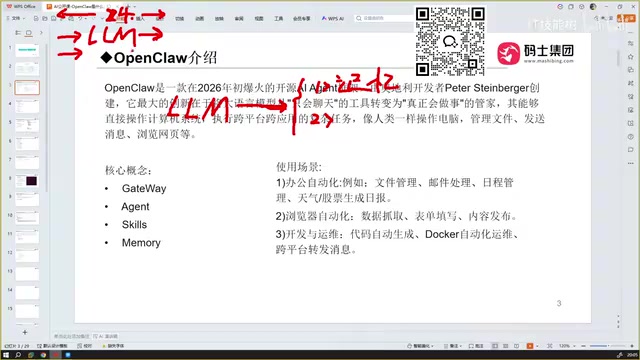
OpenClaw In-Depth Analysis: Agent Framework Capabilities and Three Critical Pitfalls to Avoid
In-depth analysis of OpenClaw Agent framework's core mechanisms, including Skill system, tool calling, and Channels remote control, plus three critical pitfalls: token costs, security risks, and intelligence limitations.
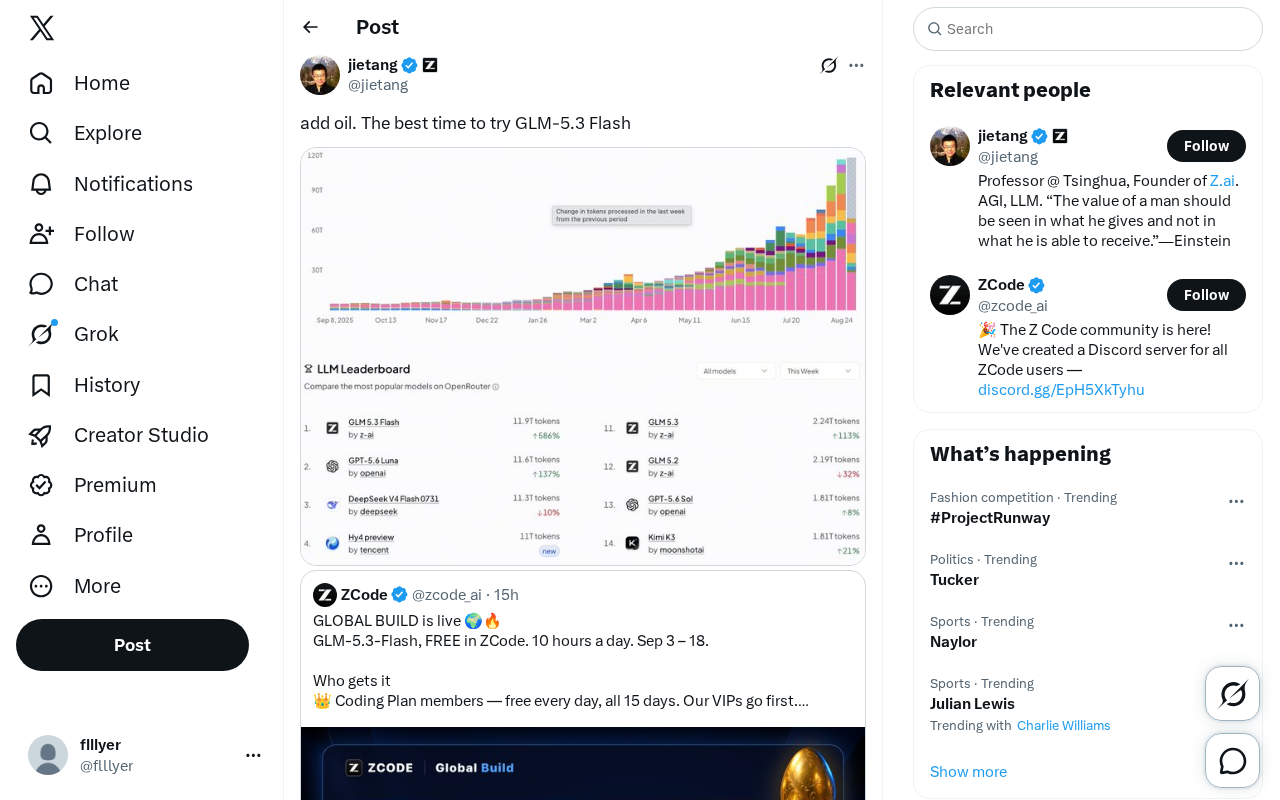
GLM-5.3 Flash: How Zhipu's Lightweight Model Is Racing to Dominate the Low-Cost Inference Market
Zhipu launches GLM-5.3 Flash, a lightweight model built for high-throughput, low-latency, low-cost inference. Learn about its positioning, GLM's evolution, and practical evaluation tips.
Engineered Bacteria to Replace Fertilizers for Global Crops as OpenAI's Internal Culture Crisis Emerges
Scientists use genetically engineered microbes to replace fertilizers via biological nitrogen fixation, cutting agricultural emissions. Meanwhile, OpenAI faces an internal culture crisis.