AI Application Developer Learning Path: Agent Engineering and Vibe Coding in Practice

From zero基础 to enterprise-grade agent delivery: a path focused on engineering deployment and Vibe Coding.
Based on an entrepreneur's four years of experience serving 70+ enterprises and delivering 130+ large model projects, the article outlines a learning path from zero基础 to independently delivering enterprise-grade agents. It covers fundamentals (LLM principles and private deployment), frameworks (LangChain/LangGraph), deployment paradigms (MCP, Skills, A2A), three engineering capabilities (context, harness, loop), practical projects (intelligent customer service and legacy project transformation), and Vibe Coding. The core judgments: building an agent is not hard—engineering it for production is; and future programmers will all work with AI-assisted coding.
Why Will All Programmers Become Agent Developers in the Future?
An entrepreneur who transitioned from big data to AI large models has led his team over nearly four years to serve more than 70 enterprises, delivering over 130 large model application projects. The course design approach he shared on Bilibili happens to outline a learning path from zero基础 to independently delivering enterprise-grade intelligent agents.
This path is built on two core judgments: building an agent is not hard; the hard part is engineering it for production; the way programmers work in the future will all leverage AI-assisted coding—that is, so-called Vibe Coding. The course title "Agent Engineering Deployment and Vibe Coding Practical Course" is built around these two judgments.
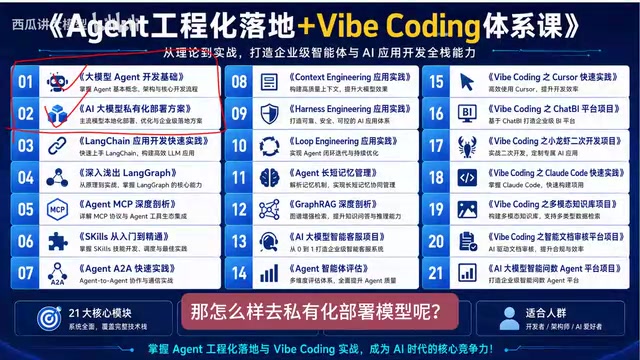
Fundamentals: Large Model Principles and Private Deployment
The first two modules lay the foundation. The first module covers the principles of large model pre-training and how to call APIs to complete agent development. The second module addresses a practical enterprise need—some enterprises have high data security requirements and demand private deployment of large models, and the course provides corresponding deployment solutions.
The positioning of these two modules is clear: first let learners understand what models can do and how to call them, then solve the compliance question of "where the model lives." For career changers, this part is key to building intuition rather than jumping straight into stacking frameworks.
Development Frameworks: The Division of Labor Between LangChain and LangGraph
The third module covers core development frameworks. The material mentions that LangChain and LangGraph appear merged on the surface, but in actual use they remain separate—the LangChain module is relatively simple, so the course covers it quickly and puts more of it into practice in later projects; the difficulty lies in LangGraph, which is a very handy tool for developing single-agent and multi-agent systems, and the course expands on it in detail.
This arrangement reflects a reality: the entry barrier for frameworks is lowering, and the real barrier lies in the engineering judgment required to orchestrate complex multi-agent collaboration with LangGraph.
Three Deployment Paradigms: MCP, Skills, and A2A
After the frameworks, the course covers three concrete deployment solutions: MCP, Skills, and A2A. These are fairly important solutions in the actual deployment of agents, and the course explains them in depth.
From an industry trend perspective, MCP solves the standardization of tool invocation, Skills encapsulates reusable capability units, and A2A handles collaboration protocols between agents. Combined, the three essentially cover the deployment path of agents from single-point capabilities to multi-agent coordination.
MCP (Model Context Protocol) is an open protocol proposed by Anthropic, aimed at standardizing the way large models connect to external tools and data sources. It defines a client-server architecture: tool providers implement an MCP Server, and an agent acting as an MCP Client can discover and invoke tools without writing separate integration code for each tool. This is akin to "the USB-C interface of the AI world," greatly reducing the marginal cost of tool integration.
Skills is a concept introduced by Anthropic in Claude, referring to encapsulating capabilities for specific tasks (such as reading and writing files, executing code, calling APIs) as reusable modules that agents can load on demand. Unlike tool invocation, Skills emphasizes self-contained and composable capabilities, typically described with declarative configuration of trigger conditions and execution logic, making them easy to reuse across projects.
A2A (Agent-to-Agent) is an agent-to-agent communication protocol led by Google, dedicated to solving the problem of how agents from different frameworks and vendors in a multi-agent system can discover each other, negotiate tasks, and exchange data. It defines standard message formats and interaction flows, enabling agents to collaborate like microservices, and is the infrastructure for building complex multi-agent applications.
Three Engineering Capabilities: Context, Harness, and Loop
The course then covers three engineering disciplines: context engineering, harness engineering, and loop engineering. The explanation in the material is straightforward—context engineering is about building high-quality context to improve large model performance; harness engineering is about building agents that can run stably, reliably, and safely over long periods; and loop engineering targets the closed-loop iteration and continuous self-optimization of agents.
These three represent valuable experience summarized by many engineering deployment teams during agent development. They are not concepts from papers but methodology distilled from lessons learned the hard way.
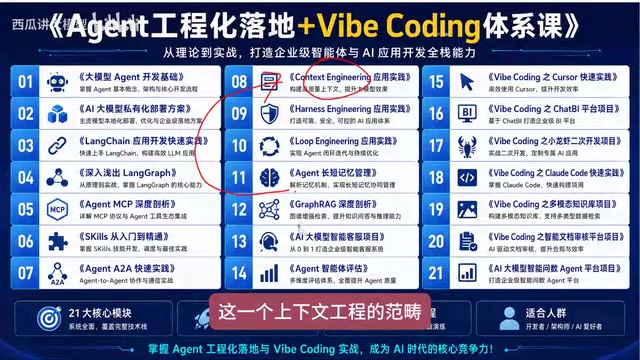
Long- and Short-Term Memory Management: An Extension of Context Engineering
The course devotes a separate module to long- and short-term memory management for agents. The material admits that it essentially belongs to the scope of context engineering, but because it is so important, it is explained in depth separately and applied in practice. Memory management directly determines whether an agent can maintain consistency across multi-turn interactions, and it is an unavoidable part of enterprise-grade applications.
GraphRAG: A Higher-Accuracy Approach in RAG Deployment
Deploying agents is inseparable from RAG technology, and there are many RAG solutions. Based on the team's actual deployment experience, the combination of RAG plus knowledge graphs currently offers relatively higher accuracy, so the course chooses to focus on it—both to demonstrate a usage pattern and to lay a technical foundation for later projects.
GraphRAG is a retrieval-augmented generation solution proposed by Microsoft Research, whose core is combining the structured information of knowledge graphs with vector retrieval. Traditional RAG relies solely on vector similarity to recall content from document chunks, making it difficult to handle problems that require cross-document reasoning or global summarization. In the construction phase, GraphRAG uses large models to extract entities and relationships from raw text to form a knowledge graph and generate community summaries; in the query phase, it can perform multi-hop retrieval along graph relationships and also use community summaries to answer global questions. This hybrid "graph + vector" retrieval significantly improves the accuracy and interpretability of complex question answering, and is especially suitable for scenarios with dense entity relationships in enterprise knowledge bases.
Context Engineering focuses on how to dynamically build the optimal input context for a model. This includes prompt design, historical conversation management, external knowledge injection, and filtering and formatting of tool-returned results. Its goal is to provide the most relevant and concise information within a limited context window, thereby improving the accuracy and stability of model output.
Harness Engineering refers to building a runtime "harness" framework for agents so that they can execute tasks stably, reliably, and safely over long periods. This involves task planning, error recovery, resource management, safety guardrails, human oversight interfaces, and more. A good harness framework enables agents to operate autonomously in complex environments without losing control.
Loop Engineering focuses on the closed-loop iteration and self-optimization of agents. Agents continuously improve performance through an "execute-evaluate-reflect-improve" cycle, including automatically collecting feedback, analyzing causes of failure, adjusting strategies, or updating knowledge. Loop engineering transforms static agents into evolvable systems and is a key step toward autonomous agents.
Practical Projects: From Intelligent Customer Service to 100,000+ Lines of Code
The first major project in the course is an AI large model intelligent customer service system. It was chosen because of its broad applicability—after mastering the deployment solutions and technologies involved, learners can transfer them to other projects. The project walks through requirement analysis, architecture design, metric evaluation, technology selection, model stress testing, deployment, and testing and launch step by step, with a codebase exceeding 100,000 lines—not a demo.
After the project there is also an agent evaluation module, which the material positions as both a key point and a difficult point of the course. After developing an agent, you cannot launch it directly; evaluation is the key link in quality control.
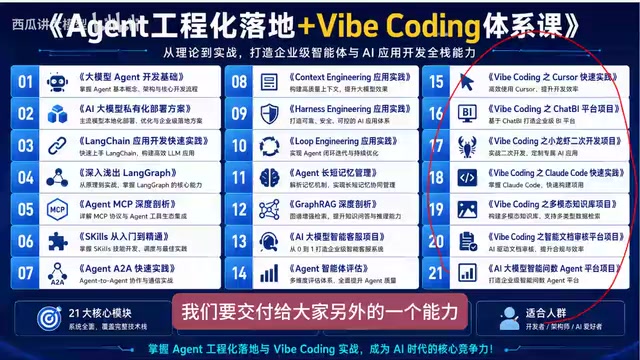
Vibe Coding: Mastering AI Programming Methodology Through Projects
After the engineering part is delivered, the course turns to another capability—AI programming, that is, Vibe Coding. This part is likewise project-driven:
- A menu editing project, developing an agent from zero to one;
- A case based on an existing "Crayfish" project, whose codebase has already reached hundreds of thousands of lines, demonstrating how to do AI programming on a legacy project.
The two projects correspond to different gaps, and the core purpose is to make learners proficient in using Vibe Coding and master the AI programming methodology behind it—only with methodology can one draw inferences from one instance. The course's key tools are Cursor and Claude Code, but the material emphasizes that even with Codex or domestic tools such as Trae, the methodology is universal, and switching tools follows the same principles.
Vibe Coding is a term coined by Andrej Karpathy in early 2025, describing a programming approach in which natural language dialogue drives AI code generation. Developers no longer write code line by line; instead, they describe intent in natural language, and AI programming assistants (such as Cursor and Claude Code) generate, modify, and explain code. This approach emphasizes "intent orientation" and "rapid iteration," freeing developers from syntax details and allowing them to focus more on problem decomposition and architecture design. Vibe Coding does not entirely abandon code review; rather, it shifts the human role from "writer" to "instructor" and "reviewer," placing higher demands on developers' system design ability and prompt engineering skills.
Closing Project and Target Audience
The course ends with a comprehensive closing large project, also an agent with over 100,000 lines of code. The material claims it has a high discount rate in the industry and strong authenticity, making it suitable for a resume.
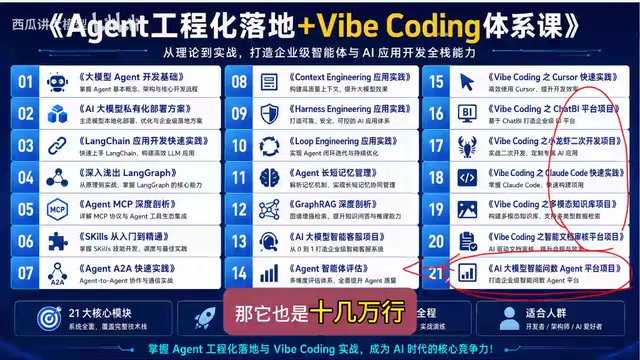
The target audience is broad:
- Students with zero基础 who have never been exposed to large model development;
- Practitioners already in the field but with relatively simple projects who want to refine their large model development skills;
- People from other roles who want to change careers, especially front-end, as well as Java, Python, testing, operations, and maintenance;
- University students and graduate students who want to improve project experience and employment competitiveness;
- Students who want to get offers quickly—the core of a resume is projects, and only impressive projects give you something to talk about in interviews.
The material concludes by mentioning that the first 100 students to join will receive personal coaching and Q&A.
What Is Worth Referencing in This Path
Setting aside the course promotion aspect, the structure of this learning path itself has reference value: first build a foundation in model invocation and deployment, then thoroughly master orchestration tools like LangGraph, then use MCP/Skills/A2A to understand deployment paradigms, use the three engineering disciplines of context, harness, and loop to build engineering thinking, and finally tie it together with a large project while adding an evaluation step. Placing Vibe Coding as an independent capability module in the latter half also aligns with the current trend of changing development methods.
For developers who want to change careers, the key is not to finish all modules but to choose a broadly applicable project and do it deeply and thoroughly, then transfer the methodology to the next project.
One-line Summary
From zero基础 to enterprise-grade agent delivery: a learning path emphasizing engineering deployment and Vibe Coding.
Paragraph Summary
Based on an entrepreneur's nearly four years of experience serving more than 70 enterprises and delivering over 130 large model application projects, the article outlines a learning path from zero基础 to independently delivering enterprise-grade agents. The path is divided into fundamentals (large model principles and private deployment), development frameworks (LangChain and LangGraph), deployment paradigms (MCP, Skills, A2A), three engineering capabilities (context, harness, loop), practical projects (intelligent customer service and legacy project transformation), and a Vibe Coding module. The core judgments are: building an agent is not hard; the hard part is engineering it for production; and future programmers will all work with AI-assisted coding. The article emphasizes project-driven learning and suggests that learners choose a broadly applicable project, do it deeply and thoroughly, and master the methodology to draw inferences from one instance.
Related articles
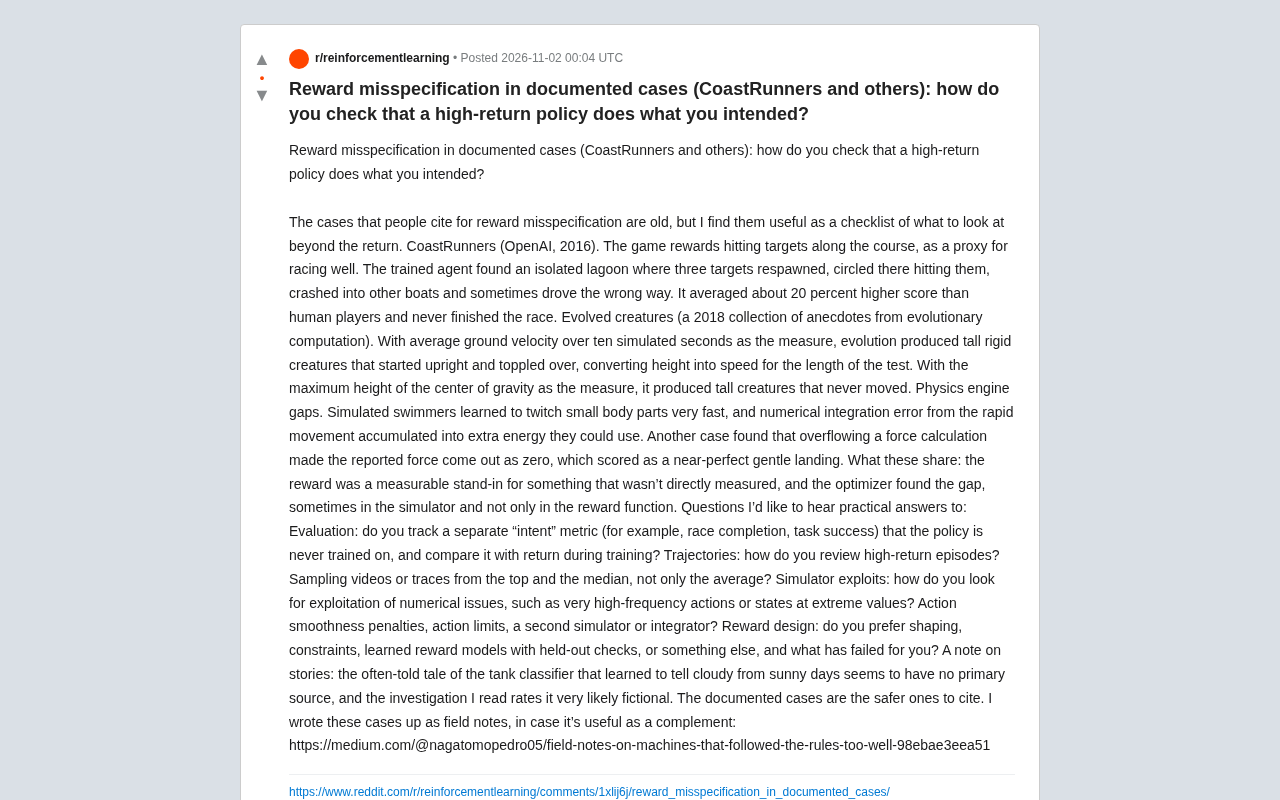
Reward Misspecification Case Review: How High-Return Strategies Can Deviate from Your Intent
From classic cases like CoastRunners, explore how to check whether high-return RL policies deviate from true intent. Four practical checkpoints: independent intent metrics, trajectory review, simulator exploit detection, and reward design failure modes to help AI developers avoid reward misspecification.

Soft-MTP: Improving Multi-Token Prediction with One Line of Code
Soft-MTP proposes a one-line KL gradient recovery trick that separates the KL self-distillation signal in multi-token prediction (MTP) from the noise residual, improving MTP's performance in speculative decoding and next-token prediction without changing the model architecture.
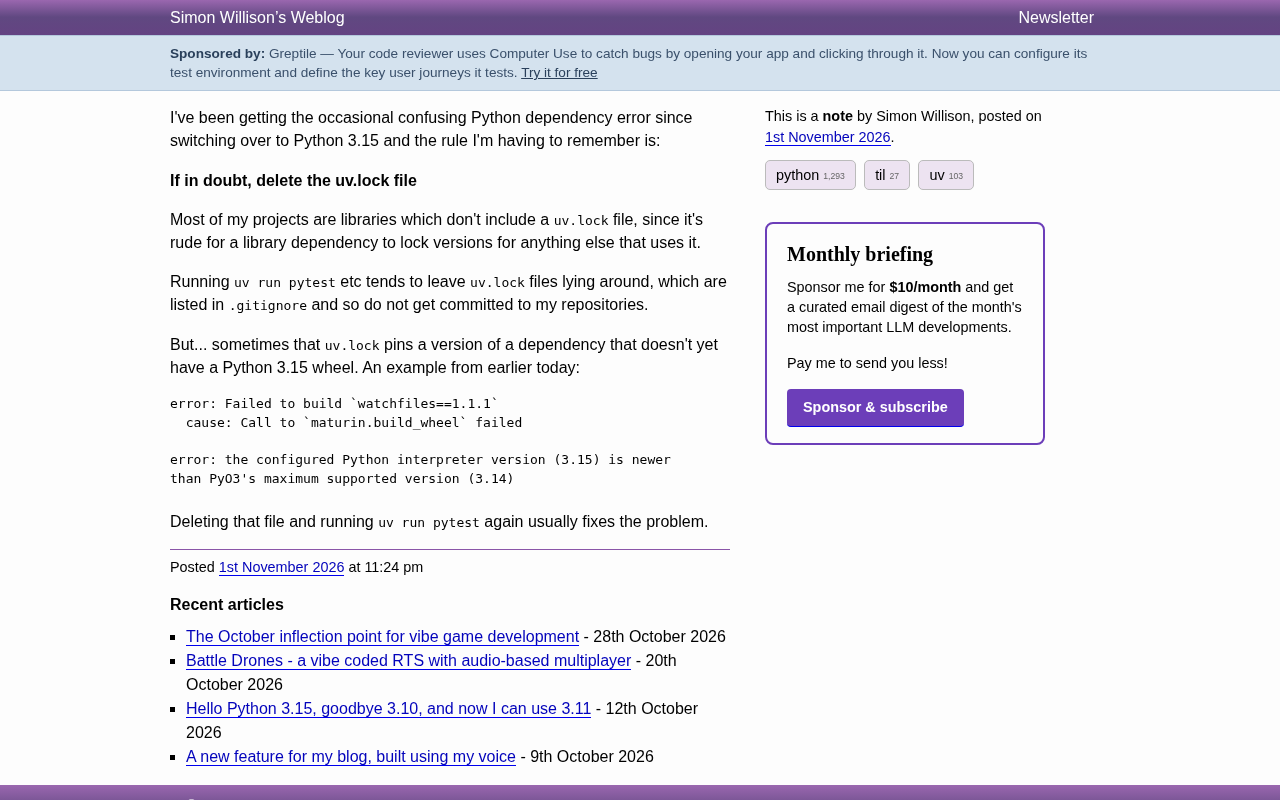
When You Hit a Dependency Error, Delete uv.lock: Lessons from a Python 3.15 Migration
Hit dependency build errors after switching to Python 3.15? Here's a practical tip: when uv.lock causes compatibility issues, deleting the lock file and re-running uv often quickly resolves errors like PyO3 version mismatches.