AI Application Implementation Tutorial: Evolution and Practice from Copilot to Agentic AI

AI applications are moving from Copilot assistance to Agentic AI autonomous execution; learning focus should shift to multi-agent collaboration and autonomous decision-making architecture.
The article outlines the three-stage evolution of AI applications from ChatGPT chatting and Copilot assistance to Agent autonomous execution, noting that products like Manus and Cloud Code in 2025 marked the establishment of the Agent model, with AI bearing about two-thirds of production. The Agentic AI taking shape in 2026 further features multi-agent division of labor and reflective adjustment, with the market growing from 2026 to 2029 and 75% of enterprises having piloted or implemented it. Faced with rapid technological iteration, the article advises learners to focus on architectural-level thinking frameworks that are hard to replace, using a Bilibili tourism planning course to illustrate its teaching mainline covering Graph engine, JManners, Agent Scope, ReAct, MCP, and Agent Skills.
The Three-Stage Evolution of AI Applications: From Chatting to Autonomous Execution
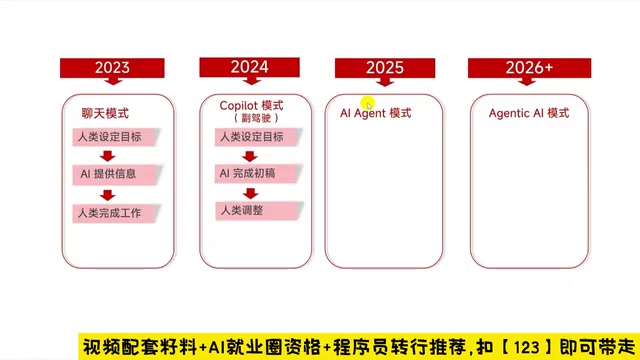
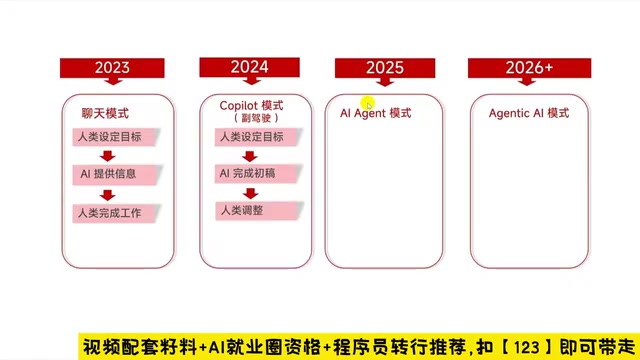
Looking back at the development of AI applications, three distinct stages of advancement are clearly visible. After OpenAI launched ChatGPT in 2023, AI primarily played the role of a "giant search engine." Users entered questions in a dialog box, the model understood the intent and returned information, but actually completing the work still required humans to open Excel or PowerPoint for secondary processing. At this point, AI accounted for a very low proportion of production, and the main productive force remained human.
By 2024, AI began to initially intervene in the production process, with the best-implemented scenario being AI programming. AI editors represented by Copilot allowed developers to have AI write code through conversation. However, AI could only control local information; the overall project structure, file creation, and debugging still required human intervention. Under this "co-pilot" model, AI bore about one-third of the productivity, and humans remained the primary operators.
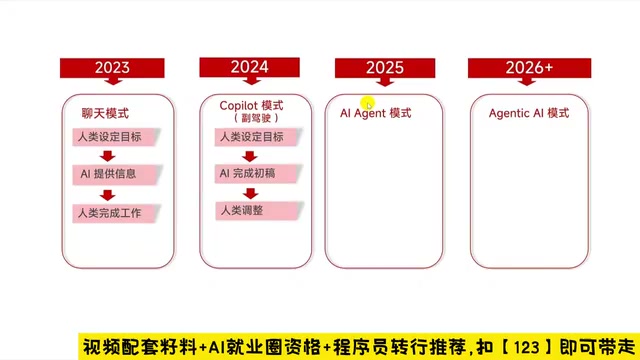
In 2025, two disruptive products emerged: Manus and Cloud Code. Manus can automate complex projects from start to finish—for example, scraping a company's Q3 business data, filtering information, writing it to a local Excel file, and generating charts, all without human intervention. Cloud Code is a minimalist dialog box where users simply describe the desired functionality or project, and code writing, file generation, and project architecture are all completed by AI. This marked the establishment of the AI Agent model: AI bears two-thirds of the production process, and humans are responsible for setting goals, providing resources, and defining rules.
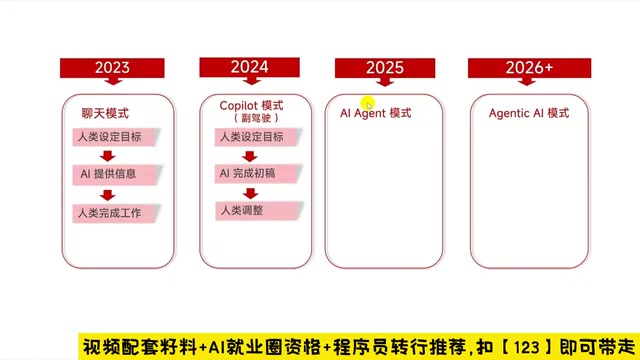
Copilot mode (co-pilot mode) refers to AI participating in work as an auxiliary tool for humans, with humans always holding the dominant role. The typical representative is GitHub Copilot: when developers write code in the editor, AI completes code snippets or generates functions in real time based on context, but project architecture design, requirement breakdown, and debugging decisions are still made by humans. In contrast, in Agent mode (intelligent agent mode), AI is given greater autonomy—it can perceive the environment, formulate plans, call tools, and execute multi-step tasks, while humans retreat to being goal setters and reviewers of results. The essential difference between the two lies in the allocation of control: Copilot is "human-led, AI-assisted," while Agent is "AI-led execution, human-led decision-making." The leap from Copilot to Agent means that AI transforms from a tool that passively responds to instructions into an execution entity that can proactively advance task workflows, which is the fundamental reason the article emphasizes the increase in productivity share from about one-third to two-thirds.
Agentic AI: Multi-Agent Collaboration and Autonomous Decision-Making
By the end of 2025, the Agent model evolved further. When facing complex tasks, the system can break them down into subtasks and assign them to multiple Agents with corresponding domain expertise for collaborative work. At the same time, Agents possess reflective adjustment capabilities—after executing a step, they evaluate whether the result meets the goal, and if inaccurate, adjust the steps until they align with the preset goal. This is the Agentic AI model taking shape in 2026.
From market data, the AI Agent market size shows a trend of gradual increase from 2026 to 2029, and currently 75% of enterprises have piloted or implemented AI Agents in the production process. Some viewpoints suggest that with AI Agents, one person can have digital employees equivalent to an entire company. The core judgment of this tutorial is: superficial new technologies are easily replaced, while the thinking frameworks of multi-agent collaboration and autonomous agent decision-making have long-term stability.
ReAct framework (Reasoning + Acting) is a classic paradigm that enables large language models to possess autonomous reasoning and action capabilities. Its core idea is to have the model alternate between "reasoning" (Thought) and "acting" (Action): the model first analyzes the current state and breaks down the next goal, then chooses to call a tool or execute an operation, observes the returned result (Observation), and continues reasoning, looping until the task is complete. This "think—act—observe" closed loop enables Agents to no longer output answers in one shot, but to dynamically adjust strategies based on intermediate results. The value of ReAct lies in solving the fragmentation problem of pure reasoning models "thinking without doing" and pure tool-calling models "doing without thinking," combining the reasoning capabilities of language models with the perception and execution capabilities of external tools. The article mentions that the course focuses on the ReAct thinking framework precisely because it is the theoretical cornerstone of the autonomous thinking and execution part; only by understanding the ReAct loop mechanism can one further master the engineering implementation of MCP tool calling and Agent Skills process-based execution.
Course Mainline: Practical Architecture with Tourism Planning as the Background
This tutorial takes the "DNA model" (autonomous AI) as its mainline, uses tourism planning as the business background, and explains the two cores of Agentic AI: multi-Agent collaboration and Agent autonomous thinking and execution.
In the multi-Agent collaboration section, the course introduces two design philosophies: one is a workflow orchestration application framework centered on the Graph engine; the other is the Agent autonomous proxy design philosophy, which is the focus. The latter involves two Agentic application frameworks—JManners (which can be regarded as a Java version of Manus) and Agent Scope (part of the Spring AI Alibaba ecosystem), and the course also covers the basics of Spring AI Alibaba.
In the autonomous thinking and execution section, the course focuses on the ReAct thinking framework to equip Agents with autonomous reasoning capabilities. At the execution level, it covers tool usage (MCP) and Agent Skills—the latter enables Agents not only to call tools to complete tasks but also to complete work according to a full set of professional processes, and is a currently hot technology attracting much attention.
Through this course, learners can master the ReAct autonomous decision-making model, multi-agent collaborative architecture design, Agent Skills engineering encapsulation, and intelligent development capabilities with popular technology stacks, ultimately obtaining a complete systematic solution for AI application implementation.
MCP (Model Context Protocol) is an open protocol proposed by Anthropic, aimed at standardizing the connection between large language models and external tools and data sources. Before MCP, every Agent application that needed to connect to databases, file systems, or third-party APIs had to write separate adapter code, forming a large amount of repetitive and hard-to-reuse "glue layer." MCP abstracts these capabilities into a unified "tool server" interface, and Agents only need to declare according to the protocol to discover and call various tools, just like providing a universal "USB interface" for AI applications. The article lists MCP as a key technology at the execution level because it solves the standardization problem of Agent capability expansion—whether connecting to search, file operations, or business systems, the same protocol can be reused. Agent Skills, which is parallel to MCP, goes a step further: it not only enables Agents to call individual tools but also encapsulates multiple tools and professional processes into reusable skill modules, enabling Agents to complete a complex task fully according to established professional standards.
Key Points
- AI applications are evolving from the Copilot assistance model to the Agent autonomous execution model, with Agentic AI becoming the core trend
- Multi-agent collaboration and autonomous decision-making thinking frameworks have long-term stability and are not easily replaced by new technologies
- The AI Agent market size will continue to grow from 2026 to 2029, and 75% of enterprises have already piloted or implemented it
- The course uses tourism planning as the background and covers Graph engine, JManners, Agent Scope, ReAct, MCP, and Agent Skills
- Learning focus should be on architecture-level capabilities rather than superficial tool usage
One-line Summary
The AI application is moving from Copilot assistance to Agentic AI autonomous execution, and the learning focus should shift to the architectural capabilities of multi-agent collaboration and autonomous decision-making.
Paragraph Summary
The article outlines the three-stage evolution of AI applications from ChatGPT chatting and Copilot assistance to Agent autonomous execution, noting that products such as Manus and Cloud Code in 2025 marked the establishment of the Agent model, with AI bearing about two-thirds of the production process. The Agentic AI taking shape in 2026 further possesses multi-agent division of labor and reflective adjustment capabilities, and the market size will continue to grow from 2026 to 2029, with 75% of enterprises having piloted or implemented it. Faced with the anxiety of rapid technological iteration, the article advises learners to focus on architectural-level thinking frameworks that are not easily replaced, and uses a Bilibili practical course on tourism planning as an example to introduce its teaching mainline covering Graph engine, JManners, Agent Scope, ReAct, MCP, and Agent Skills.
Related articles

DeepSeek's New Model Head-to-Head: Who's Better at Generating Japanese Urban Clusters?
Bilibili creator tests DeepSeek's new checkpoint Flash 1017: stunning on Japanese modern urban cluster generation, second only to Opus 5.5, while GLM 5.3, Kimi K3, Qwen 3.8 Flash and others stumbled.

DeepSeek V4.1 Flash 1017 Breakdown: It Won the Benchmarks, But at What Cost?
DeepSeek V4.1 Flash 1017 update 37 days later: official benchmarks improve but third-party tests show the main win is shorter output. Breakdown of benchmarks, cost accounting, and hidden costs of a 5-hour outage, with upgrade advice for three user types.

Actress Misdiagnosed with Multiple Sclerosis for Five Years: Can AI Solve the MS Diagnostic Dilemma?
Actress Christina Applegate's five-year MS misdiagnosis raises awareness. We analyze why MS lacks a gold-standard test, the causes of the ~15% false-positive rate, and how AI and new diagnostic guidelines could improve accuracy—along with their limits.