AI Autonomously Fixing Bugs: A Practical Methodology for Data Loop-Driven Agent Self-Iteration

How data feedback loops enable AI Agents to autonomously find, fix, and verify bugs.
This article explores how AI Agents achieve autonomous bug fixing through data loop-driven self-iteration. Using a real case where an Agent independently discovered a TTS bug, wrote a fix, passed all tests, and verified the user experience, it reveals three core principles: clearly defining 'done,' designing measurable feedback signals, and ensuring feedback flows back to form a closed loop.
At 7:34 AM, an AI Agent Autonomously Fixed a Bug
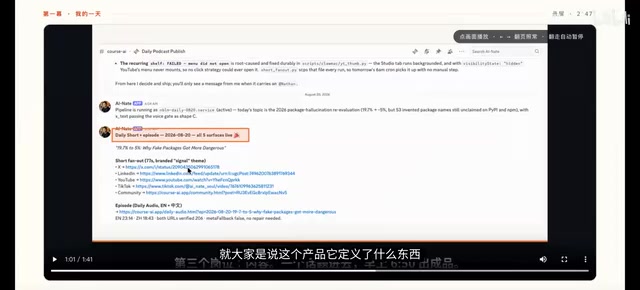
During a public lecture at Moonshot Academy, the speaker shared a real-world case: at 7:34 one morning, an AI Agent proactively discovered an actual bug in a product — the text-to-speech function for Filipino script (Filipino/Fijian and similar languages) was failing 100% of the time. A user working in Hindi clicked the read-aloud button twice and received only error messages both times.
An AI Agent refers to an AI system capable of perceiving its environment, making autonomous decisions, and executing actions. Unlike traditional conversational AI, Agents possess capabilities for goal decomposition, tool invocation, multi-step reasoning, and autonomous action. In the software engineering domain, Agents can integrate code repository access, static analysis tools, testing frameworks, and deployment pipelines to form an end-to-end automated repair chain. The Filipino script TTS (Text-to-Speech) failure mentioned in this case involves multilingual support — the kind of edge case easily overlooked in traditional manual QA processes, yet precisely the area where AI continuous monitoring excels.
This Agent did far more than just "discover the problem." It pinpointed the exact line of code causing the error, wrote a fix, ran all tests (28 tests passed), and verified that without the patch, 15 test cases would have failed.
What impressed the speaker most was how the Agent wrapped up: it didn't treat "deployment successful" as task completion. Instead, it went back and reproduced the original failure scenario, confirming that the user could now actually hear the audio. This led to the core principle of the entire talk — first, clearly define what "done" actually means.
Redefining the "Done" Standard for Agents
In traditional software development, "deployment successful" often signals the end of a task. But in the context of Agent self-iteration, this standard falls far short. True "done" should mean the problem is thoroughly resolved and real user value has been delivered.
This might seem like a subtle adjustment in standards, but it's actually the critical prerequisite for whether an Agent can work reliably — only with a clear definition of completion does the AI know how far to iterate and at what granularity to verify. In software engineering, this aligns with the concept of "Acceptance Criteria," but for Agents, acceptance criteria must be formalized descriptions that are machine-understandable and automatically verifiable, rather than vague human-language expressions.
Core Design Principle: Building Data Loops to Drive Agent Self-Iteration
The core concept the speaker repeatedly emphasized was the Data Loop. When building an Agent system, the most important thing to think through is "how to construct a data loop."
A data loop means: an AI Agent produces a result, and behind that result there must be a feedback signal. If you can feed this feedback information back into the Agent system, it can continuously self-iterate and self-optimize based on that information.
The data loop concept originates from the feedback loop thinking in Cybernetics, first proposed by Norbert Wiener in 1948. In machine learning, this idea manifests as the "observe-act-reward" cycle in Online Learning and Reinforcement Learning. In recent years, with the rise of LLM Agent frameworks (such as LangChain, AutoGPT, CrewAI), the data loop has been concretized as: Agent executes task → environment returns results → results evaluated → prompt/strategy adjusted → execute again. This aligns closely with the CI/CD (Continuous Integration/Continuous Deployment) philosophy in DevOps, but Agents bring the human judgment step into the automation scope as well.
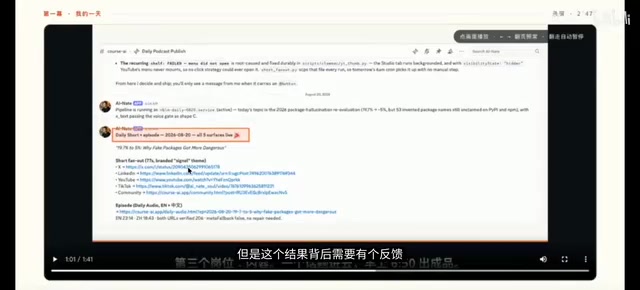
Returning to the bug-fixing case, the data loop is demonstrated perfectly:
- Producing results: Agent discovers the bug and generates fix code
- Obtaining feedback: Running tests (28 passed, 15 would have originally failed)
- Verification feedback: Reproducing the failure scenario, confirming the user can actually hear audio
It's precisely this loop that upgrades AI from a "one-shot execution tool" to a "system capable of continuous improvement." An Agent without feedback signals is like working blindfolded — it can never know whether it's doing things right.
Why Feedback Loops Determine Agent System Reliability
For developers building AI applications, this is a highly inspiring design principle. The reason many Agent systems are "unreliable" is fundamentally the lack of a feedback loop — they can generate content but cannot verify its correctness, let alone self-correct based on verification results.
This also explains why many current Agent applications perform impressively in demos but frequently "crash and burn" in production environments. Demo environments often have humans nearby for real-time correction, while production environments require Agents to autonomously judge right from wrong. Without built-in feedback mechanisms, an Agent is essentially performing "open-loop control" — issuing commands without checking results — an unreliable design in any engineering system.
Once a data loop is established, the system gains the ability to "improve with use." This is the fundamental logic behind AI Agent self-iteration.
Understanding Agent Loops by Comparing Traditional Product Development
To help the audience better understand the significance of Agent self-iteration, the speaker compared it against traditional industry product development processes.
Six Steps of Traditional Product Development
Using the example of building a TikTok-like product, traditional development roughly follows this path:
- Finding user needs: First define a problem. For example, the problem TikTok aims to solve is "helping people spend their idle time on interesting things."
- Understanding target users: Research who the users behind the problem are. TikTok's early users were primarily young people with a desire to express themselves and share their lives.

- Defining ICP: Determine the Ideal Customer Profile to lock in the target user group. ICP is a market positioning tool commonly used in the SaaS industry, helping teams focus on the most valuable user segments. It typically includes demographics, behavioral characteristics, pain points, and purchase motivations. In the AI era, ICPs can be dynamically generated and updated by AI through user behavior data, evolving from static documents into real-time models.
- Writing the PRD: Product managers write a Product Requirement Doc specifying what features the product should implement. The PRD is the core communication vehicle between product managers and engineering teams, typically containing user stories, functional specifications, acceptance criteria, and priority rankings. Notably, the "acceptance criteria" section of PRDs is evolving into the Agent's "definition of done" — machine-understandable, automatically executable success conditions.
- Handing off to development: The product manager hands the PRD to the development team, and engineers implement it.
- Launch and feedback iteration: After launch, gather user feedback, then iterate the product based on that feedback — filling gaps, improving shortcomings, and strengthening features users love.
The Leap from Manual Loops to Agent-Automated Loops
The traditional product development process is itself a "data loop" — except every step in this loop is driven by humans, with cycles measured in weeks or even months. Product managers define problems, developers implement, users provide feedback, and teams iterate again.
The revolutionary aspect of Agent self-iteration is that it compresses this loop to machine-executable granularity and speed. In the earlier case, from discovering the bug, locating the code, writing the fix, running tests, to verifying user experience, the entire loop was completed autonomously by AI in an extremely short time — even happening in the early morning before developers had woken up.
The technical foundations for this leap include the maturation of several key capabilities: first, large language models' code comprehension and generation abilities (GPT-4, Claude have reached considerable proficiency on code tasks); second, the standardization of Function Calling and Tool Use interfaces, enabling Agents to operate in real development environments; third, the maturation of Observability infrastructure, including log aggregation, distributed tracing, and anomaly detection systems, providing Agents with "eyes" to perceive their environment. Traditional development loop cycles are typically 1-4 weeks (one Sprint), while Agent loops can be compressed to the minute level. This order-of-magnitude speed difference isn't merely an efficiency improvement — it may give rise to entirely new software maintenance paradigms, shifting from "humans discover problems then fix them" to "AI preventive maintenance."
Three Core Insights for Agent Developers
This talk used specific cases as entry points to reveal the underlying methodology for building reliable Agent systems:
First, clearly define "done." Don't let the Agent treat intermediate states (like successful deployment) as endpoints. Instead, measure by actual user value delivery. This is the prerequisite for reliable Agent operation. In practice, this means defining clear "Termination Conditions" for each Agent task, similar to the "Terminal State" concept in reinforcement learning — the Agent must know what state means the task is truly finished.
Second, design measurable feedback signals. In the case, "28 tests passed," "15 cases would have failed," and "the user can actually hear audio" are all clear, quantifiable feedback. The clearer the feedback, the stronger the data loop. Good feedback signals should have three characteristics: automatically collectible (not dependent on human judgment), clear thresholds (able to distinguish success from failure), and strong timeliness (obtainable within a reasonable timeframe).
Third, let feedback flow back into the system to form a loop. Feedback shouldn't just be recorded — it must genuinely feed back into the Agent to become input for its next iteration. This is the core mechanism of "self-iteration." In technical implementation, this can be accomplished through multiple approaches: injecting test results into the Agent's context window, updating the Agent's Working Memory, adjusting the task priority queue, or fine-tuning the Agent's behavioral strategy over longer time horizons.
Looking at the vision of "AI discovering bugs itself, fixing them itself, and verifying them itself," future software systems will increasingly possess self-maintenance and self-evolution capabilities. For every developer currently building Agent systems, thinking clearly about "where is my data loop" may be a more critical question than which foundation model to choose.
Key Takeaways
Related articles

Uber Deploys ChatGPT Work Company-Wide: AI in the Workplace Enters the Scaled Implementation Phase
Uber deploys ChatGPT Work to 30,000+ employees, extending it from engineering to all roles. We analyze its expert-engineer pairing, end-to-end automation, and questions of AI control and power concentration—insights for scaling AI in the workplace.

Shift at Midnight Hands-On: When "ID Verification" Becomes Alien Hunting
Shift at Midnight blends ID verification with horror survival in a four-player co-op game. We break down its inspection mechanics and chaotic humor.

Zelensky Recounts the Outbreak of War: I Need Ammunition, Not a Ride
Zelensky recalls the first day of war in a YouTube interview: farewell to family, rejecting Biden's evacuation offer with "I need ammunition, not a ride," and how Bucha shaped his stance on compromise and peace talks.