AI Large Language Model Zero-to-Hero Systematic Tutorial: A Complete Guide from Basics to Practice

A complete zero-to-hero LLM tutorial covering RAG, Agent, fine-tuning, and enterprise-level AI projects.
This systematic 748-episode AI large model tutorial provides a complete learning path from fundamentals to enterprise practice. It covers LLM basics, Transformer architecture, Prompt Engineering, and three core advanced technologies: RAG (Retrieval-Augmented Generation), AI Agents, and model fine-tuning. Practical projects include enterprise knowledge bases, AI customer service, medical Q&A systems, and digital humans, using frameworks like LangChain and LangGraph.
Course Overview: Why You Need a Systematic LLM Tutorial
In an era of rapidly evolving AI large model technology, learning resources may seem abundant but are actually highly fragmented. This Bilibili tutorial series, boasting "a full 748 episodes," attempts to solve a core pain point: existing LLM tutorials on the market aren't systematic or comprehensive enough.
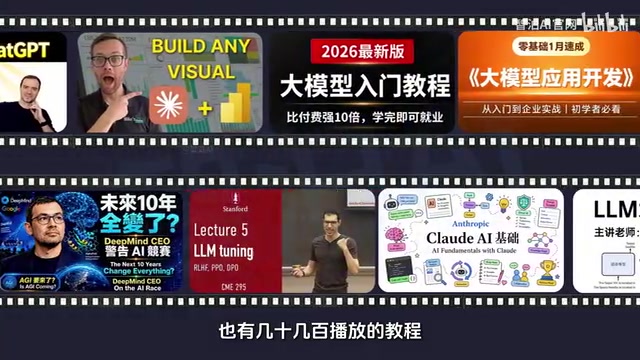
The creator claims to have spent a month before production researching various LLM tutorials on Bilibili—from those with hundreds of thousands of views to those with just a few hundred—ultimately concluding that there was a lack of a complete curriculum that both beginners could understand and that offered sufficient hands-on practice.
This course took three months to produce, combining "knowledge + hands-on practice" and covering three major modules: Fundamentals, Advanced, and Practical. The goal is to ensure learners are "absorbing knowledge points every single second."
Course Architecture: A Three-Stage Progressive Learning Path
Fundamentals: Building a Cognitive Framework for Large Models
The fundamentals section is designed to help learners build a complete understanding of large models from scratch, step by step:
- LLM Basic Concepts: Understanding what Large Language Models (LLMs) are, grasping their fundamental principles and typical application scenarios
A Large Language Model (LLM) is a deep learning-based natural language processing model that learns statistical patterns and semantic relationships in language through pre-training on massive text datasets. Its core idea is "Next Token Prediction"—given a text sequence, the model predicts the most likely next word. Modern LLMs like GPT-4, Claude, and LLaMA typically have billions to trillions of parameters, which are continuously optimized through backpropagation during training. Notably, "Emergent Abilities" refer to advanced capabilities like reasoning and code generation that appear when parameter scale exceeds certain thresholds—capabilities absent in smaller models. This is a key characteristic distinguishing large models from traditional NLP models.
- AI Development Environment Setup: Configuring a local Python development environment to prepare for subsequent hands-on work
- Transformer Core Architecture: Deep-diving into the underlying technical architecture of large models, understanding key concepts like the attention mechanism
Transformer is a neural network architecture proposed by the Google team in the 2017 paper Attention Is All You Need, which fundamentally transformed the technical paradigm of NLP. Its core innovation is the Self-Attention mechanism, which allows the model to attend to information from all other positions in a sequence when processing each position, thereby capturing long-range dependencies. Compared to previous RNN and LSTM architectures, Transformer supports highly parallelized computation, dramatically improving training efficiency. A complete Transformer contains both an Encoder and a Decoder: BERT-type models primarily use the encoder and excel at understanding tasks; GPT-type models primarily use the decoder and excel at generation tasks. Multi-Head Attention, Positional Encoding, Layer Normalization, and Feed-Forward Neural Networks (FFN) are its four core components.
- Prompt Engineering: Mastering methodologies for efficient interaction with large models, learning to write high-quality prompts
- API Calls: Learning to invoke LLM capabilities through programming interfaces to build automated applications
The core value of this stage lies in helping beginners build systematic understanding rather than staying at the surface level of "knowing how to use ChatGPT."
Advanced: Mastering the Three Core Technologies—RAG, Agent, and Fine-tuning
The advanced section focuses on the three core directions in current LLM application development:
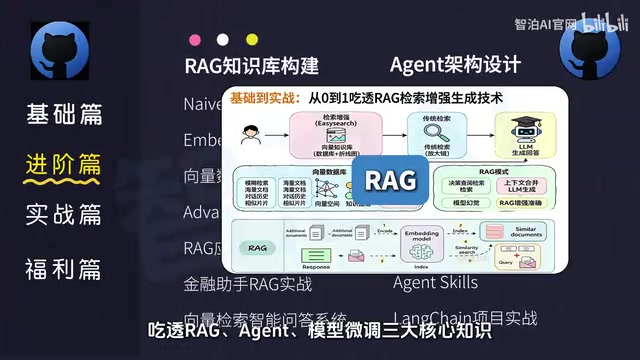
- RAG (Retrieval-Augmented Generation): Enabling LLMs to answer questions based on external knowledge bases, effectively addressing model hallucinations and knowledge currency issues
RAG (Retrieval-Augmented Generation) is a technical framework proposed by Facebook AI Research in 2020. Its core idea is to retrieve relevant information from an external knowledge base before the LLM generates an answer, injecting the retrieved results as context into the prompt so the model generates responses based on real data. A typical RAG pipeline includes: Document Chunking → Embedding → Storage in a vector database (e.g., Milvus, Pinecone, Chroma) → Semantic retrieval at query time → Feeding Top-K results along with the question into the LLM for answer generation. RAG effectively addresses three major LLM pain points: knowledge cutoff date limitations, insufficient domain knowledge, and hallucination (the model fabricating non-existent information). Advanced RAG techniques also include query rewriting, hybrid retrieval (keyword + semantic), reranking, and other optimization strategies.
- Agent (AI Agents): Empowering LLMs with autonomous planning, tool invocation, and task execution capabilities to achieve more complex automated workflows
AI Agents represent an advanced form of LLM applications. The core concept is enabling LLMs to not just "answer questions" but autonomously plan task steps, invoke external tools, observe execution results, and iteratively optimize. Classic Agent architectures follow the "Perceive-Plan-Act" loop, with notable examples including AutoGPT and BabyAGI. Key Agent capabilities include: task decomposition (breaking complex goals into executable subtasks), tool use (calling search engines, code interpreters, APIs, and other external tools), memory management (short-term working memory and long-term experiential memory), and self-reflection (evaluating execution results and adjusting strategies). Since 2024, Multi-Agent collaboration has become a new trend, with multiple Agents of different roles working together to accomplish complex tasks.
- Fine-tuning: Customized training of models for specific business scenarios to improve performance in vertical domains
Fine-tuning refers to further training a pre-trained large model using domain-specific or task-specific data to adapt it to particular scenarios. Traditional Full Fine-tuning requires updating all model parameters and is extremely computationally expensive. In recent years, Parameter-Efficient Fine-Tuning (PEFT) techniques have significantly lowered the barrier, with LoRA (Low-Rank Adaptation) being the most representative—by adding low-rank decomposition matrices alongside the model's weight matrices, only a tiny fraction of new parameters (typically less than 1% of the original model) need to be trained to achieve results close to full fine-tuning. Other mainstream methods include QLoRA (quantization + LoRA, further reducing VRAM requirements), Prefix Tuning, and Adapters. Data quality matters far more than quantity for fine-tuning—typically a few hundred to a few thousand high-quality labeled examples can significantly improve model performance on specific tasks.
At the framework level, the course covers practical applications of mainstream development frameworks like LangChain and LangGraph. LangChain is an open-source framework created by Harrison Chase in late 2022 that quickly became the de facto standard tool for LLM application development. It provides modular abstraction layers, encapsulating LLM calls, prompt templates, memory management, document loading, vector storage, and other functions as composable components, allowing developers to build complex AI applications like building blocks. LangGraph is an extension library from the LangChain team specifically designed for building stateful, multi-step Agent workflows. Based on the concept of Directed Acyclic Graphs (DAGs), it defines each decision node and action of an Agent as nodes in a graph, with edges defining transition logic, supporting conditional branching, loops, human-in-the-loop collaboration, and other complex control flows. Compared to LangChain's chain-based calls, LangGraph is better suited for production-grade Agent systems requiring dynamic decision-making, state persistence, and error recovery.
Practical: Aligned with Enterprise-Level Project Requirements
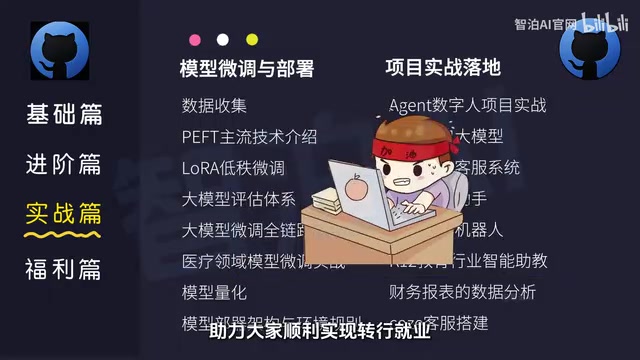
The practical section is where the entire course comes together, containing multiple projects aligned with real job requirements:
- Enterprise RAG Knowledge Base: Building an intelligent Q&A system based on private documents, supporting multi-format document parsing including PDF, Word, etc. Typical enterprise applications include internal knowledge management, contract review assistance, and technical documentation retrieval. Core challenges lie in document parsing accuracy, chunking strategy design, and retrieval recall optimization.
- AI Intelligent Customer Service: Developing an automated customer service system capable of handling user inquiries, covering intent recognition and multi-turn dialogue. Modern AI customer service systems need to handle complex tasks like dialogue state tracking, slot filling, and sentiment analysis, while also requiring human-AI collaboration capabilities—smoothly transferring to human agents when the model cannot handle a situation.
- AI Medical Q&A System: A professional Q&A application in a vertical domain, demonstrating practical methods for combining domain knowledge with large models. The medical field demands extremely high accuracy, requiring special attention to hallucination control, accurate understanding of medical terminology, and compliance issues.
- Agent Digital Human: A digital human interaction system combining agent technology with multimodal capabilities. Such projects involve the integration of multiple technologies including Automatic Speech Recognition (ASR), Text-to-Speech (TTS), and digital avatar driving, representing the trend of AI applications evolving from pure text to multimodal interaction.
Objective Evaluation and Learning Recommendations
Course Strengths
From a course design perspective, this LLM tutorial has several commendable aspects:
- Complete System: From basic concepts to enterprise-level practice, it forms a complete learning loop, avoiding the pitfalls of fragmented learning
- Mainstream Tech Stack: RAG, Agent, and fine-tuning are the three mainstream directions in current LLM applications—the topic selection is precise and highly practical
- Rich Supporting Resources: Provides mind maps, materials, e-books, and courseware to lower the self-study barrier
Points to Keep in Mind
As a rational learner, you should also note the following:
- The volume of 748 episodes means a significant time investment. It's advisable to first assess your learning goals and available time, then create a reasonable study plan. Estimating an average of 10-15 minutes per episode, completing the entire course requires 125-187 hours—equivalent to 2-3 months at 2 hours of daily study.
- Marketing language in the title should be taken with a grain of salt; focus on the quality and timeliness of the technical content itself. The LLM field iterates extremely fast—some technical approaches from 2023 may already have better alternatives in 2024, so pay attention to publication dates and technology versions.
- Free tutorials typically have limited depth. For those wanting to dive deeper into RAG optimization, Agent architecture design, or other specific areas, supplementary professional materials and papers may be needed. Consider following the latest papers on arXiv, technical blogs from major model providers, and open-source project practices on GitHub.
Target Audience
This course is well-suited for:
- Complete beginners interested in AI large models but lacking a systematic learning path
- Software engineers with Python programming experience who want to transition into AI application development
- Product managers or technical leaders who want to understand the full landscape of LLM technology
Conclusion
In the context of rapidly iterating LLM technology, systematic learning is far more important than fragmented information gathering. The value of this course lies in providing a relatively complete learning framework that helps learners build a comprehensive cognitive chain from Transformer theory to RAG and Agent practice. However, learning outcomes ultimately depend on personal commitment and hands-on ability—finishing the tutorial is just the starting point; real growth comes from independent thinking and project practice.
The LLM industry is currently at a critical transition from "technology exploration" to "industrial deployment." Mastering the three core technologies of RAG, Agent, and fine-tuning means having the fundamental capabilities to participate in LLM application development. But it's important to recognize that technology is continuously evolving—today's best practices may be replaced by new approaches in six months. Maintaining a habit of continuous learning is more important than mastering any fixed body of knowledge.
Related articles
Understanding GitHub's Availability Report: Platform Stability and Developer Response Strategies
Deep dive into GitHub's monthly availability report: analyzing service degradation impacts, CI/CD fault tolerance, and platform dependency risk strategies for resilient development.
OpenAI's Claim of Solving a Millennium Prize Problem Sparks Academic Controversy
OpenAI claims its AI solved a Millennium Prize Problem, sparking debates over attribution, verification, and AI's role in reshaping mathematical research.
Ledoit-Wolf Covariance Shrinkage in Practice: 57% Lower Turnover + 10x GPU Acceleration
Learn how Ledoit-Wolf covariance shrinkage reduces portfolio turnover by up to 57% and how cuML GPU acceleration cuts backtest time from 1.5 hours to 9 minutes.