AI LLM Interview Crash Course: How to Explain LangGraph and RAG Projects Clearly
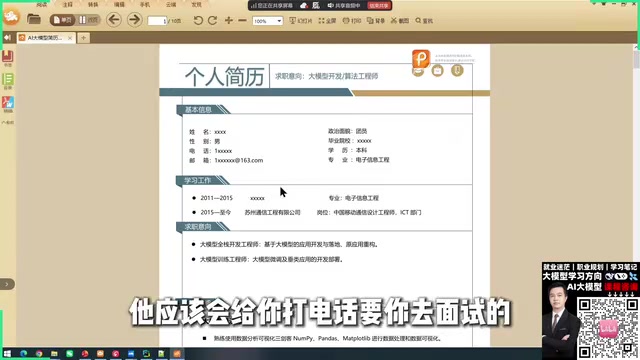
Clear the resume gate first for AI LLM interviews: ordering, skill trimming, and the logic of packaging three projects.
This article is based on a live-streamed beginner class for AI large-model job interviews. It points out that framework interview questions can be crammed, but if the resume and projects are not explained clearly, you won't even get an interview chance. Core advice includes: order resume modules by "what you most want the interviewer to see first"; revise the professional skills template according to your real mastery and write specifics line by line; because AI application projects generally last one to three months with teams of two or three, it is recommended to package three or more projects on the resume to support the timeline, with exceptions for continuously iterated projects at big companies; LangGraph interviews focus on state structure design and state consistency across multi-turn workflows, while RAG projects should be described qualitatively around bottlenecks, changes, and the direction of effectiveness changes.
Lesson One of the Interview Crash Course: Resume and Projects Are the Real Door Openers
In a live-streamed beginner interview class for AI large-model positions, the instructor set aside 20 LangChain- and LangGraph-related interview questions and first tackled a more fundamental issue: how to write a resume and how to package projects. This arrangement itself makes one thing clear—framework APIs can be crammed at the last minute, but if the project experience on your resume can't be explained clearly, you won't even get an interview chance.
The livestream covered four topics: rules for writing an AI large-model resume, project packaging on the resume, LangChain and LangGraph interview questions, and a separately scheduled written-test segment. This article focuses on the first two parts and offers actionable advice combined with the logic of presenting RAG projects.
The Core Rule of Resume Ordering: Put the Most Eye-Catching Thing First
The first rule the instructor gave is very direct: put what you are willing to show HR or the interviewer at the very front, and put what you don't want seen at the back. This is not about layout aesthetics but about the game of information priority.
A typical resume contains five blocks: basic information, work experience, professional skills, job intention, project experience, and self-evaluation. Basic information is fixed at the front; there is no uniform standard for the order of the other modules. The only criterion is this—whichever part is most likely to make the interviewer want to "give you a call" should be moved to the front.
- For a prestigious-school computer-related background, put education first and make it prominent
- If your education is ordinary, move the professional skills module earlier and trade the density of your tech stack for attention
- If your projects are impressive enough, putting project experience first also works
This rule matters because the people screening resumes spend an extremely short average time on each one, and content beyond the first three screens is far less likely to be seen.
How to Write Professional Skills: The Template Is the Skeleton, Replacement Is the Key
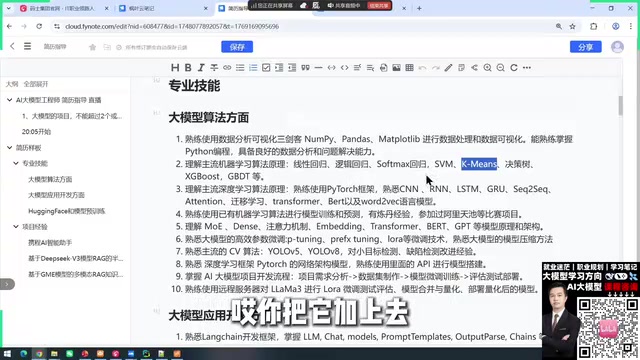
The livestream showed a ready-made professional skills template, but the instructor emphasized not copying it verbatim but that "after Ctrl+C and Ctrl+V, you must modify it." For each skill item listed in the template, keep what you know and delete what you don't.
Taking vector-retrieval-related skills as an example, the template provides wording that can be expanded line by line:
- Line one: deployment and text vectorization based on embedding models such as BGE and Qwen
- Line two: text vectorization and re-ranking based on Qwen embedding and re-rank models
- Line three: text and image vectorization based on GME-embedding-VL, completing multimodal embedding model deployment
Breaking a long list of skills into multiple lines, each corresponding to a specific capability, makes it easier for the interviewer to judge your true boundaries than piling up keywords. The instructor was quite sharp about the attitude of "not wanting to change a single word": if you are unwilling to adjust even a template to your actual situation, then the job search itself is worth reconsidering.
The Logic Behind the Number of Packaged Projects: Why at Least Three Are Recommended
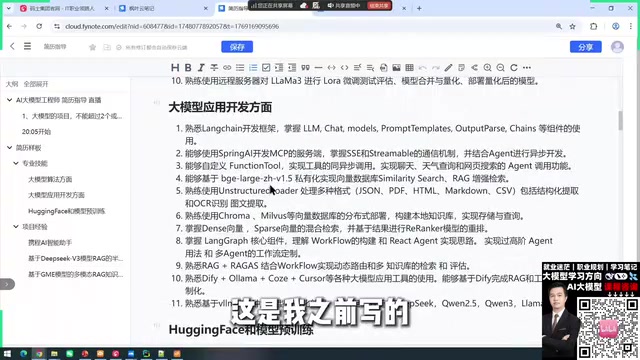
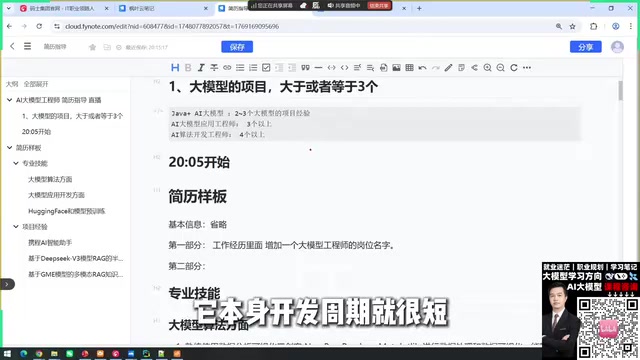
This was the most information-dense part of the session. The instructor's advice was that the number of projects on an AI large-model resume should be greater than or equal to three. This recommendation is supported by an industry observation mentioned repeatedly—AI application projects generally have very short development cycles.
The livestream gave a real case: a student independently developed an intelligent procurement assistant based on an existing ERP system at a company. The entire project was completed by one person and took about two months. Other AI large-model application projects the instructor encountered had development cycles roughly between one and three months, with team sizes usually around two people and no more than three.
At this pace, if the project timeline on the resume spans six to eight months, writing only one project simply won't hold up on the timeline; three projects create a reasonable narrative density.
There are exceptions as well: after completing a project at a big company, if you continue optimizing, iterating, and adding new features, a single project's cycle can be extended, and writing one or two projects can also make sense. The instructor also acknowledged that a small number of students write only one or two large-model projects, so this advice is a rule of thumb rather than a hard standard.
Embedding and re-rank are two links in the RAG pipeline that are easily confused but have different responsibilities. Embedding models (such as BGE, Qwen-embedding, and GME-embedding-VL) map text or images into dense vectors so that semantically similar content is closer in vector space, thereby supporting vector retrieval; they determine "whether it can be recalled." Re-rank models perform finer relevance scoring and reordering on the candidate documents initially recalled. They are usually more computationally expensive but act only on a small number of candidates, and are used to improve the accuracy of top results; they determine "whether what is recalled is ranked correctly." Multimodal embedding (such as GME-embedding-VL) further maps images into the same vector space, enabling text queries to retrieve image content. Being able to distinguish the roles of the two and when to introduce them is an important signal of RAG engineering experience in an interview.
How to Explain LangGraph and RAG Projects Clearly
The interview-question segment involved the LangChain and LangGraph frameworks. The two have different positions in project presentation, and they should be explained separately.
LangChain-type questions usually fall at the component level—document loading, splitting, vectorization, and retriever configuration. When answering, explaining the reason for each choice is more convincing than listing APIs. For example, why this splitting strategy was chosen, how Top-K for retrieval was set, and under what circumstances the re-rank model was introduced.
LangGraph's exam points center on state management. What the interviewer cares about is not which nodes you have called, but how you design the state structure, how you pass and update state across multi-turn workflows, and how you ensure state consistency when encountering branches and loops. Expanding on this part when presenting a project directly demonstrates the depth of your understanding of agent orchestration, rather than merely being able to run a demo.
For RAG projects, the most likely follow-up question is about effectiveness. The materials did not provide specific performance metrics, but the presentation logic can follow one main line: where the bottleneck of the original solution was, what changes were made, and in what direction retrieval quality or answer accuracy changed after the changes. Qualitatively describing the trend and making the causal chain clear is safer than reporting a number whose source you can't remember.
RAG (Retrieval-Augmented Generation) is a technical paradigm that combines information retrieval with large language model generation: when faced with a user question, the system first retrieves relevant document fragments from an external knowledge base, then passes these fragments as context to the large model to generate an answer. Compared with relying directly on memory in model parameters, RAG enables answers to be based on updatable private data and significantly reduces hallucinations. A typical RAG pipeline consists of document loading, text splitting, vector embedding, vector database retrieval, re-rank, and final generation. The trade-offs at each step affect the final result, which is why interviewers repeatedly ask "why was it designed this way."
LangGraph is a stateful orchestration framework built on top of LangChain. Its core abstraction is the "graph": nodes represent processing steps, edges represent flow directions, and it can support conditional branches and loops. It explicitly models multi-turn agent workflows as state machines. All nodes share a readable and writable state object, and each transition determines the next step based on the current state. Therefore, what is truly valuable in an interview is: what fields are stored in the state, which nodes are responsible for updating them, how loop termination conditions are set, and how state remains consistent during concurrency or exceptions. Being able to explain these questions clearly shows that you understand design patterns for agent orchestration, rather than merely assembling nodes according to examples.
An Implicit Main Thread in Interview Presentation
Looking at the content of this livestream as a whole, resume, skills, and projects all serve the same goal: to let the interviewer form the judgment "this person can get work done" in the shortest possible time. Short project cycles and small teams are the reality of AI application development. The number and style of projects on a resume should fit this reality, rather than piling up a luxurious career history that cannot withstand follow-up questions.
Trim professional skills according to your true level of mastery, organize projects according to the real development pace, and explain the design decisions of state management and the retrieval pipeline thoroughly in the interview—if these three things are done, then the LangChain and LangGraph interview questions will have room to shine.
Related articles

Developer Naming Woes: The Technical Names That Drive Us Crazy
Why is technical naming so maddening? From Nginx and Vite to Qt and Sudo, a YouTube creator rants about the chaos of developer naming and pronunciation, revealing the tug-of-war between creators' intentions and community habits, and the cultural roots behind spelling traps like PyPI and GNOME.

Figma Workplace Scandal: Employee Sues CEO for Forcing Confrontation with Harasser
Figma and its CEO are sued by a current employee alleging sexual harassment and discrimination, and forcing the victim to confront her harasser. This article outlines the background, potential impact, and industry reflection.

Jensen Huang and Nvidia: Elite Privilege Behind the Revolving Door of Business and Politics
An opinion piece uses Jensen Huang's reappointment as Nvidia CEO to examine business-government ties and elite impunity, questioning free-market ideals and AI industry governance.