AI Names Files 'Whatever, All Good': Reflecting on Opus's Naming Logic and Agent Interaction Design

Claude named files after users' vague replies, exposing how AI Agents handle semantic emptiness in ambiguous instructions.
A Reddit user discovered that Claude Opus named output files after throwaway user responses like "continue" and "whatever, all good," sparking discussion about AI Agent interaction design. The root cause: when context lacks a clear task theme, the model's attention mechanism treats the user's most recent input as the strongest signal and maps it literally to the output — not sarcasm, but mechanical execution of a semantic void. The article argues that clear user instructions remain essential, and that well-designed AI Agents should proactively seek clarification or make reasonable inferences rather than defaulting to literal interpretation. Details like naming and default behaviors are key metrics of Agent product maturity.
A Reddit Post That Got People Thinking
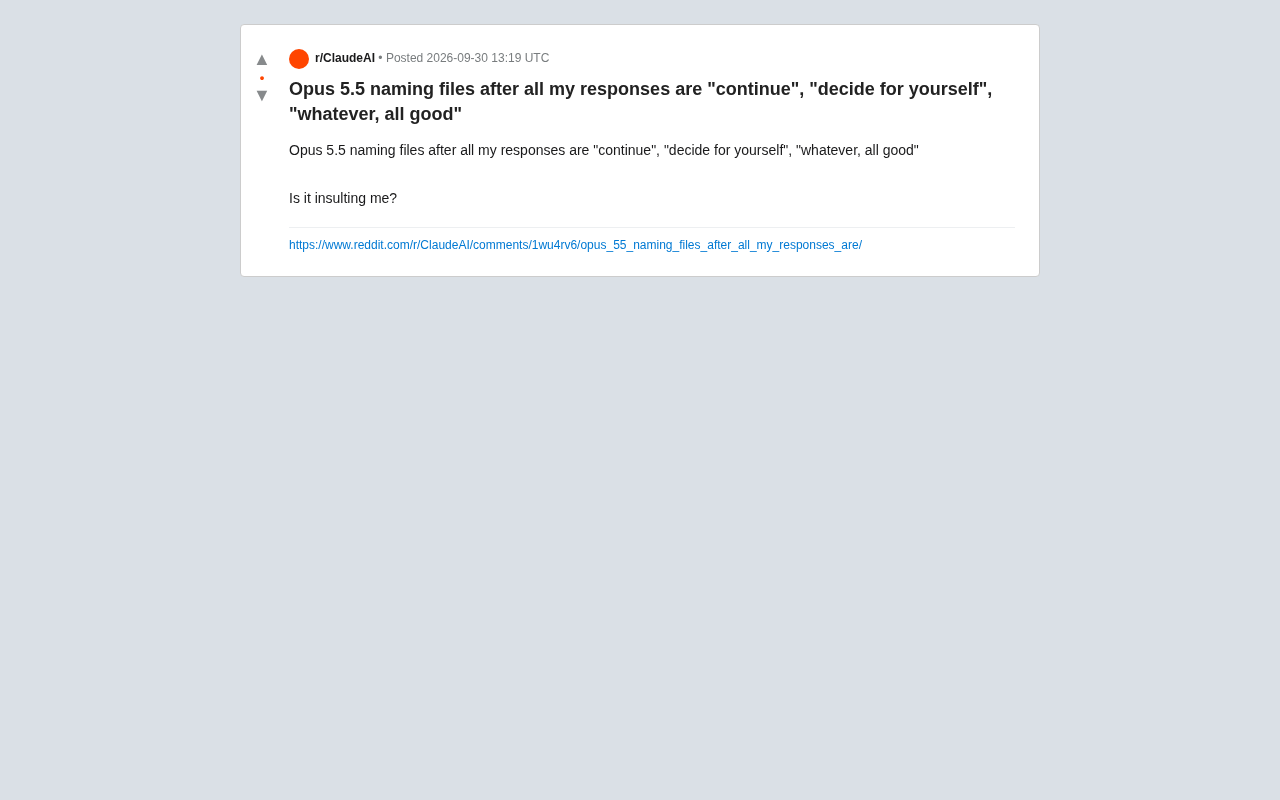
A Reddit user recently shared a fascinating experience: while collaborating with Claude Opus 5.5, the AI named generated files things like "continue," "decide for yourself," and "whatever, all good." The user half-jokingly asked: "Is it being sarcastic?"
This seemingly absurd phenomenon actually reveals a very real interaction design issue in how AI Agents autonomously execute tasks. When a user repeatedly gives vague responses like "continue," "you decide," or "whatever" across multiple conversation turns, the model — faced with a situation where it needs to name an output file — lacks a clear semantic anchor. So it simply uses the user's most recent reply as the filename.
Why Does This Naming Happen?
How the Model Decides on a Filename
In AI-assisted coding or document generation workflows, when the model needs to save a file, it typically infers a "reasonable" filename from context. Ideally, it extracts keywords from the task content — if the user is doing data analysis, for example, it might name the file data_analysis.py.
But when the context lacks a clear task theme and the user's latest input happens to be something as vague as "continue," the model's attention mechanism treats these recently occurring words as the most relevant source of information. The result: the user's throwaway reply gets "faithfully" converted into a filename.
This touches on a core mechanism of large language models — the Attention Mechanism. In the Transformer architecture, when generating each token, the model assigns different "attention weights" to all words in the context; higher weight means greater influence on the current output. In long conversations, the model doesn't treat all historical information equally — it tends to assign more weight to recent inputs and high-frequency words. When the task theme has been diluted after several rounds of "continue" and "whatever," the user's most recent words become the strongest signal in the context, so the model "rationally" selects them as the naming source. This is also a manifestation of what the AI field calls recency bias — the model is more sensitive to information closer to the generation point.
This Isn't Sarcasm — It's Semantic Emptiness
From a technical standpoint, AI has no emotions and is incapable of sarcasm. It simply made what it considered the "most contextually relevant" choice given insufficient information. This exposes a real weakness in how models handle ambiguous instructions: they cannot proactively recognize that "this reply isn't suitable as a filename," nor will they ask the user, "What would you like to call this file?"
In other words, the AI takes the user's semantic void at face value and mechanically maps it to the output. This tendency toward "literal interpretation" appears in various forms across many Agent workflows.
Implications for AI Agent Interaction Design
Clear Instructions Still Matter
This case serves as a vivid reminder: even as model capabilities grow stronger, the quality of user input still directly affects output quality. When you want the AI to produce well-structured, properly named files, giving clear intent at key moments is far more effective than a string of "continues."
A Good Agent Should Know When to Ask
This phenomenon also illustrates — by counterexample — an important capability that a great AI Agent should have: proactively seeking clarification when information is insufficient. When an agent needs to name a file but has no real basis to do so, it should either make a reasonable inference from the task content or briefly confirm with the user — not write "whatever, all good" directly into the filename.
Details like these may seem trivial, but they are important indicators of an Agent product's maturity. Naming conventions, directory structure, and the reasonableness of default behaviors collectively shape the user's intuitive sense of whether a tool is "smart."
The "proactive clarification" capability mentioned here corresponds to a formal concept in AI Agent design: Clarification Request under Uncertainty. Current mainstream Agent frameworks (such as ReAct and Plan-and-Execute) typically divide an agent's action space into "execute" and "ask" categories — but knowing when to ask rather than execute remains a hard problem. Asking too frequently frustrates users; staying too silent produces the "literal execution" issue described in this article. Researchers call this tradeoff the proactivity dilemma. Some products address this by setting a confidence threshold: only when the model's certainty about a decision falls below a set value does it trigger a clarification process; otherwise, it executes automatically and notes its reasoning in the output for the user to confirm after the fact.
The Real Pain Point Behind the Humor
The reason this post resonated with so many people is that heavy AI users have all encountered similar "literal execution" awkwardness. It presents, with a touch of humor, the boundary problem AI faces when making autonomous decisions — models are powerful, but they still need clear context to deliver their full value.
Conclusion
The quirky story of an AI naming a file "decide for yourself" points to a genuinely important question about human-AI collaboration. It reminds us that vague instructions can lead to unexpected results when working with AI Agents, and it signals to developers that equipping agents with the ability to clarify and make reasonable inferences at critical decision points is key to improving the product experience.
As AI Agents take on more and more autonomous tasks, these "devils in the details" will only receive more attention. After all, a truly useful tool doesn't just get the job done — it also knows what to do when you say "whatever."
Related articles

Amphibious Transforming Drone: Beyond 100x Power Savings, What Are the Real Needs?
Is the amphibious transforming drone just a gimmick? Starting from the 100x power difference of the M4 Morphobot, explore real application scenarios and thesis topic ideas, analyzing boundary conditions where pure drones and pure ground robots both fail.

Warhound Raises $200 Million: Genetically Engineered "War Dogs" Paired with Anduril Gear
Warhound raises $200M, backed by Ben Lamm and Palmer Luckey, to genetically engineer dogs for military and law enforcement use and equip them with Anduril gear. This article analyzes its technology direction, funding logic, and ethical controversy.

Claude API Comes to Google Cloud: IAM Integration and SDK Access Guide
Anthropic hosts the full Claude API on Google Cloud with IAM-controlled permissions and unified billing. This guide covers the Vertex AI and Anthropic-hosted entry points, IAM role configuration, and SDK access.