AI Programming in Practice: The Complete Workflow from Zero to Deployment with Claude Code + Codex

A complete guide to AI programming with Claude Code and Codex, from zero experience to project deployment.
This article breaks down a practical AI programming course built around Claude Code, Codex, and Vibe Coding. It covers three core skills — Brainstorming, collaborative debugging, and plugin development — and walks through a complete workflow from requirements definition to production deployment. The piece also examines efficiency claims, tool selection rationale, and how AI is reshaping the skills developers and project managers need.
Why Most People Get Stuck at the Door of AI Programming
Many people watch others write code with AI and think it looks effortless, but the moment they try it themselves, they're met with endless errors and infinite loops, ultimately falling into frustration. B-site creator Baili offers an insightful perspective in his AI programming course series: What's holding you back usually isn't a lack of coding fundamentals — it's a lack of methods for collaborating with AI.
This observation deserves serious consideration. In traditional thinking, programming ability equates to mastery of syntax, algorithms, and frameworks. But in the era of AI-assisted programming, this logic is being rewritten — the real bottleneck has shifted from "can you write code" to "can you direct AI to write code." In other words, AI programming is fundamentally a discipline of "human-AI collaboration," not purely a technical skill.
In fact, the concept of human-AI collaborative programming is rooted in decades of research in the field of Human-Computer Interaction (HCI). As early as the 1960s, computer scientist J.C.R. Licklider proposed a vision of "man-computer symbiosis," arguing that humans and computers should each leverage their respective strengths to complement one another. In the traditional programming era, this symbiosis was primarily reflected in IDE features like auto-completion and syntax highlighting. The emergence of Large Language Models (LLMs) has pushed this collaboration into an entirely new dimension — AI is no longer just providing hints but can understand natural language descriptions and generate complete code logic. This means the core skill of programming is shifting from "writing instructions" to "expressing intent," representing a fundamental transformation in the interaction paradigm.
This also explains why complete beginners might actually have an advantage: they don't carry the mental models of traditional programming, making them more receptive to the new paradigm of "describing requirements in natural language and letting AI handle the implementation."
Course Core Positioning: No Toy Demos, Only Real Projects
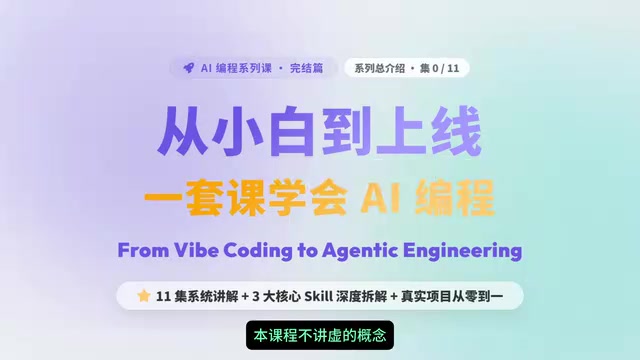
The biggest difference between this AI programming course and the countless tutorials on the market is its explicit refusal to build toy-level demos like Snake games. The course creator has laid out four hardcore pillars that form the backbone of the entire learning path:
Real-World Deployment: A Complete Loop from Development to Production
The course's goal isn't to demonstrate some isolated feature — it's to build a complete open-source project from scratch that can actually be deployed and accessed. This is crucial — the gap between a working product and a classroom demo is filled with countless overlooked engineering details.
In software engineering, there's a massive chasm between "runs on my local machine" and "runs stably in production" — commonly known as the "last mile" problem. This chasm includes but isn't limited to: environment configuration and dependency management (compatibility across different operating systems and runtime versions), CI/CD pipeline setup, domain configuration and SSL certificate management, database migration and data persistence, logging and error tracking, security hardening and access control. Traditionally, this work requires a dedicated DevOps engineer. AI programming tools are now attempting to automate these steps — for example, completing Docker container configuration and generating cloud deployment scripts through natural language commands — significantly lowering the barrier to going live for independent developers.
Breaking Down Three Core Skills
The course provides an in-depth breakdown of three essential AI programming competencies:
- Brainstorming: How to transform vague ideas into clear requirements that AI can understand
- Read and Play: Practical methods for code reading and collaborative debugging
- Plugin Collaboration & Custom Plugin Development: Not just using existing tools, but building your own extensions
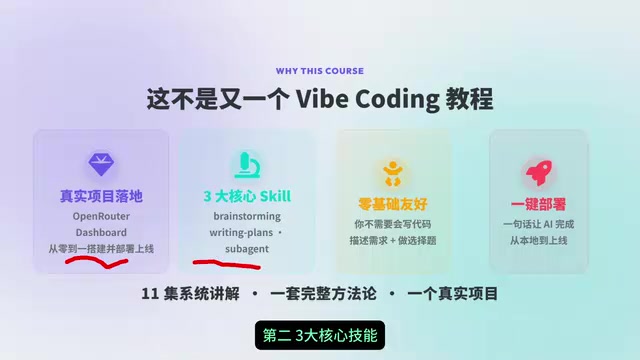
The combination of these three skills effectively outlines a complete AI development workflow: from requirements gathering, to code implementation, to tool customization. Among these, the importance of the Brainstorming phase is often underestimated — in AI programming scenarios, the clarity of your requirement description directly determines the quality of AI output. This aligns with the core principles of Prompt Engineering: a well-structured prompt that includes constraints and expected output formats is often far more efficient than repeatedly revising vague instructions.
Beginner-Friendly with One-Click Deployment
The course emphasizes that "you don't need to know how to write code — just describe your requirements and make multiple-choice decisions." At the same time, it goes beyond teaching you to write code and shows you how to get AI to help you deploy with one click. These two aspects lower the entry barrier while also bridging the "last mile" from development to delivery.
Tool Stack Analysis: Claude Code + Codex + Vibe Coding
The course's technology choices themselves reflect cutting-edge trends in the AI programming landscape.
Using Claude Code and Codex Together
These two represent the most mainstream directions for AI programming assistants today. Claude Code is a command-line AI programming tool developed by Anthropic, built on the Claude large language model. Its core advantage lies in its ultra-long context window (supporting up to 200K tokens), which enables it to understand an entire code repository's structure, dependencies, and business logic at once, rather than processing a single file in isolation. For multi-step task planning, Claude Code can decompose complex development requirements into ordered execution steps, progressively completing code generation, test writing, and refactoring optimization. This "global understanding + step-by-step execution" capability makes it particularly well-suited for medium to large projects involving coordinated modifications across multiple files.
Codex was originally created by OpenAI through fine-tuning GPT-series models, specifically optimized for code generation tasks. It serves as the core engine behind GitHub Copilot and was one of the first products to commercialize AI code generation at scale. Codex-type tools are trained on billions of lines of open-source code from GitHub, covering dozens of programming languages, which makes them exceptionally strong at instant tasks like code completion and function generation. In 2025, OpenAI further launched an upgraded Codex agent capable of autonomously executing code and running tests in a sandbox environment, pushing AI programming from a "suggestive" model to an "autonomous execution" model.
Using both together is essentially about finding balance between "deep planning" and "rapid execution" — Claude Code handles understanding the overall architecture and formulating implementation plans, while Codex-type tools provide high-speed code generation and completion support during specific coding tasks.
Vibe Coding: The Core Philosophy of Atmosphere-Driven Programming
Vibe Coding is a recently trending AI programming concept, first coined in February 2025 by Andrej Karpathy, former Tesla AI Director and OpenAI co-founder. He described how his programming approach had evolved into "fully embracing the vibes, riding the exponential wave, and forgetting that code even exists." The core idea: developers describe their intent in natural language, AI handles generating and iterating code, and humans primarily serve as "product managers" and "reviewers." This aligns closely with the course's emphasis on "describing requirements and making multiple-choice decisions."
This concept has sparked extensive discussion in the developer community. Supporters see it as representing the democratization of software development, enabling non-technical individuals to build applications. Critics worry it could lead to massive accumulation of "technical debt" — when developers don't understand the code AI generates, debugging and maintenance become extremely difficult. The current industry consensus is that Vibe Coding delivers enormous value during prototype validation and MVP (Minimum Viable Product) development, but production-grade systems still require deep human review of code quality and security.
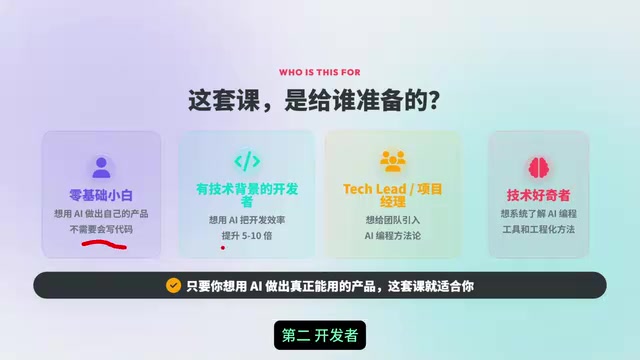
The course claims this methodology can boost development efficiency by 5-10x. This figure warrants a balanced perspective. Multiple authoritative studies provide reference data: GitHub's 2022 research showed that developers using Copilot completed tasks 55% faster than the control group; Google DeepMind's 2024 internal research indicated that AI-assisted tools improved code generation speed by approximately 2x; McKinsey's 2023 report noted that AI tools save roughly 50% of time on code documentation and about 35% on code generation, but improvements in code maintenance and refactoring were relatively modest (around 20%). Therefore, a "5-10x" efficiency boost is more likely to appear in specific scenarios — such as rapid prototyping, boilerplate code generation, API integration, and other standardized, highly repetitive tasks — rather than as an average across all development work. Tasks requiring deep architectural design or complex business logic still demand significant human involvement. The actual magnitude of efficiency gains depends largely on the type of task and the user's level of collaboration skill.
Course Structure and Target Audience
The complete course spans 11 episodes, divided into four progressive stages:
- Foundational Understanding — Building the right mental model for AI programming
- Core Skills — Mastering Brainstorming, collaborative debugging, and plugin development
- Hands-On Advanced — Building a real project
- Deployment & Delivery — Completing deployment and delivery

This "cognition → skills → practice → delivery" structure is remarkably comprehensive, avoiding the common pitfall of tutorials that "teach tools but not deployment." This structure mirrors the progressive logic of Bloom's Taxonomy in educational theory: from "knowing what it is" (cognition) to "knowing how to do it" (skill application), then to "being able to do it independently" (practical analysis and synthesis), and finally to "being able to deliver results" (evaluation and creation). Each stage builds on the previous one, ensuring learners develop sufficient capability at every level.
The course targets four types of learners:
- Complete beginners who want to build their own products with AI
- Developers looking to boost efficiency 5-10x
- Project managers wanting to introduce AI programming workflows to their teams
- Tech enthusiasts seeking a systematic understanding of cutting-edge tools
This broad coverage indicates that AI programming's value has extended from "personal tool" to "team workflow" level. The inclusion of project managers as a target audience is particularly noteworthy — it signals that AI programming isn't just changing "who writes the code" but is also reshaping "how software development processes are managed." When AI can rapidly generate prototypes and iteration plans, the focus of project management will shift from progress tracking and resource allocation toward requirements quality control and review decisions on AI output.
The Direction of Skill Restructuring in the AI Programming Era
The deeper trends reflected in this course deserve the attention of every technology professional. As "writing code" is increasingly delegated to AI, where will human value migrate?
Judging from the course design, the answer points in three directions: requirements definition capability (articulating your ideas clearly), judgment and review capability (distinguishing good AI output from bad), and engineering integration capability (making all the parts work together and actually go live). These are precisely the abilities that AI currently struggles to replace.
These three directions align with a classic insight from software engineering: across the entire software development lifecycle, requirements errors are the most costly type of defect. IBM's research data shows that defects introduced during the requirements phase cost over 15 times more to fix if they're not discovered until the system testing phase. AI can dramatically accelerate code generation, but if the requirements definition itself is flawed, AI will simply generate the wrong code faster. Therefore, requirements definition capability hasn't depreciated in the AI era — it has actually become more critical, because flawed requirements are amplified into flawed products at an accelerated pace.
For those looking to get started with AI programming, rather than agonizing over "should I learn programming syntax," it's better to first cultivate a mindset for effective collaboration with AI. After all, the scarcest talent in the future may not be people who can write code, but people who know how to direct AI to create real value.
Key Takeaways
Related articles
Google Antigravity + Gemini 3.7 Flash: An Efficient Approach to Multi-Agent Collaboration
Explore how Google's Antigravity orchestration platform and Gemini 3.7 Flash model work together to solve complex multi-agent math and engineering problems.
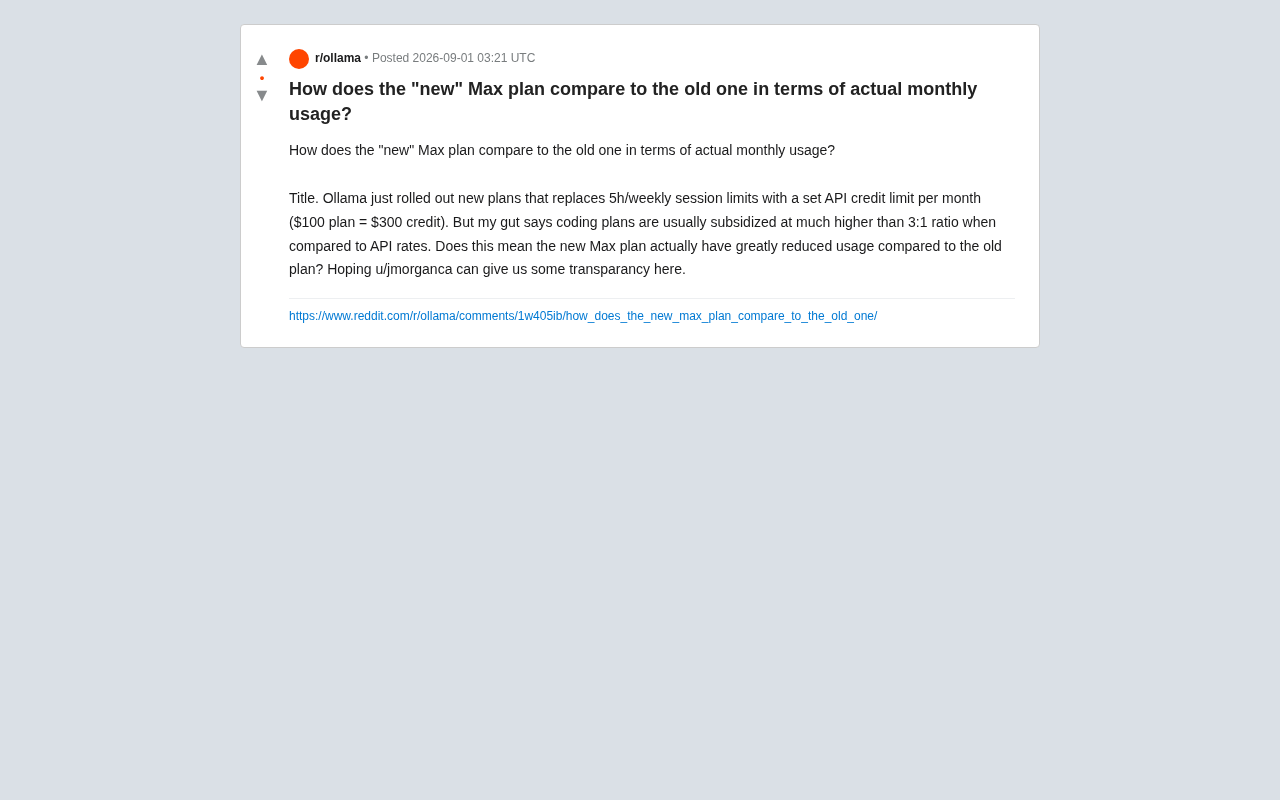
Max Plan Shifts from Subscription to Credits — Has Your Usage Actually Shrunk?
AI coding subscriptions shift from session-time to API credits. A $100 Max plan now offers $300 in credits at a 3:1 ratio — has actual usage really shrunk?

OpenAI Cuts Off Cursor: The Full Story Behind the Feud and China's Push for Open-Source, Affordable AI
OpenAI cuts Cursor's model access over Musk's acquisition; Cursor pivots to Claude. Meanwhile, Chinese AI models like Qwen, GLM, and Hunyuan push open-source affordability, accelerating AI democratization.