@ai-sdk/sandbox-vercel 1.0.188 Released: The Sandbox Capability Evolution Behind a Dependency Update

@ai-sdk/sandbox-vercel 1.0.188 is released, essentially a patch update syncing the upstream harness dependency.
This article interprets the @ai-sdk/sandbox-vercel 1.0.188 update. Labeled as Patch Changes, its core change is merely syncing the @ai-sdk/harness dependency to 1.0.188, automatically published by github-actions and GPG-signature verified. The article notes that sandbox-vercel is AI SDK's sandbox adapter layer for the Vercel environment, responsible for safely executing model-generated code, with its capability boundaries directly affected by the upstream harness. Both share the same version number, reflecting the fixed versioning strategy in the monorepo ecosystem—reducing version matrix complexity but obscuring individual package change volume. The author advises developers to check the corresponding harness version changes when evaluating upgrades and offers practical upgrade recommendations for production environments.
The AI SDK ecosystem has seen another version iteration. @ai-sdk/sandbox-vercel has released version 1.0.188. Although officially labeled as Patch Changes, this update touches the dependency chain of the underlying harness module, making it worth examining from an engineering perspective.
The Substance of a "Minor" Update
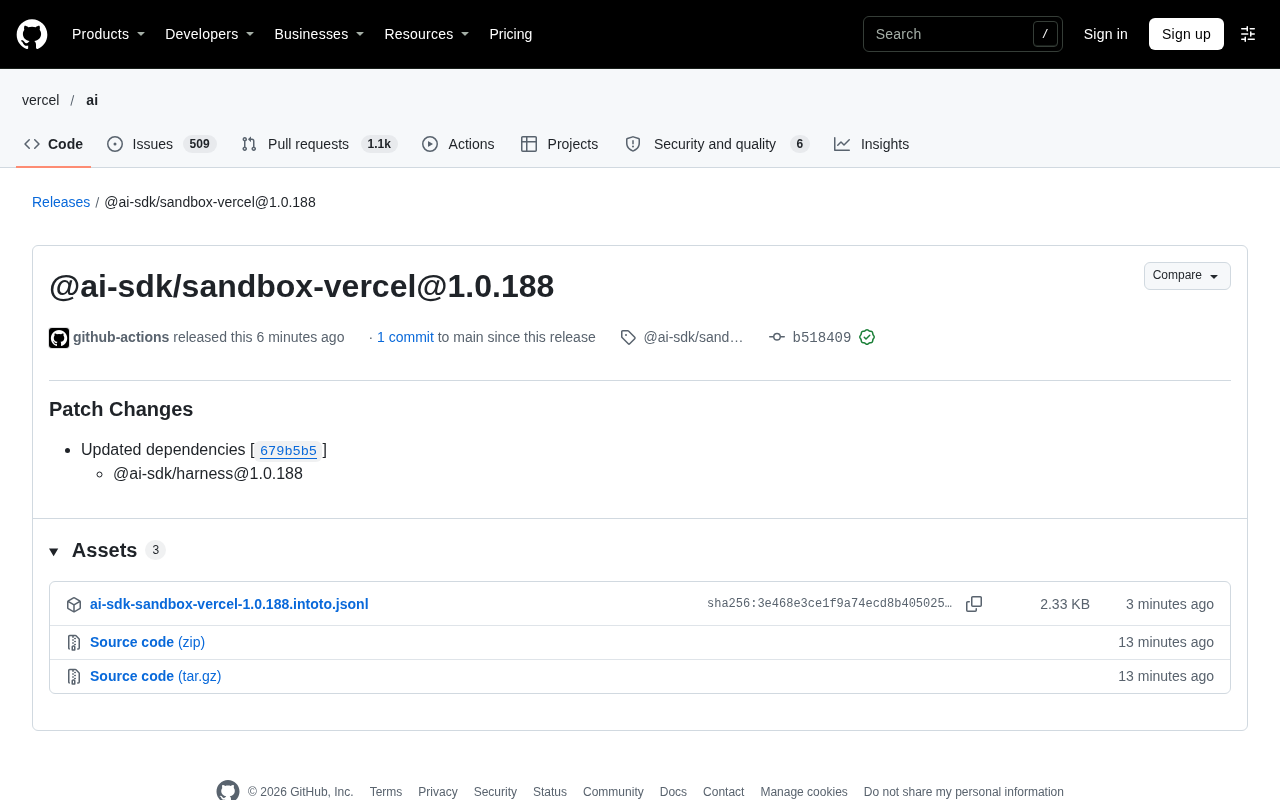
According to the GitHub Release page, the core change in @ai-sdk/sandbox-vercel@1.0.188 is just one line: updating the dependency @ai-sdk/harness to 1.0.188. The commit record shows this version was automatically published by github-actions, associated with a single commit, and verified through GPG signature.
On the surface, this is just a routine sync. But @ai-sdk/harness is the underlying component in AI SDK responsible for orchestrating sandbox execution environments. As the sandbox adapter layer for the Vercel environment, sandbox-vercel's capability boundaries are directly affected by the harness version. Dependency syncing often means upstream fixes, interface alignment, or behavioral consistency adjustments are being propagated to the adapter layer.
For developers relying on AI SDK to build Agent execution environments, this kind of coordinated version number update is an important signal for judging compatibility: sandbox-vercel and harness maintain the same version number, indicating that the two are strictly bound in their release cadence.
Why the Sandbox Adapter Layer Deserves Attention
In AI application development, safely executing model-generated code is an unavoidable step. sandbox-vercel's role is precisely to bring AI SDK's sandbox abstraction into the Vercel runtime environment, allowing developers to run untrusted code without building their own isolation infrastructure.
According to the GitHub repository information, this package is an official module under the @ai-sdk organization, and its release process is highly automated—triggered by github-actions and commit-signature verified. This engineering discipline indicates the project has entered a stable maintenance phase, with version iterations focused on dependency syncing and minor patches rather than aggressive feature expansion.
For users, this means upgrade risk is low, but it also reminds us: real capability changes usually happen at the upstream harness layer, and tracking the dependency chain is more valuable than watching a single package's changelog.
Sandbox in the context of AI applications refers to an isolated execution environment: when model-generated code runs within it, it can only access explicitly granted resources (files, network, system calls), and any boundary violation will be intercepted or terminated. Isolation techniques include containers, microVMs (such as Firecracker), seccomp system call filtering, and language-level runtime restrictions. The core trade-off of sandboxing lies between isolation strength and startup latency—the more thorough the isolation, the slower the cold start typically is, while Agent scenarios often require high-frequency, short-duration code execution, so the performance characteristics of a sandbox solution directly affect product experience. The value of sandbox-vercel lies in encapsulating these isolation details into a unified interface, so developers only need to care about "running this code" without building isolation infrastructure themselves.
Adapter Layer is an intermediate layer between abstract interfaces and concrete runtime environments. AI SDK defines a set of universal sandbox operation semantics, while different cloud platforms (Vercel, AWS, local) have different underlying capabilities, API forms, and limitations. The adapter layer's job is to smooth out these differences and expose a consistent calling convention upward. This also explains why the adapter layer's own code changes are usually minimal: the real logic lives in the upstream harness, and the adapter layer mainly handles protocol translation and environment binding.
Version Number Strategy and Ecosystem Coordination
You may not have noticed that sandbox-vercel and harness share the same version number, 1.0.188. This alignment strategy is not uncommon in monorepo-style SDK ecosystems. The benefit is reduced complexity of the version matrix; the drawback is that the actual change volume of individual packages may be obscured by the version number.
When evaluating upgrades, developers are advised to also check the changes in the corresponding harness version rather than relying solely on sandbox-vercel's Patch notes. This release comes with no behavioral change description, making it a pure dependency-propagation update.
Monorepo and fixed versioning are key background for understanding this version alignment. In a monorepo, multiple packages share the same repository and release pipeline, and there are two common versioning strategies: independent versioning (each package increments independently based on its own changes, like Lerna's independent mode) and fixed versioning (all packages share the same version number, like Lerna's fixed mode). The latter makes "if you installed A at 1.0.188, pair it with B at 1.0.188" the default mental model, greatly simplifying dependency resolution and compatibility judgment. The cost is that version numbers no longer precisely reflect the change magnitude of individual packages—a package that only changed one dependency line will also jump to a new number along with the major version. In this article, sandbox-vercel and harness both at 1.0.188 is a typical manifestation of the fixed versioning strategy.
Patch in Semantic Versioning (SemVer) refers to backward-compatible bug fixes, theoretically introducing no new features and breaking no existing APIs. But under fixed versioning, the meaning of the Patch number is diluted: it may only mean "the pipeline ran another round" rather than "this package fixed a bug." Therefore, when judging upgrade impact, you should rely on the actual diff of the upstream harness rather than the adapter layer's own Patch label.
Practical Recommendations
For teams already using this package in production, this upgrade can be handled through the standard patch process: lock the version and run regression tests on the sandbox execution path. For teams currently evaluating sandbox solutions, the signal from this release is that AI SDK's sandbox system still treats the Vercel environment as a first-class citizen, with active official maintenance, making it suitable for projects that need deep integration with the Vercel deployment pipeline.
Keeping up with the release cadence of the @ai-sdk organization is more meaningful than chasing individual versions.
Related articles

Gemini 4 Neon Review: Benchmark Scores Rival Carbon, API Pricing and Quota Breakdown
Google Gemini 4 Neon is now live, benchmark scores closely tracking Carbon, API pricing 3/15 at twice Hydrogen's rate. This article compiles Bilibili creator testing: Neon can replace 90% of Carbon scenarios, AntiGravity quota consumption is only one-third of Carbon, plus subscription channel restrictions and 2API ban risks.

Gemini 4 Helium Coming Soon? Signals of Google Loosening Subscription Restrictions
Google team member hints releases will continue; community speculates Gemini 4 Helium (Flash Lite) may be next. Subscription ban controversy gets a response as product lead says "Soon," suggesting restrictions may be lifted. This article covers Gemini developments, OpenAI Coding Agent and risk management, Doubao real-time audio-video API, and compute business dynamics.

AI-Assisted React Development in Practice: Optimizing a Video App and Handling Errors
A 14-year veteran developer demonstrates AI-assisted React video app optimization: compressing video from 80MB to 5MB (~94%) via ImageKit, plus reliable error handling and retry mechanisms. Includes planning, code understanding, and verification methods for working with AI.