AI SDK Svelte Releases Version 5.0.184 Update

@ai-sdk/svelte releases patch update 5.0.184, syncing the ai core package to 7.0.184.
Vercel's AI SDK Svelte adapter package @ai-sdk/svelte has released version 5.0.184, a routine patch update whose core change is syncing the underlying ai core package to 7.0.184, with no new APIs or breaking changes. This version was automatically published by GitHub Actions with a GPG-verified signature, reflecting a highly automated release process. The article notes that the adapter package and core package versions remain linked, and developers should pay attention to dependency constraints when upgrading; it is recommended to first validate compatibility in a test environment and confirm through the lockfile that the ai dependency correctly resolves to 7.0.184. Overall, this is a routine version focused on stability maintenance, suitable for Svelte AI projects prioritizing stability to upgrade as needed.
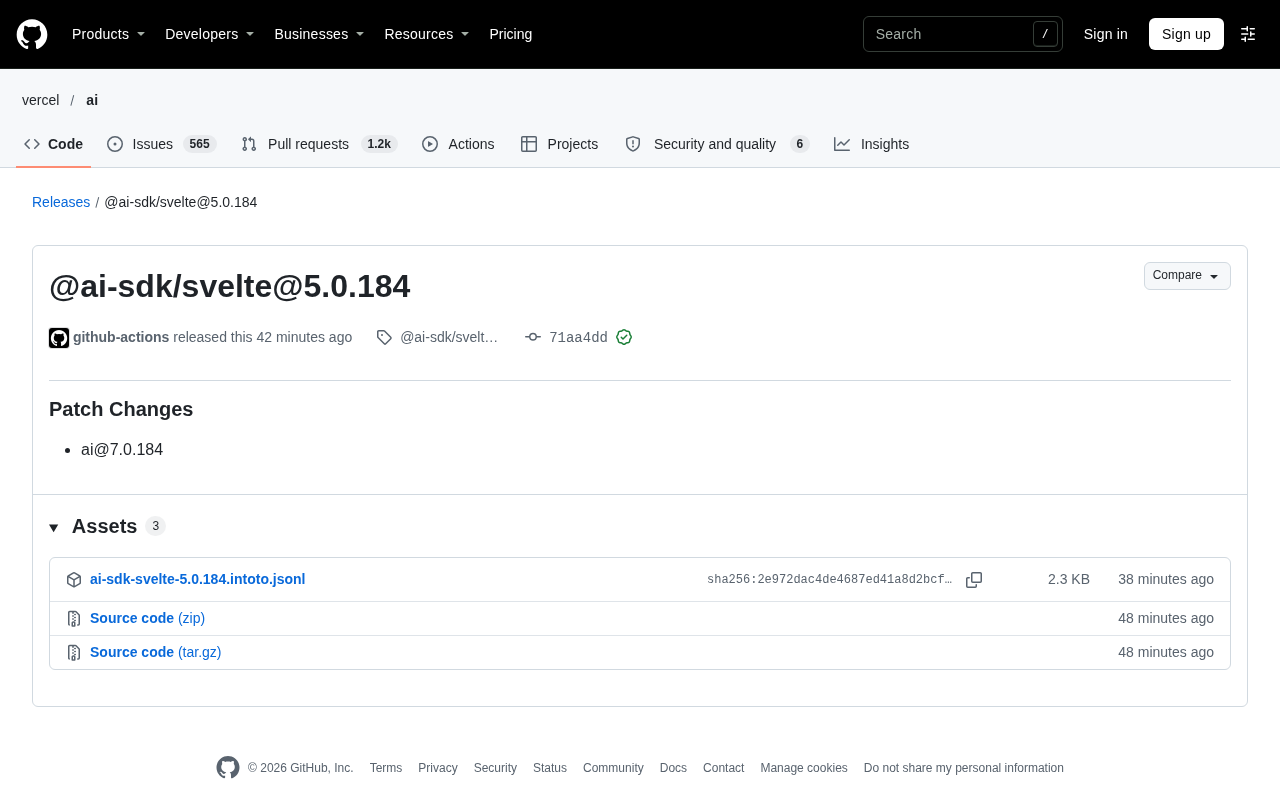
The AI SDK project under Vercel continues to iterate, and its Svelte adapter package @ai-sdk/svelte has released version 5.0.184. This is a routine patch update, with the core change being the synchronization of the underlying ai package to version 7.0.184.
Core Content of the Version Update
According to the release records on GitHub, the change type for @ai-sdk/svelte@5.0.184 is marked as Patch Changes, with the corresponding commit hash 71aa4dd. This update introduces no new APIs or breaking changes; the main work is aligning the version of the dependent ai core package to 7.0.184.
For developers building AI applications with the Svelte framework, such patch updates typically mean bug fixes, type definition adjustments, or internal implementation optimizations. Although the release notes do not list specific fixes item by item, keeping the adapter package and core package versions in sync is a standard practice to avoid runtime behavior inconsistencies.
AI SDK is an open-source TypeScript toolkit launched by Vercel, providing a unified API to call various large language models (such as OpenAI, Anthropic, Google, etc.) and encapsulating common capabilities like streaming responses, tool calling, and structured output. It adopts a layered design: the core package ai contains framework-agnostic low-level logic, while adapter packages like @ai-sdk/svelte and @ai-sdk/react are responsible for integrating core capabilities into the reactive systems of specific frameworks. This architecture means that when the core package fixes bugs or adjusts types, the adapter packages must synchronize versions to ensure consistent behavior — which is why the patch update described in this article uses version linkage.
Why Patch Versions Deserve Attention
In the release cadence of AI SDK, the version number of @ai-sdk/svelte is linked with the ai core package. 5.0.184 corresponds to ai@7.0.184, and this version mapping relationship allows developers to quickly determine compatibility.
You may not have noticed that this commit was automatically published by GitHub Actions and carries a GitHub-verified signature (GPG key ID: B5690EEEBB952194). This means the release process is highly automated, which reflects the maturity of project maintenance.
For teams currently using Svelte with AI SDK, it is recommended to first validate this patch version in a test environment and confirm compatibility with existing code before upgrading to production. Especially when a project has pinned a specific ai core package version, pay attention to the version constraints between the adapter package and the core package.
Semantic Versioning (SemVer) specifies the version number format as major.minor.patch: major version changes indicate incompatible API modifications, minor versions indicate backward-compatible feature additions, and patch versions contain only backward-compatible bug fixes. The 5.0.184 in this article is a patch version, so it contains no new features or breaking changes. Note that the 5.x of @ai-sdk/svelte and the 7.x of ai are not the same major version number; the adapter package locks the compatible range of the core package through its own dependency declaration, and developers should not directly assume that the major version numbers of the two correspond one-to-one.
How to Obtain and Verify
Developers can install this version via npm or pnpm:
npm install @ai-sdk/svelte@5.0.184
After installation, check whether the ai dependency in package.json resolves to 7.0.184. If the project uses a lockfile, it is recommended to update the lockfile in sync to ensure a consistent dependency tree.
The GitHub release page provides a full tag comparison feature, allowing developers to view the specific differences between 5.0.184 and the previous version. Although the release notes this time are fairly brief, the details of changes can be traced through the commit records.
The lockfile (such as package-lock.json or pnpm-lock.yaml) records the exact version and integrity hash of each package in the dependency tree, ensuring that different environments install consistent dependencies. When the adapter package is upgraded and updates its version constraint on the ai core package, if the lockfile is not refreshed in sync, the package manager may continue to use the old core package, causing a version mismatch between the adapter package and the core package. After running npm install or pnpm update, you should check whether the resolved version of ai in the lockfile is 7.0.184; if necessary, run npm ls ai to verify the actual installed version.
Significance for Svelte AI Developers
The toolchain for the Svelte ecosystem in AI application development is gradually maturing. As the official adapter layer, @ai-sdk/svelte is responsible for integrating AI SDK capabilities such as streaming responses and tool calling into Svelte's reactive system. The continuous release of patch versions shows that the maintenance team is actively following the evolution of the core package.
For Svelte projects building chat interfaces, AI-assisted programming tools, or smart forms, keeping the adapter package updated helps obtain the latest stability fixes. However, patch updates usually do not include new features; if you are looking forward to new capabilities, you need to pay attention to the release notes for minor or major versions.
Overall, 5.0.184 is a routine maintenance version, suitable for projects prioritizing stability to upgrade as needed.
One-line Summary
@ai-sdk/svelte releases patch update 5.0.184, syncing the ai core package to 7.0.184.
Paragraph Summary
Vercel's AI SDK Svelte adapter package @ai-sdk/svelte has released version 5.0.184, a routine patch update whose core change is syncing the underlying ai core package to 7.0.184, with no new APIs or breaking changes. This version was automatically published by GitHub Actions with a GPG-verified signature, reflecting a highly automated release process. The article notes that the adapter package and core package versions remain linked, and developers should pay attention to dependency constraints when upgrading. It is recommended to first validate compatibility in a test environment and confirm through the lockfile that the ai dependency correctly resolves to 7.0.184. Overall, this is a routine version focused on stability maintenance, suitable for Svelte AI projects prioritizing stability to upgrade as needed.
Related articles

Pure-Code Video Generation Tested: Which AI Model Actually Follows Instructions?
A Bilibili creator tested three AI models' pure-code video generation with unified prompts and three revisions each: Xiaonaomao has a high ceiling but lacks stability, GPT 6.2 Extra models well but only follows half the instructions, and OPAS 5.5 remains the benchmark.

GPT-6 Six-Tier Hands-On Test: Astra Ultra Dominates but Bills Double
GPT-6 six-tier test: Astra Ultra sweeps 3:0 in 3D tasks thanks to sub-agents and runs 14% faster, but hidden backend bills make its real cost 2.6x single-threaded.

GPT-6.2 Astra vs Fable 5.2: Huge Cost-Efficiency Gap Across 12 Real-World Tests
Bilibili creator tests GPT-6.2 Astra vs Fable 5.2 across 12 real tasks: Fable wins 7-5 but costs 7.2x more and takes nearly 5x longer. Token efficiency emerges as the key selection metric.