@ai-sdk/tui 1.0.161 Released: Dependency Updates and the Evolution of the AI SDK Ecosystem

@ai-sdk/tui releases patch 1.0.161, updating dependencies and showcasing engineering standardization in the AI SDK ecosystem.
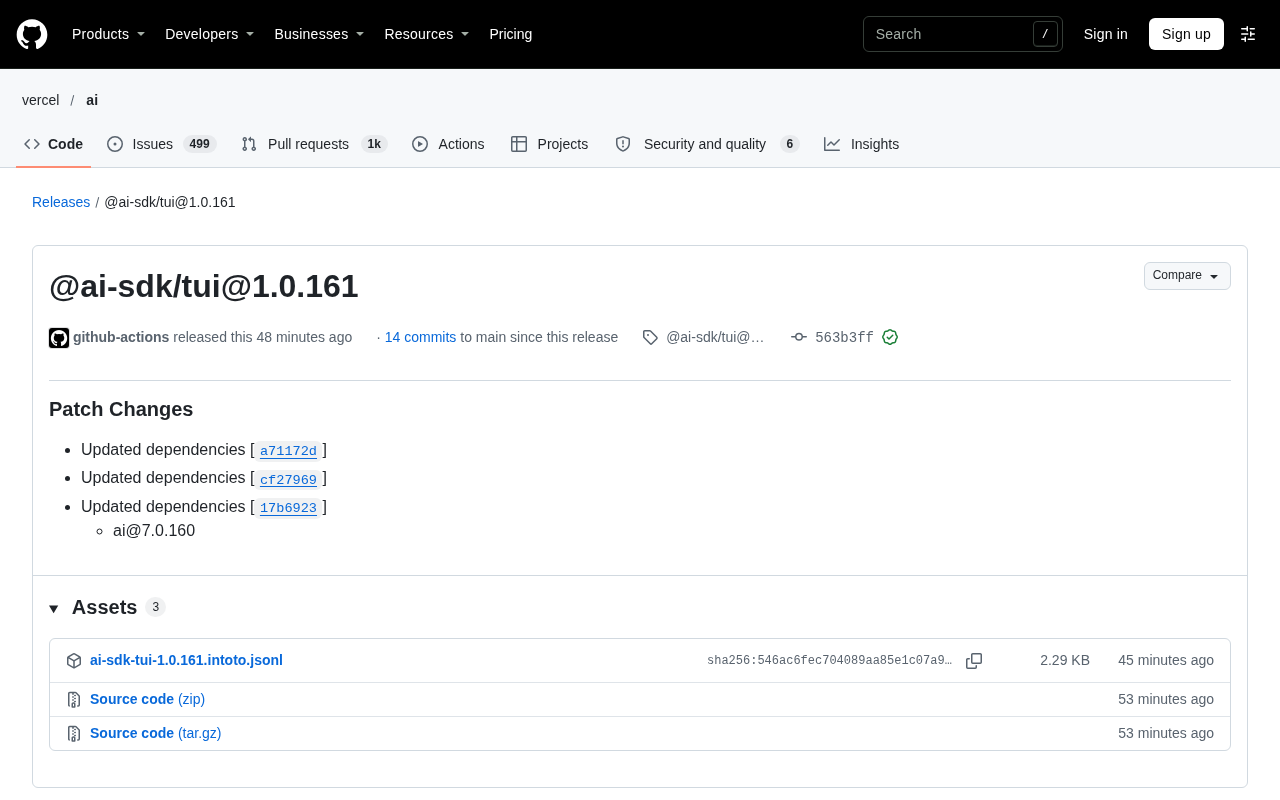
@ai-sdk/tui released patch version 1.0.161, containing 13 commits. The core change is updating three dependencies and synchronously upgrading the ai package to 7.0.160. The release was automatically completed by GitHub Actions and carries GPG signature verification. The article notes that for terminal UI libraries, keeping up with the underlying ai package version ensures compatibility with AI SDK core functionality, fixes security vulnerabilities, and incorporates upstream performance improvements. It also introduces the positioning of @ai-sdk/tui: AI SDK was launched by Vercel to simplify frontend and backend integration of AI capabilities, while the TUI package enables developers to build interactive AI applications in the command line, such as terminal chat assistants, streaming response debugging tools, and intelligent CLI scripts. The author recommends that existing users upgrade promptly and believes this minor version update reflects the activity of the AI toolchain and the standardization of engineering practices.
Recently, @ai-sdk/tui, a terminal user interface component library within the AI SDK ecosystem, released version 1.0.161. This is a minor version update that mainly involves dependency adjustments, but it reflects the continuous iteration and maturation of the AI development toolchain.
Version Update Details
According to the release information on GitHub, @ai-sdk/tui@1.0.161 is a patch version (Patch Changes) containing a total of 13 commits. The core of this update is updating dependencies, specifically including three dependency changes, along with synchronously upgrading the ai package to version 7.0.160. The release was automatically completed by the github-actions bot, and the commit carries a GitHub-verified signature, demonstrating the project's emphasis on supply chain security.
The Significance of Dependency Updates
Although it appears to be a routine dependency upgrade on the surface, for a terminal UI library like @ai-sdk/tui, dependency stability directly affects the developer experience. Keeping up with the underlying ai package version in a timely manner ensures that TUI components remain compatible with AI SDK core functionality, fixes potential security vulnerabilities, and incorporates upstream performance improvements.
What Is @ai-sdk/tui?
@ai-sdk/tui is part of the AI SDK project, focused on providing user interface components for terminal applications. AI SDK was launched by Vercel to simplify the integration of AI capabilities on both the frontend and backend, supporting streaming text generation, tool calling, and other capabilities. The TUI (Terminal User Interface) package enables developers to build interactive AI applications in command-line environments, such as chatbots, real-time log viewers, and more.
Use Cases
- Command-line AI assistants: Interact directly with AI models in the terminal without a graphical interface.
- Development debugging tools: Display streaming responses and status of AI requests in real time.
- Automation scripts: Combine with other AI SDK modules to build intelligent CLI tools.
TUI (Terminal User Interface) is an interaction paradigm alongside GUI (Graphical User Interface) and CLI (pure command-line interface): it draws borders, panels, lists, input fields, and other controls using characters in a text terminal, and supports keyboard navigation, focus switching, and partial refresh. Typical examples include htop, vim, lazygit, and others. Compared to a CLI that outputs results once, a TUI can maintain a continuously updating, interactive screen state; compared to a GUI, it requires no browser or desktop environment, uses fewer resources, and can be used remotely over SSH. For AI applications, streaming output tokens, tool call progress, and multi-turn conversation history are naturally suited to being presented in dynamic panels—this is exactly where the value of TUI components lies.
@ai-sdk/tui belongs to Vercel's AI SDK ecosystem. AI SDK itself is a unified abstraction layer across frontend frameworks (React, Svelte, Vue, etc.) and the server side. Its core is the ai package, which provides primitives such as streamText, generateObject, and tool calling, and connects to multiple model providers. The TUI package can be understood as a rendering layer that extends these capabilities into Node.js terminal processes.
Automated Practices in the Open Source Ecosystem
This release was automatically triggered by GitHub Actions, reflecting the maturity of modern open source projects in continuous integration and continuous deployment (CI/CD). Automated version releases not only reduce human error but also ensure a stable release cadence. At the same time, GPG signature verification in commits further enhances code credibility, which is especially important for AI toolchains with long dependency chains.
GPG signature verification (along with GitHub's commit signing mechanism) means that the author generates a signature for the commit content using a private key, and anyone can use the corresponding public key to verify that the commit was indeed created by the private key holder and that the content has not been tampered with. GitHub displays a "Verified" badge next to the commit. This is significant in the open source supply chain: first, it prevents others from impersonating maintainers to push code to the repository; second, it provides downstream users with auditable proof of origin. Combined with npm package provenance mechanisms, dependents can trace which repository, which commit, and which CI process produced a given release version.
Automated releases completed by the github-actions bot are typically based on workflows such as changesets: merged PRs record the change type (patch/minor/major), and after merging, CI automatically calculates the version number, generates the changelog, creates the tag, and publishes to npm. Such processes allow patch versions to be released frequently and with low risk, and they are also the foundation that makes possible the rhythm described in this article—"13 commits, with a single dependency update triggering a new version."
Advice for Developers
If you are using @ai-sdk/tui, it is recommended to update to version 1.0.161 promptly to obtain the latest dependency fixes. For developers who have not yet tried it, you can follow the official AI SDK documentation to learn how to use TUI components to quickly build terminal AI applications. As AI application forms diversify, terminal interfaces, as a lightweight interaction method, still have irreplaceable value.
Conclusion
Although @ai-sdk/tui@1.0.161 is a minor version, it reflects the activity of the AI SDK ecosystem and the standardization of engineering practices. Details such as dependency updates, automated releases, and signature verification together support a reliable open source tool library. For developers following the AI development toolchain, this is a development worth noting.
Related articles

9 AI Subscription Plans Compared: The Real Cost Per 100M Tokens Revealed
Bilibili creator tests 9 AI subscription plans from Volcano, Alibaba, Tencent, Baidu, Zhipu, Xiaomi, MiniMax and more, converting them all to real cost per 100M tokens, breaking down fixed-quota vs. three-tier coefficient billing and how caching, time-of-day discounts, and window limits affect actual quota.
Vibe Coding for Beginners: Expressing Intent Instead of Handwriting Code
What is Vibe Coding? A 137-episode Bilibili course defines it: the core is expressing intent, not writing code. This article analyzes Vibe Coding's productivity logic, target audience, and entry expectations to help beginners decide if it's worth learning.

LangChain Beginner's Guide: An Agent Development Roadmap from LangGraph to Deep Agents
Clarify the encapsulation relationship among LangChain, LangGraph, and Deep Agents, and master the learning path and selection logic for agent development frameworks—suitable for beginners in large model development.