AI SDK Workflow 2.0.83 Released: Patch Update and Version Dependencies

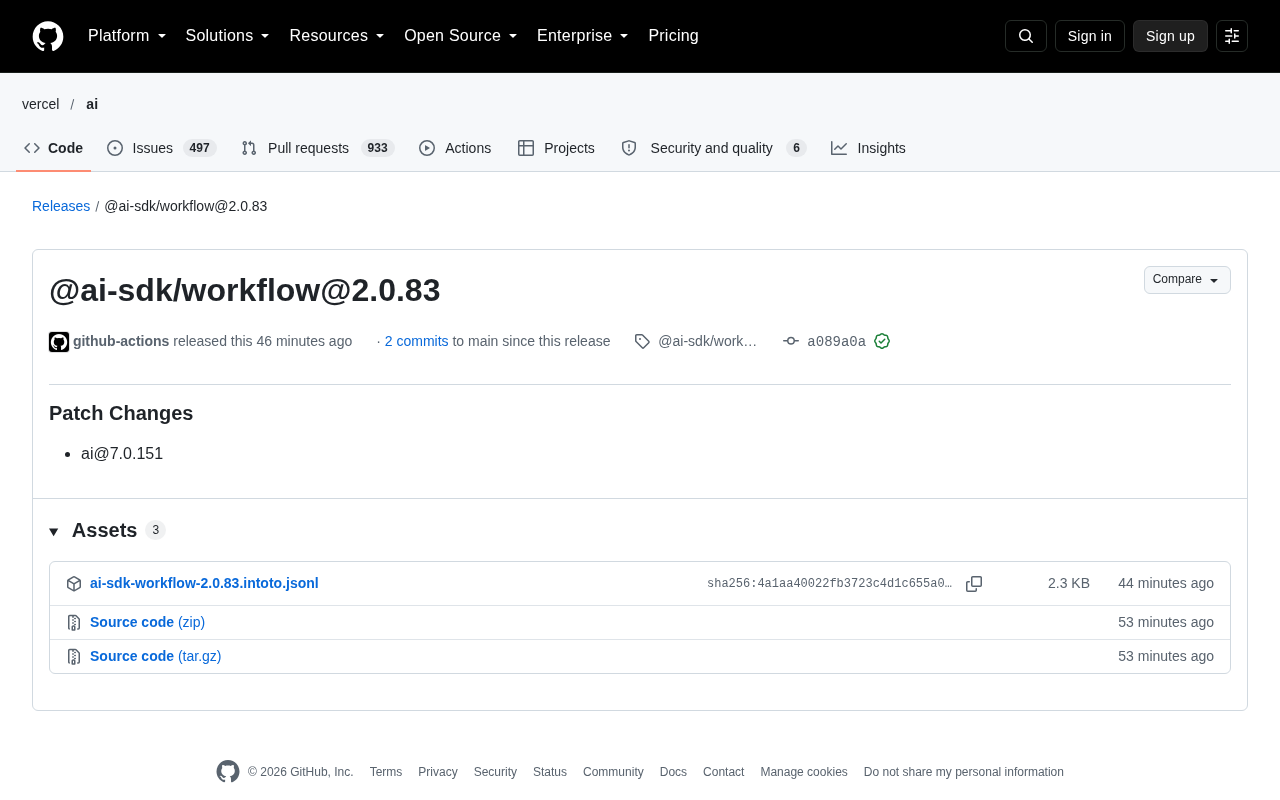
@ai-sdk/workflow releases patch 2.0.83, only upgrading the ai dependency to 7.0.151.
Vercel's @ai-sdk/workflow has released patch version 2.0.83, with the only change being an upgrade of the underlying ai package to 7.0.151, automatically published by github-actions with GPG signature verification. The article notes that such dependency-only patches are common in monorepos, and their value lies in keeping the workflow package in sync with the core package's compatible range. It also explains semantic versioning, peer dependencies, and the ecosystem signals behind the workflow layer's independent versioning.
Vercel's AI SDK toolchain recently released version 2.0.83 of @ai-sdk/workflow. According to the GitHub Releases page, this is a small patch update (Patch Changes), primarily aimed at syncing dependency versions, with no new features or breaking changes introduced. For developers building workflow applications with the AI SDK, understanding the meaning behind such version numbers is more valuable than chasing the latest release.
What the Patch Version Actually Changes
According to the release notes, the core change in version 2.0.83 is just one item: upgrading the ai package to 7.0.151. The release was automatically created by the github-actions bot, and the commit is verified with a GitHub signature (GPG key ID: B5690EEEBB952194), indicating that the release process itself is a standardized automated pipeline.
Patches like this that "only bump dependencies without changing code" are very common in monorepo toolchains. As a workflow wrapper layer in the AI SDK ecosystem, the behavior of @ai-sdk/workflow largely depends on the implementation of the underlying ai core package. When the core package fixes certain edge cases or adjusts internal interfaces, upper-layer packages can benefit synchronously through a single dependency upgrade, without the need to write duplicate changelogs.
In other words, the value of 2.0.83 lies not in "what it adds," but in keeping the workflow package within the same compatible range as the core package.
Semantic Versioning (SemVer) is the foundation for understanding what version numbers mean. It specifies that a version number consists of three parts: MAJOR.MINOR.PATCH. The major version increments when there are incompatible API changes, the minor version increments when functionality is added in a backward-compatible manner, and the patch number increments when backward-compatible bug fixes are made. Therefore, 2.0.83 is a patch version and theoretically contains no API breaking changes, so the upgrade risk is low.
In a monorepo, packages depend on each other through workspace links, and version synchronization is often handled automatically by tools like Changesets. The fact that @ai-sdk/workflow only bumps the ai dependency version without writing a business changelog is a typical patch change record automatically generated by Changesets.
Why Developers Should Pay Attention to These Small Versions
Many people are accustomed to only looking at major version updates and consider patch versions insignificant. But in rapidly iterating libraries like the AI SDK, patch versions often carry critical fixes.
On one hand, version 7.0.151 of the ai core package may include fixes for streaming responses, tool calls, or token counting—details that directly affect workflow stability. On the other hand, a patch-level increment in semantic versioning usually means there are no API breaking changes, so the upgrade risk is low and it can be safely auto-merged in CI pipelines.
From an engineering practice perspective, incorporating such dependency upgrades into a regular dependency update strategy is much safer than waiting for major versions and upgrading in bulk. Bulk upgrades tend to accumulate compatibility debt, while small, frequent steps expose problems within a smaller scope.
Peer dependency is a way of declaring dependencies between npm packages: package A declares that it needs to work with a certain version range of package B, but does not install B directly; instead, it requires the user to provide a compatible B in the project. If the project's locked ai version range does not include 7.0.151, npm/pnpm will throw a peer dependency warning, or even cause installation failure or unexpected runtime behavior. Therefore, before upgrading, you should check the version constraint for ai in package.json to ensure that 7.0.151 falls within ^7.0.0 or a similar allowed range.
The Ecosystem Signal Behind the Version Number
@ai-sdk/workflow reaching the 2.0.x series indicates that this workflow abstraction has become relatively stable. The early AI SDK ecosystem focused more on single model calls, while the independent versioning of the workflow layer reflects growing developer demand for multi-step, orchestratable AI processes.
Splitting workflow capabilities into a separately maintained package also aligns with Vercel's consistent modular approach: keep the core package lightweight and introduce upper-layer capabilities as needed. The benefit of this split for end users is controllable bundle size, while for maintainers it means release cadences can be decoupled.
One caveat, though: the information provided in this release note is very limited—only the dependency version number is visible, with no specific fixes or migration notes attached. If you are troubleshooting a specific issue, it is recommended to check the changelog for ai@7.0.151 directly rather than staying on the release page of the workflow package.
Workflow orchestration refers to organizing multiple AI calls, tool executions, and conditional branches into reusable, observable multi-step processes. Unlike single model calls, the workflow layer needs to handle state passing between steps, error retries, concurrency control, and aggregation of streaming outputs. The AI SDK splits this capability out of the core package into an independent workflow package, keeping the core package lightweight while allowing complex orchestration logic to evolve and be versioned independently. This also explains why the workflow package upgrades its dependencies in sync with the core package.
Upgrade Recommendations
For production environments, pure dependency patches like this can usually be upgraded directly, but it is still recommended to run existing test cases after upgrading, especially integration tests involving tool calls and multi-step orchestration. If the project locks the version range of the ai package, you need to confirm whether 7.0.151 falls within the allowed range to avoid peer dependency warnings.
For teams still waiting to see, you can treat this as a routine maintenance window and take the opportunity to check whether there are outdated AI SDK-related packages in the dependency tree, maintaining version consistency across the entire chain.
One-line Summary
@ai-sdk/workflow releases patch 2.0.83, only upgrading the ai dependency to 7.0.151.
Paragraph Summary
Vercel's @ai-sdk/workflow has released patch version 2.0.83, with the only change being an upgrade of the underlying ai package to 7.0.151, automatically published by github-actions with GPG signature verification. The article notes that such dependency-only patches are common in monorepos; their value lies in keeping the workflow package in sync with the core package's compatible range, and they may carry critical fixes for streaming responses, tool calls, and more. Patch versions have no breaking changes and low upgrade risk, so they should be included in a regular dependency update strategy and auto-merged. Meanwhile, the independent versioning of the workflow layer reflects growing demand for multi-step AI orchestration and an increasingly modular ecosystem. Production environments can upgrade directly, but should run integration tests and check peer dependency compatibility ranges.
Related articles

LLaMA-Factory in Practice: A Complete No-Code Guide to Fine-Tuning Large Models
An introduction to LLaMA-Factory, the open-source fine-tuning tool: its 60.1K-star background, supported models and algorithms, local vs. cloud deployment, and CUDA setup steps.

Zeng Ming's Deep Retrospective: Why OpenAI May Not Be the Ultimate Winner — and Why the Corporate System Will Disappear
Zeng Ming's deep retrospective on the AI endgame: model companies are just infrastructure, OpenAI and Anthropic won't be the final winners; the next battle is the Agent entry point standard; the corporate system will disappear as AI restructures collaboration, and only mission-driven companies can survive the cycle.

OpenHands v1.28.0: OpenCode and PI Added as Built-in Agents, API Keys Requestable In-Conversation
OpenHands ships 5 releases in 21 days: v1.27.0 adds OpenCode and PI as built-in agents, v1.28.0 enables in-chat key requests. ACP integration, credential reuse, model list changes, and upgrade advice.