AIAgentCogNest: An Open-Source AI Agent Knowledge Incubation & Development Tutorial Project
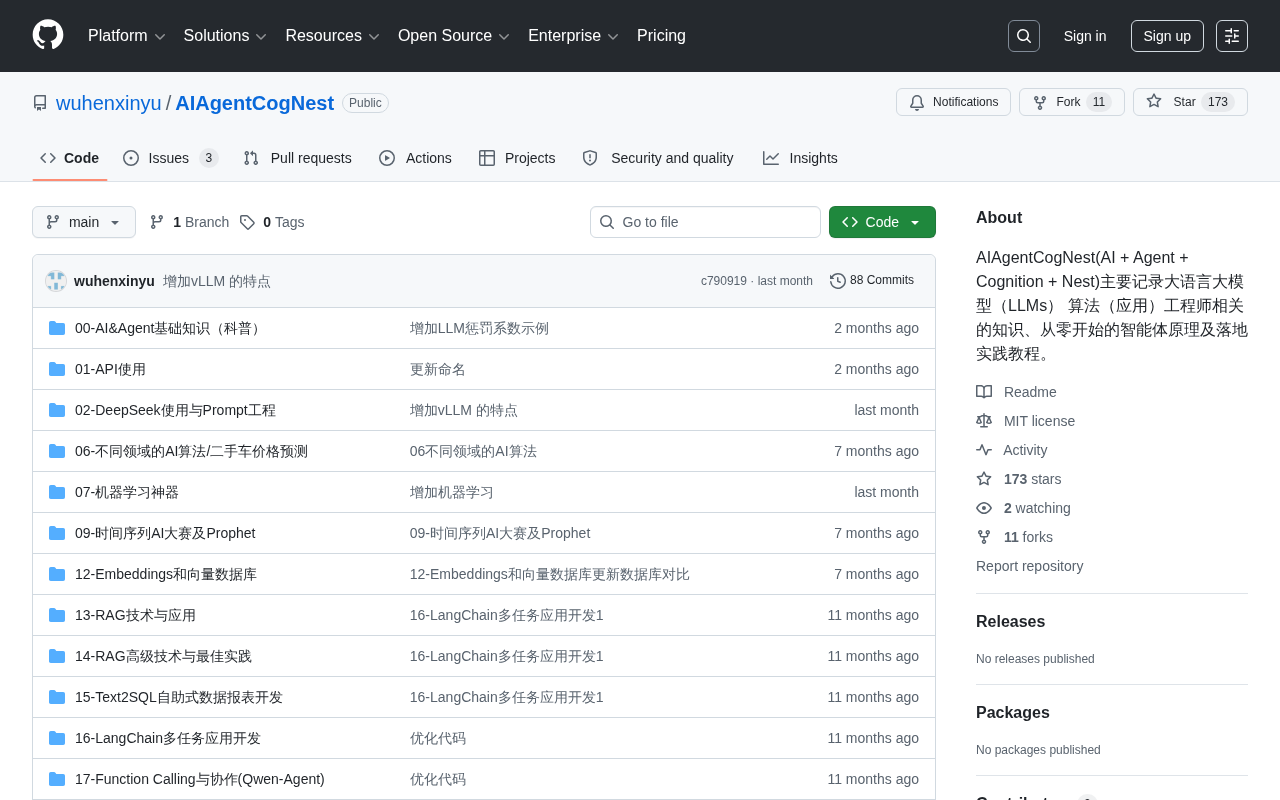
AIAgentCogNest is an open-source project building a structured learning path from AI Agent concepts to production engineering.
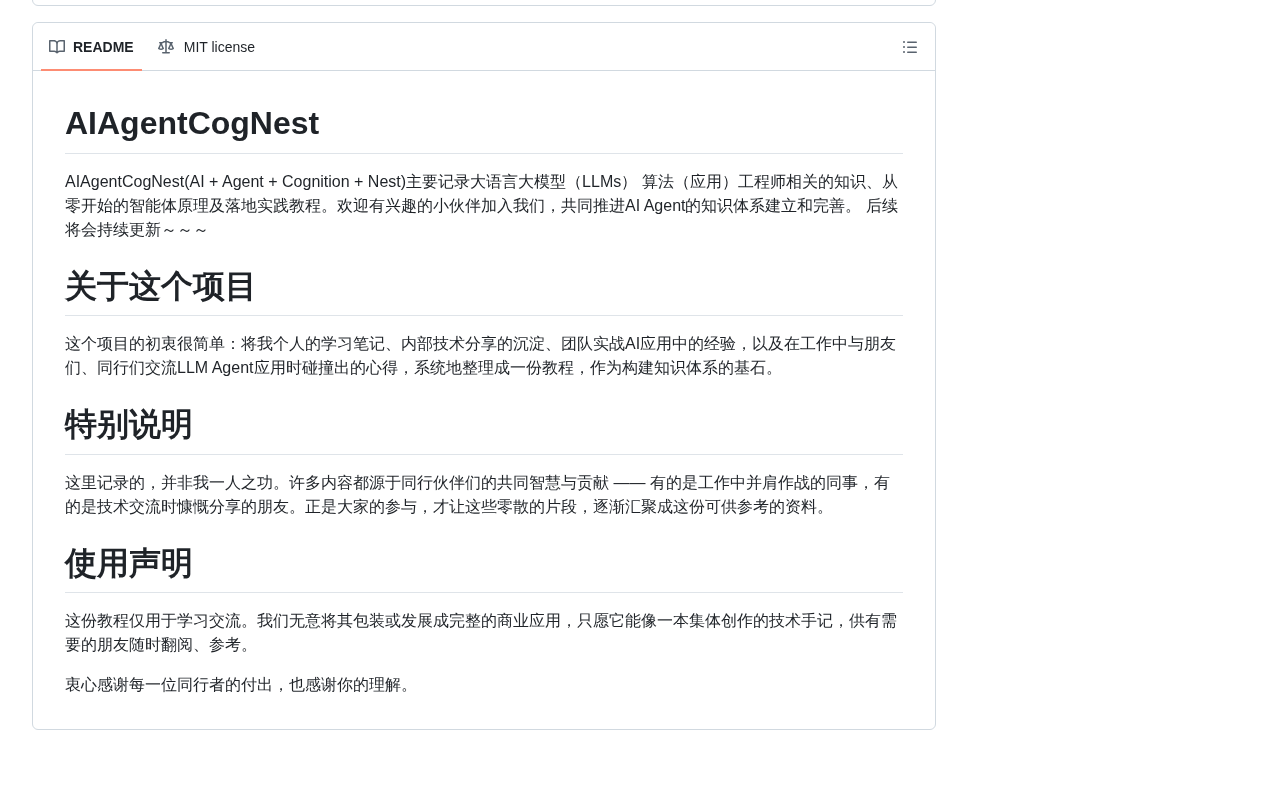
AIAgentCogNest is a Python-based open-source project whose name combines AI, Agent, Cognition, and Nest — positioning itself as an "AI Agent Cognitive Nest." It targets the steep learning curve of AI Agent development and the scarcity of structured tutorials, serving four audiences: AI application developers, engineering practitioners, enthusiasts, and teams migrating from traditional software. Unlike pure code repositories, it emphasizes a complete path from conceptual understanding to production deployment, with particular attention to engineering concerns often overlooked in tutorials. Currently at 85 Stars and 3 Forks, the project is in early growth stages and its long-term value depends on continued content development and community contribution.
A Knowledge Incubation Project for AI Agent Learners
As large model application development continues to surge, systematically mastering how to build AI Agents has become a real challenge for many developers and organizations. The open-source project AIAgentCogNest was created specifically to address this pain point. The name is a combination of four words — AI + Agent + Cognition + Nest — translating roughly to "AI Agent Cognitive Nest." Its mission is to help AI application developers, AI engineering practitioners, AI enthusiasts, and teams looking to transform traditional software applications into AI Agent-powered products build a comprehensive, structured knowledge base around AI Agents.
As of now, AIAgentCogNest has earned 85 Stars and 3 Forks on GitHub, with Python as its primary language. While the project is still in its early stages, its focus on the combination of "knowledge incubation + knowledge systems + LLM application development tutorials" reflects a genuine gap in today's AI Agent ecosystem.
Why a Knowledge Incubation Project Like This Is Needed
AI Agents have become one of the most important deployment forms for large models. Unlike simple conversational Q&A, Agents emphasize autonomous planning, tool invocation, memory management, and multi-step execution — making the technology stack significantly more complex than standard prompt engineering. For developers, there's a steep learning curve between understanding the basic concepts of Agents and mastering framework selection and production deployment.
The two words "Cognition" and "Nest" in the project name are particularly well-chosen. "Cognition" signals that the project is concerned not only with code implementation but also with understanding the cognitive mechanisms behind Agents. "Nest" uses the metaphor of a gradually incubating and growing nest to emphasize the accumulation and systematization of knowledge. This positioning sets it apart from a pure code repository or toolkit — it's closer to a structured learning and practice platform.
The project is especially valuable for the niche scenario of "migrating traditional software to AI Agent applications." Many legacy software teams face mounting pressure to adopt AI, yet lack a clear, structured migration path. Tutorial-style resources like this fill the gap between starting from scratch and achieving real engineering practice.
The AI Agent technology stack typically spans several core layers: the Planning Layer decomposes complex tasks into executable sub-steps, with common implementations including ReAct (Reasoning + Acting) and Chain-of-Thought prompting strategies; the Tool Use Layer allows Agents to call external APIs, code interpreters, search engines, and more via Function Calling or plugin mechanisms to expand capability boundaries; the Memory Layer is divided into short-term context window memory and long-term external storage (such as vector databases), maintaining information continuity across sessions; and the Execution Layer handles the triggering of specific actions and feedback on results. Mainstream Agent frameworks today include LangChain, LlamaIndex, AutoGen, and CrewAI, each with different levels of abstraction and target use cases. It's precisely this multi-layered, multi-framework landscape that makes a systematic learning path so essential.
Core Positioning and Target Audience
Based on the project description, AIAgentCogNest primarily serves four groups:
AI Application Developers
For engineers who already have a programming foundation and want to break into AI Agent development, the project provides a guided path from concept to practice, lowering the barrier to getting started with various frameworks and tools.
AI Engineering Practitioners
This group focuses on how to move Agents from experimental prototypes to production environments — covering deployment, monitoring, performance optimization, and other engineering concerns that many tutorials overlook but enterprises care about most.
The challenges of pushing Agents into production are far more complex than the prototyping phase. Typical issues include: latency and cost control — multi-step Agents invoke large models far more frequently than single-turn Q&A, requiring token consumption and response latency to be managed through caching, tiered model calls, and similar strategies; observability — Agent reasoning paths are opaque, requiring robust tracing and logging systems to track every tool call and decision; security and permission boundaries — Agents can actively execute code and access external services, making prevention of Prompt Injection attacks and privilege escalation critical for production deployment; and failure recovery mechanisms — a failure at any step in a multi-step execution chain can cause the entire task to collapse, requiring well-designed retry and rollback strategies. These engineering challenges are often underrepresented in academic tutorials, yet are precisely what enterprise practitioners most urgently need systematic guidance on.
AI Enthusiasts
For individuals interested in AI Agents but lacking a structured learning path, the project offers a beginner-friendly knowledge framework to get started.
Traditional Software Teams Transitioning to AI
For teams with existing software products, the project helps them understand how to incorporate Agent capabilities and upgrade their application architecture.
The Value and Limitations of Open-Source Tutorial Projects
Choosing Python as the primary language aligns with the mainstream of today's AI development ecosystem. Python enjoys the most comprehensive library support across LLM application development and Agent frameworks, allowing the project's content to closely mirror developers' real-world working environments.
That said, it's worth maintaining a realistic perspective on this type of project. The current 85 Stars indicate that the project is still in its early growth stage, and the completeness of its content, update frequency, and community engagement all warrant continued observation. For open-source tutorial projects, long-term value depends on whether the knowledge system is sufficiently comprehensive, whether the examples are grounded in real-world practice, and whether the project can keep pace with the rapid iteration of AI Agent technologies.
For developers interested in learning AI Agents, it's best used as one reference framework among many — to be combined with official framework documentation and hands-on project practice. The greatest value of tutorial-style resources lies in providing a clear learning roadmap; actual skill development still comes from doing.
Summary
AIAgentCogNest represents an exploratory direction within the AI Agent learning resource ecosystem — going beyond just providing code to build a complete knowledge incubation path from conceptual understanding to engineering implementation. Given the high technical barrier of Agent development and the relative scarcity of high-quality, systematic Chinese-language tutorials, projects like this serve a meaningful purpose. For developers, engineers, and transitioning teams looking for an AI Agent learning path, it offers a worthy starting point — though its ultimate value still depends on the continued refinement of its content and the growth of its community.
Related articles

Spotit: Turn Every Mac App into a Real-Time Interactive Tutorial
Spotit is an AI-powered interactive tutorial tool for Mac. Press a shortcut, ask in plain language, and it highlights exactly where to click next — guiding you through any Mac app as you learn by doing.
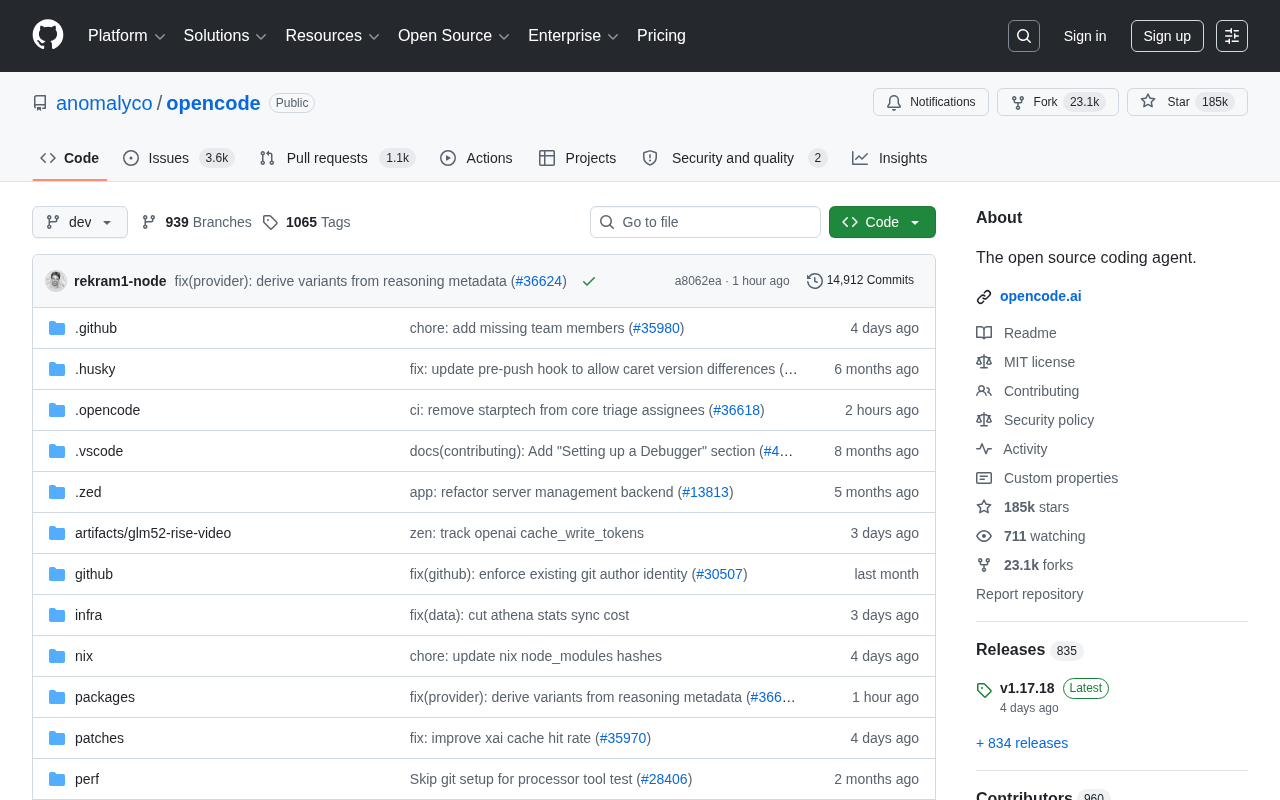
OpenCode: The Open-Source Coding Agent That Hit 150K GitHub Stars
OpenCode is an open-source TypeScript coding agent with 150K+ GitHub stars. Learn about its features, advantages, and use cases for AI-powered development.
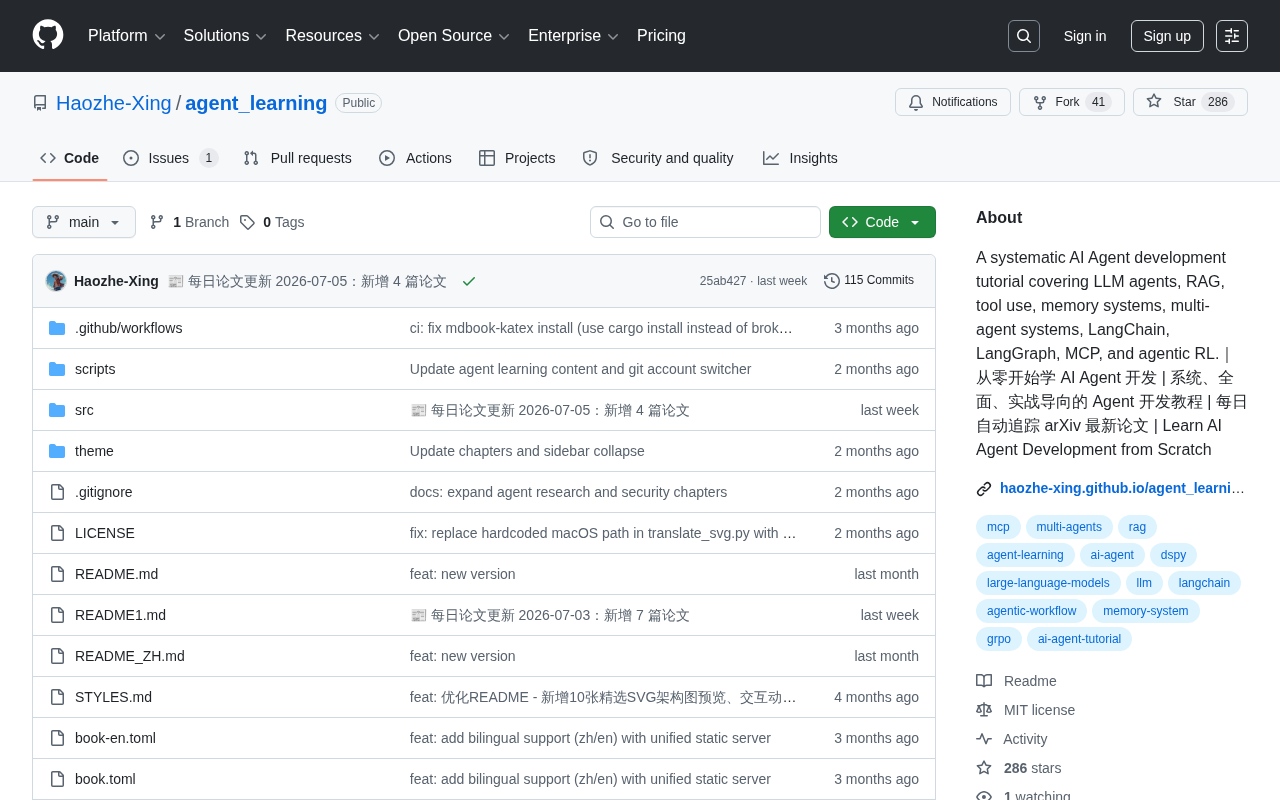
Learning AI Agent Development from Scratch: An Open-Source Tutorial Worth Bookmarking
Haozhe-Xing/agent_learning is a systematic, hands-on open-source tutorial for learning AI Agent development from scratch, with daily arXiv paper tracking built in.