Alteryx One in Action: Building AI Agents with Ask Alteryx

Alteryx One uses Ask Alteryx and Agent Studio to package trusted workflows into auditable AI agents.
Based on Alteryx senior sales engineer Joe Mark's nearly hour-long official demo, this article explains how Alteryx One shifts from a data preparation tool to the data foundation for the agent era. It covers: Alteryx One as a unified platform where Designer and Server remain components; Ask Alteryx generating inspectable workflow skeletons via natural language; Agent Studio packaging trusted workflows into conversational agents with full audit trails; Live Query enabling in-place queries on Databricks, Snowflake, and BigQuery while inheriting Unity Catalog governance; and Alteryx Skills plus MCP server letting external tools like Claude Code and ChatGPT create and run Alteryx assets. The key differentiator is not the model itself but the traceable, reproducible data pipeline behind it.
Alteryx One in Action: Building AI Agents with Ask Alteryx
Alteryx has long been viewed as a low-code ETL and data preparation tool, but the latest Alteryx One platform is completely rewriting that impression. In a complete official tutorial on Bilibili, Alteryx senior sales engineer Joe Mark delivered a nearly hour-long live demo showing how to build a conversational, auditable AI agent from scratch using Ask Alteryx and Agent Studio. The entire demo never stayed at the conceptual level—instead, it used a fictional wine company, Average Joe Wine, as the thread to connect data preparation, direct queries, agent creation, and the MCP server into one complete workflow.
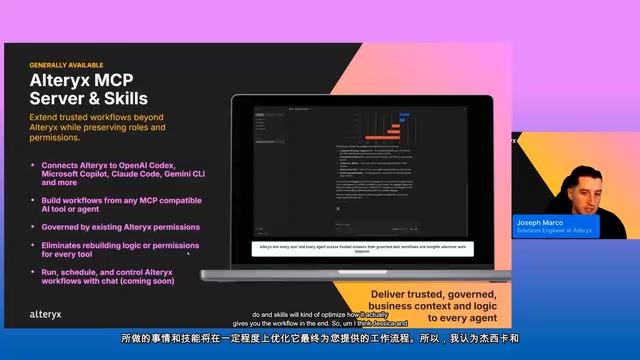
What Exactly Is Alteryx One: A Platform, Not a Single Tool
Joe opened with a question: when you hear "Alteryx One," what do you think it represents? Answers tend to split into two camps—some say it's Alteryx's cloud product, others say it's a design tool in the browser. His clarification was clear: Alteryx One is the unified platform for the evolution of all Alteryx capabilities, and Designer and Server remain part of it rather than being replaced.
This judgment matters especially for long-time users. Over the past decade, Alteryx users have experienced the expansion from Designer Desktop to Server, and then to enterprise governance and collaboration capabilities. Now Alteryx One consolidates these capabilities into a single desktop application entry point, letting users complete data preparation, collaborative sharing, and agent building within the same interface. Designer is embedded as a component, now at version 26.2, with some color scheme adjustments, but the core operating logic remains continuous.
For new users, Joe's advice was direct: don't rush to learn where every tool is—start with Ask Alteryx.
Ask Alteryx: Completing Your First Workflow with Natural Language
In the demo, Joe played the role of a product analyst at Average Joe Wine, facing a typical dilemma: sales data scattered across Excel, SQL, and multiple files, while management demands to see product sales performance and revenue trends as soon as possible. Rather than opening the toolbox and dragging tools one by one, he described his situation in the Ask Alteryx sidebar—a beginner, scattered data, wanting to see product performance first.
The system then offered several optional use cases, and he chose "Product Performance and Revenue Trend Analysis." Within seconds, input tools, data cleaning steps, and aggregation logic were automatically placed on the canvas, with mock data pre-filled. Joe emphasized that this mock data could be replaced with real data, but more importantly, what he got was a structurally complete workflow skeleton where every step could be inspected.
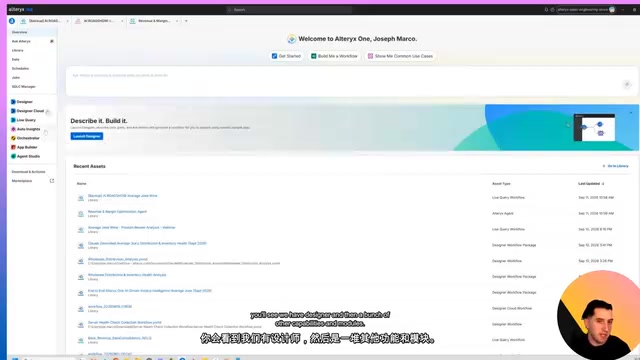
The next actions demonstrated the balance of "human-AI collaboration": Joe checked the formulas and field types, made minor adjustments to the flow, then hid the Ask Alteryx panel and returned to the traditional Designer canvas to continue optimizing. His view: AI builds the skeleton, humans calibrate the logic—you're still the expert on data and business, and you need to judge whether the AI's answers are right or wrong.
This segment also explained the division of labor between Ask Alteryx and Agent Studio: the former is a building and troubleshooting assistant that helps turn ideas into runnable workflows; the latter is where trusted outputs are packaged into conversational agents.
Agent Studio: Turning Trusted Data into Conversational Agents
With the workflow ready, Joe turned his attention to agents. In Agent Studio, he created a conversational agent called "Revenue Optimization Agent," filling in the name, description, and custom instructions, and attached the workflow output he had just built as a knowledge source. A dropdown menu on the interface allowed precise selection of datasets or workflows, ensuring the agent only answered based on verified assets.
The live Q&A session was the most telling. Joe entered: "Give me a summary of Average Joe Wine's top three performing products, along with recommendations to drive growth and improve customer satisfaction." The agent quickly returned Chardonnay, Riesling, and Pinot Grigio, and additionally pointed out that the Los Angeles store was a key factor in sales contribution, and based on payment method data, suggested optimizing the credit card payment experience.
Joe specifically noted that these answers were not generated out of thin air by the model, but derived along the datasets and reasoning logic he had set up. More critically, the system retained a complete audit trail—what data was used at each step, what transformations were executed, which records were filtered—all traceable. This is precisely the core difference between Alteryx agents and simply uploading files to a general-purpose chatbot and asking questions: the latter can give you an answer, but it's hard to tell you where the answer came from, and even harder to reproduce it exactly after the data updates.
Audit Trail refers to the traceable record of all key operations left by the system during a data processing or query process, typically including: which data sources and fields were used, which transformations and filters were executed, in what order calls were made, and how the final output was generated. In AI agent scenarios, the significance of the audit trail lies in binding the "answer" to the "production process of the answer," making results reviewable, reproducible, and accountable. For regulated industries (finance, healthcare, auditing), model outputs lacking an audit trail are difficult to incorporate into formal decision-making processes. Alteryx's advantage is that its underlying engine is fundamentally a deterministic workflow engine, where every transformation step has clear inputs and outputs, so the agent's answers can be drilled down layer by layer to specific tool configurations and data snapshots, rather than only providing an inexplicable natural language conclusion.
Live Query and Multilingual Data: Analyze Without Moving Data
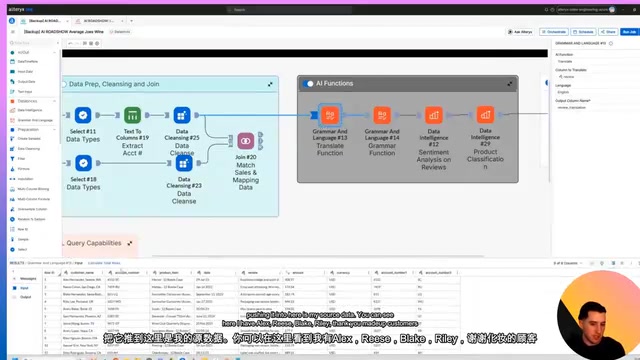
In the middle of the tutorial, Joe switched the scenario to a multi-cloud computing environment. Suppose customer review data is stored in Databricks, while invoice data is scattered across documents and systems—how does Alteryx handle this? The answer is Live Query. It allows users to connect directly to cloud data platforms such as Databricks, Snowflake, or BigQuery, executing queries and analysis where the data resides, without first performing large-scale data movement.
In the demo, Joe connected to a customer review table in Databricks, with reviews in multiple languages. He invoked the AI function integrated between Alteryx and Databricks, specifying "translate the review field to English" in the tool configuration, and the output panel on the right displayed the translation results in real time. Throughout the process, the data never left Databricks, and Alteryx inherited Unity Catalog's governance rules and permission system—users still saw only the data they were already authorized to access.
Joe's assessment: Live Query enables ordinary analysts to handle cross-platform data tasks that previously required engineer involvement, while SQL users can still write queries directly within Alteryx workflows—both paths coexist.
Data Movement is a common cost of traditional ETL: extracting, transmitting, and loading data from source systems to analysis platforms consumes network and storage costs, and brings latency, replica consistency, and compliance risks. Live Query (direct query/query pushdown) takes the approach of pushing computation to where the data resides, returning only query results or a small amount of aggregated data to the analysis layer, leaving source data untouched. This relies on two prerequisites: first, the target platform must have query interfaces that can be called externally (such as Databricks SQL, Snowflake, BigQuery); second, the permission and governance system must be inheritable—for example, Databricks' Unity Catalog provides unified metadata, permissions, and lineage management, with external tools running under its rules, and users can only see data they are already authorized to access. Direct query is particularly suitable for scenarios with large data volumes, frequent updates, or data residency regulations.
MCP Server and Alteryx Skills: Bringing Platform Capabilities into Claude Code
For more technical users, the latter half of the tutorial demonstrated the combination of the MCP server and Alteryx Skills. Joe invoked Alteryx Skills in Claude Code, and simply by describing "build a wholesale distribution analysis workflow to check inventory and distribution status," a complete workflow including map visualization and distribution optimization recommendations was generated. He didn't manually drag any tools—he only added a few interactions and explanations.
The demo of connecting to Alteryx One via the MCP server in ChatGPT was equally direct: Joe asked "what workflows can you access," and the system listed the workflow assets exposed in the environment, highlighting entries related to Average Joe Wine. He even built a small agent specifically designed to match the most suitable workflow for "customer sentiment analysis" from a large number of workflows.
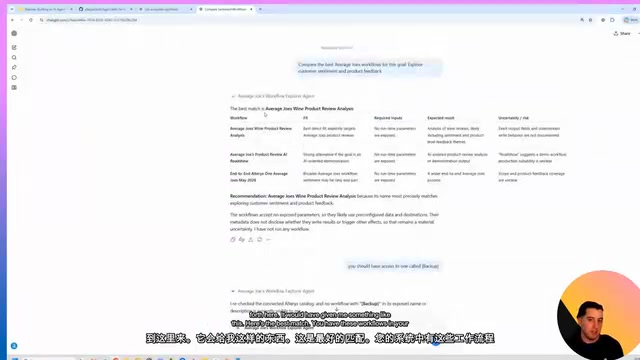
This means an important shift: users can create, discover, and run Alteryx assets with external AI tools without even opening the Alteryx interface. But what underlies this is still verifiable, auditable workflows, not black-box model outputs. Joe called these assets VRA—visible, understandable, repeatable, auditable—which is also the foundation of trust he repeatedly emphasized.
MCP (Model Context Protocol) is an open protocol for AI applications (such as Claude Code, ChatGPT, and other clients) to connect to external tools and data sources in a standardized way, without having to write separate integrations for each system. It uses a client-server structure: the MCP server exposes a platform's capabilities (such as listing workflows, running assets, reading metadata) as a number of "tools" and "resources," and the AI client calls them as needed during conversations. For Alteryx, the MCP server essentially turns governable assets within the platform into interfaces callable by external AI, enabling developers to initiate operations in their familiar coding environments while execution still lands on Alteryx's deterministic workflows. Alteryx Skills are pre-built capability packages that help AI understand how to use Alteryx's building blocks to complete specific tasks, reducing the cost of converting natural language into runnable workflows.
Who Should Use Which Path
During the Q&A session, Joe gave clear advice on user segmentation. Brand-new users should start with Ask Alteryx, describing problems in natural language to quickly obtain a workflow skeleton; existing users can use it for troubleshooting and documentation; developers accustomed to Claude Code, Codex, or Gemini can stay in their familiar environments through Skills and the MCP server while reusing Alteryx's governance and assets.
Governance was also specifically addressed: when data is not inside Alteryx, how are permissions and auditing guaranteed? Joe's answer: Alteryx One's management console provides audit logs, and in Databricks scenarios, Unity Catalog's governance rules are directly inherited—the platform does not change the customer's existing data architecture.
The signal from the entire demo was clear: Alteryx is shifting from a data preparation tool to the data foundation for the agent era, and its differentiation lies not in the model itself, but in the traceable, reproducible data pipeline behind the model.
Unity Catalog is the unified data governance layer provided by Databricks, centrally managing metadata, access permissions, lineage, and auditing for data assets (tables, views, volumes, models, etc.). Its key value is that governance rules are bound to data storage rather than to a particular front-end tool: any client connecting to Databricks—including Alteryx's Live Query—runs under the same permission model and cannot bypass existing authorization boundaries. This explains why Alteryx can "not change the customer's existing data architecture" in Databricks scenarios: the platform acts merely as a controlled query and orchestration entry point, while identity, permissions, and auditing are still uniformly adjudicated by Unity Catalog, so enterprises don't need to rebuild a governance system for the new AI analysis pipeline.
One-line Summary
Alteryx One uses Ask Alteryx and Agent Studio to package trusted workflows into auditable AI agents.
Paragraph Summary
Based on a nearly hour-long official demo by Alteryx senior sales engineer Joe Mark, this article outlines how the Alteryx One platform is shifting from a data preparation tool to the data foundation for the agent era. Core points include: Alteryx One is a unified platform entry point, with Designer and Server remaining components rather than being replaced; Ask Alteryx automatically generates an inspectable workflow skeleton through natural language descriptions, suitable for new users; Agent Studio packages trusted workflows into conversational agents with a complete audit trail, distinguishing them from general-purpose chatbots; Live Query supports in-place queries on Databricks, Snowflake, and BigQuery while inheriting Unity Catalog governance; Alteryx Skills and the MCP server let external tools like Claude Code and ChatGPT directly create and run Alteryx assets. The article emphasizes that its differentiation lies not in the model itself, but in the traceable, reproducible data pipeline behind the model.
Related articles

GPT-Next Leak, Gemini 4 Argon Imminent: AI News Roundup
GPT-Next leak suggests extreme efficiency; OpenAI's 28-day shipping pledge boosts speed 50%; Gemini 4 Argon nears release; Anthropic subscription value report sparks debate.

GPT-Next Leaked, Gemini 4 Argon Speeds Up, Fable 5.5 May Launch Today
OpenAI's GPT-Next model leaks, expected to be extremely low-cost and possibly part of the 28-day release plan; Gemini 4 Argon internal testing accelerates, NanoBanana 2.1 is live; Semi Analysis tests show Claude Max's equivalent API value is about 5 times that of ChatGPT Pro; Fable 5.5 may launch today.

Gemini 4 Argon Launches Globally: Key Highlights from the AI Daily Brief
Google opens Gemini 4 Argon globally across Pro and Ultra subscriptions and the API, and demonstrates robot control. This article rounds up open-source models, Agent infrastructure, cost transparency, and safety governance updates.