API Mock vs. Sandbox in Agent Testing: A Detailed Layered Strategy Guide

A layered strategy combining API Mocks and Sandboxes for comprehensive AI Agent testing.
When testing AI Agents, API Mocks offer speed and control but miss real-world bugs, while Sandboxes provide realistic behavior at higher cost. This article explains why Mocks fail in production — from assumption-reality gaps to contract drift — and presents a layered testing strategy: Mocks for unit tests and edge cases, Sandboxes for integration validation, contract testing as a bridge, plus production monitoring feedback loops.
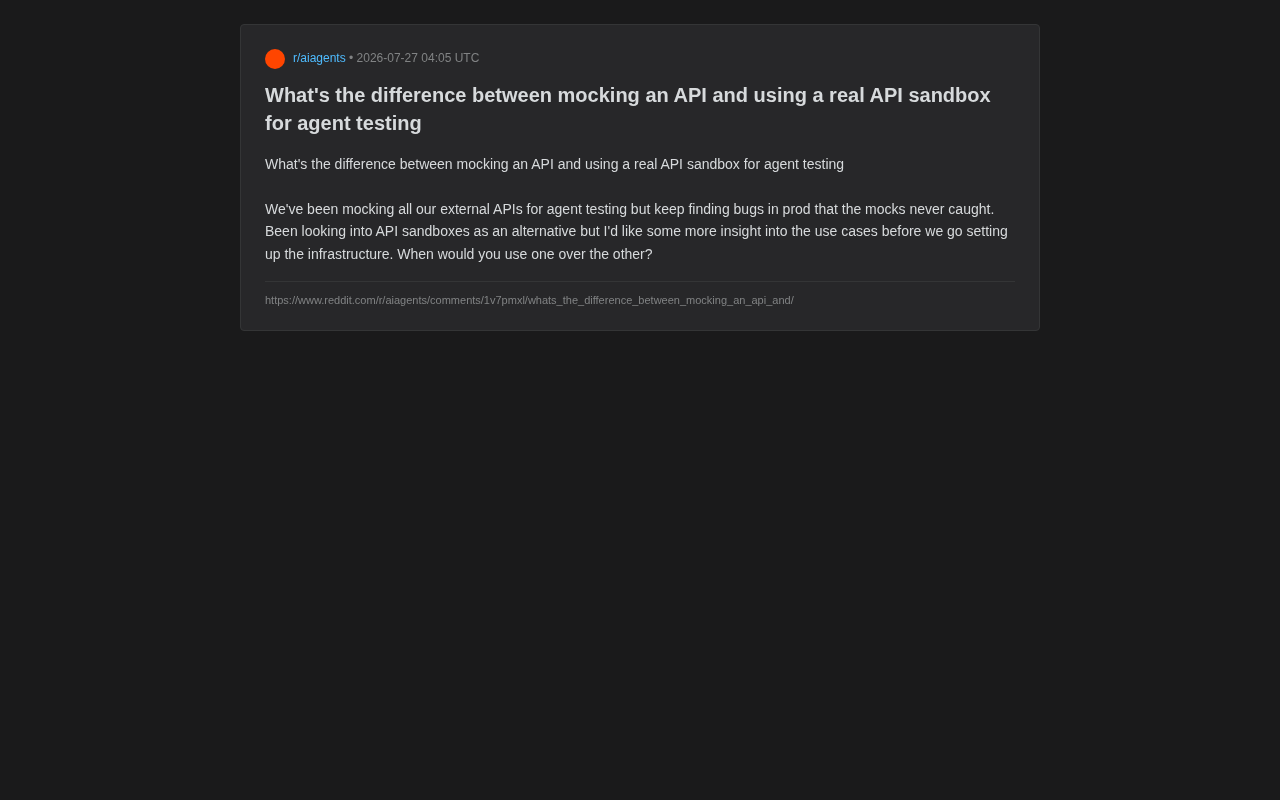
When building and testing AI Agents, the reliability of external APIs is a critical factor in determining system quality. Recently, a developer on Reddit raised a highly representative concern: their team had been using Mocks to test Agent interactions with external APIs, but production kept surfacing bugs that Mocks never caught. They were considering switching to API Sandboxes but weren't clear on the appropriate use cases for each approach.
This question strikes at the core tension in modern Agent engineering test strategy — the trade-off between test speed and test fidelity. This article systematically examines the fundamental differences between API Mocks and real API Sandboxes, their respective strengths and weaknesses, and practical recommendations for Agent testing.
Mock vs. Sandbox: The Fundamental Difference
To understand the differences, you first need to recognize that they play entirely different roles in the testing pipeline.
API Mock: Fully Controlled Simulation
A Mock is essentially a "fake" API response written by the developer. You predefine what data a given request should return, then intercept real network calls during testing and directly return these preset results. Its core characteristic is that it's entirely under your control.
The biggest advantage of Mocks is speed and determinism. They don't depend on the network, don't consume real quotas, run extremely fast, and produce completely predictable results. This makes them ideal for unit tests and rapid feedback loops in CI/CD pipelines. CI/CD (Continuous Integration/Continuous Deployment) is a core practice in modern software engineering — continuous integration requires developers to frequently merge code changes into the main branch, with each merge automatically triggering build and test processes; continuous deployment automatically releases code that passes testing to production. In this pipeline, test execution speed is crucial: if every commit requires waiting minutes or even tens of minutes for API calls to return, development efficiency suffers dramatically. This is precisely why Mocks are irreplaceable in CI/CD scenarios — they can complete responses in milliseconds, allowing a build containing hundreds of test cases to finish in just a few minutes.
However, the problem lies precisely in the "fully controlled" aspect. Mocks can only reflect your understanding of the API's behavior. When you manually write {"status": "success", "data": {...}}, you're actually encoding your assumptions about the API. Real APIs in production may return formats, edge cases, or error states you never anticipated — this is the root cause of the original poster's predicament.
API Sandbox: An Isolated Copy of the Real System
A Sandbox is a test environment officially set up by the API provider that behaves consistently with production but with isolated data. It runs real server-side code, processes real request logic, but doesn't affect real data or produce real consequences (e.g., no actual charges, shipments, or emails sent).
The value of a Sandbox lies in its ability to capture the behavioral details of the real API: real latency, real rate limits, real error response formats, real authentication flows, and those edge cases that documentation often glosses over.
Why Mocks Miss Production Bugs
The phenomenon described in the original post is extremely common in Agent engineering, with several deep-rooted causes behind it.
Assumption-Reality Gaps
The complexity of Agent systems lies in their need to make dynamic decisions based on API return values. When Mocks return idealized, simplified data, the Agent's reasoning path tends to follow the "happy path." Happy path is a classic term in software testing, referring to the normal execution flow from start to finish under ideal conditions where all inputs are valid and all external dependencies work normally. The counterparts are sad paths and edge cases. In an Agent system, the happy path might be: user sends request → LLM correctly understands intent → API returns data normally → Agent successfully completes task. But in reality, an API might return HTTP 429 (Too Many Requests), 502 (Bad Gateway), or a JSON structure where a field is null instead of the expected object. A robust Agent must handle these non-ideal paths, and over-reliance on Mocks often validates only the happy path — scenarios involving null values, unexpected field structures, pagination boundaries, or different error codes trigger untested branch logic in the Agent.
Timing and Concurrency Issues
Mocks typically return synchronously and instantly. But real APIs exhibit network latency, timeouts, and intermittent failures. The Agent's retry logic, timeout handling, and state management when dealing with these timing issues only reveal defects when facing real uncertainty.
Contract Drift from API Evolution
Mocks are static snapshots. When the API provider updates the interface, modifies response formats, or deprecates certain fields, your Mock remains stuck in the past. This "contract drift" causes tests to pass while production fails — it's one of the most insidious risks in Mock testing.
The deeper mechanism of contract drift is this: in microservice architectures and third-party API integrations, the API's response format is essentially a "contract" — consumers depend on specific field names, data types, and nested structures to parse data. However, API providers may adjust response structures due to version upgrades, feature iterations, or bug fixes — for example, changing a field from a string type to an array type, adding required parameters, or deprecating an endpoint. If the consumer's Mock is still written based on the old contract, all tests will still pass, but the system will immediately crash when interfacing with the real API in production. This problem is especially tricky because it produces no compilation errors or static analysis warnings at the code level — it only manifests at runtime.
How to Choose: A Layered Testing Strategy
In practice, Mock and Sandbox aren't an either-or choice. Mature engineering practices should combine both to build a layered testing pyramid.
Unit Test Layer: Prefer Mocks
When testing the Agent's core logic, decision branches, and data processing, Mocks are the best choice. They're fast, stable, work offline, and allow you to precisely construct various edge scenarios (including error conditions that are hard to reproduce in a Sandbox). This layer should cover a large number of test cases.
Integration Test Layer: Introduce Sandboxes
When you need to verify the Agent's end-to-end interaction with real APIs, Sandboxes are indispensable. They can validate authentication flows, real data structures, and whether error handling chains work correctly. This layer has fewer tests but delivers extremely high value, specifically designed to catch integration issues that Mocks can't discover.
Contract Testing as a Bridge
Also worth mentioning is "Contract Testing" as an intermediate approach. Contract testing is a testing method specifically designed to address inter-service integration reliability. Its core idea is to record API request-response pairs as a verifiable "contract" file. Pact is the most popular open-source framework in this space, originally developed by an Australian team and supporting multiple programming languages. The workflow is: the consumer side generates a contract file defining the expected request format and response structure; the contract file is then shared with the provider side, which runs contract verification tests to ensure its API actually meets the consumer's expectations. When the provider modifies API behavior causing the contract to no longer match, the verification test fails immediately, catching breaking changes before deployment. This approach fills the gap between Mock (entirely fictional) and Sandbox (entirely real), retaining Mock's speed advantage while providing timely alerts when APIs change, effectively mitigating contract drift issues.
Special Recommendations for Agent Testing
Agent testing has its unique characteristics because it involves the combination of LLM non-deterministic output and external tool calls. Unlike traditional software, LLM-based Agent systems have inherent non-determinism — even with identical inputs, the LLM's output may differ with each call. This is due to large language models using probability-based token sampling mechanisms (controlled by parameters like temperature and top-p); even with temperature set to 0, different inference engine implementations and floating-point precision differences can cause minor output variations. This non-determinism, layered on top of the uncertainty of external API calls, creates a dual challenge for Agent testing: you can neither precisely predict what tool call instructions the LLM will generate, nor fully predict what the API will return. Therefore, Agent testing strategy needs to shift from "validating exact output" to "validating behavioral boundaries" — ensuring the Agent makes reasonable decisions under various possible API responses, rather than pursuing identical output every time.
Here are several practical recommendations:
Prioritize testing tool-calling loops in the Sandbox. The core of an Agent is the "Perceive-Decide-Act" loop, a pattern derived from classical agent theory. In modern LLM-based Agents, this loop manifests as: the Agent receives user instructions or environmental information (perceive), performs reasoning and planning through the LLM (decide), then calls external tools or APIs to execute specific actions (act), and enters the next cycle based on execution results. OpenAI's Function Calling, Anthropic's Tool Use, and LangChain's Agent framework are all implementations of this pattern. The tool-calling step is the critical node where the Agent interacts with the external world — the LLM outputs structured function call intents (such as which API to call and what parameters to pass), the system executes the actual call, and returns results to the LLM for next-step reasoning. This means the format, latency, and error patterns of API return values directly affect the quality of the LLM's subsequent reasoning. This loop has the highest dependency on real responses and should be fully verified in a Sandbox.
Use Mocks to cover exception scenarios. API failures, rate limiting, and timeouts in production are difficult to actively trigger in a Sandbox. In this case, Mocks are actually more controllable tools. You can use Mocks to intentionally inject various faults to test the Agent's robustness.
Establish a production monitoring feedback loop. No matter how thorough the testing, you can never exhaust all scenarios. A production monitoring feedback loop is an important component of Site Reliability Engineering (SRE) philosophy, with the core idea of treating the production environment as the ultimate test environment. Through observability tools — including log aggregation (e.g., ELK Stack), distributed tracing (e.g., Jaeger, OpenTelemetry), and metrics monitoring (e.g., Prometheus/Grafana) — you continuously collect behavioral data from the system at runtime. When the Agent encounters unexpected API responses or anomalous behavior in production, this data is captured and automatically or semi-automatically transformed into new test cases. This approach is also reflected in Chaos Engineering — Netflix's Chaos Monkey proactively injects failures in production to discover system vulnerabilities, then feeds findings back into testing and architectural improvements. Feeding anomalous cases discovered in production back as new test cases (whether Mock or Sandbox) to form a continuous improvement loop is the lasting solution to the "Mocks miss bugs" problem.
Conclusion
The original poster's predicament reveals a universal truth: the fidelity of your tests determines the upper limit of bugs they can catch. Mocks are fast but lose fidelity; Sandboxes are realistic but cost more. The two aren't competitors — they're complements.
For systems like Agents that are highly dependent on external interactions and exhibit dynamic, complex behavior, relying solely on Mocks does indeed create hidden risks. The sensible approach is: use Mocks to ensure rapid feedback and edge case coverage, use Sandboxes to ensure the reliability of real integrations, and supplement with contract testing and production monitoring to build a complete quality defense line.
Key Takeaways
Related articles
Altman: Taking OpenAI Public This Year Would Be 'Ill-Advised'
OpenAI CEO Sam Altman says going public this year would be 'ill-advised,' even as the company has confidentially filed IPO paperwork. Here's what it means for AI.
An Open Letter to Dario: If AI Safety Is Real, Open the Model Weights
Developer Jacob's open letter to Anthropic CEO Dario Amodei went viral on Hacker News, challenging the contradiction between AI safety rhetoric and closed-source models: if safety truly matters, why not open the weights?
Ludwig: Building Custom LLMs and Neural Networks with Declarative Low-Code Configuration
Ludwig is an open-source low-code ML framework that builds custom LLMs and neural networks via declarative YAML config — no boilerplate training code required.