Beyond LangChain: How to Choose Backend Infrastructure for AI Applications?

Once LangChain works, an AI product's success depends on the backend infrastructure beneath the orchestration layer.
Inspired by a Reddit discussion, the article notes that once a LangChain chain works, developers realize the complexity of "non-chain" parts: auth, data storage, vector retrieval, file management, document parsing, usage tracking, and background tasks. It analyzes three key decisions: normalizing documents to Markdown before ingestion to decouple chunking and indexing from file formats; the framework boundary debate—whether LangChain should handle everything or focus on orchestration with persistence and search behind independent backend APIs, with the community leaning toward decoupling for replaceability and team division of labor; and common production component choices and layered architecture recommendations. The conclusion: designing the "non-chain" layer early may matter more than optimizing the chain itself.
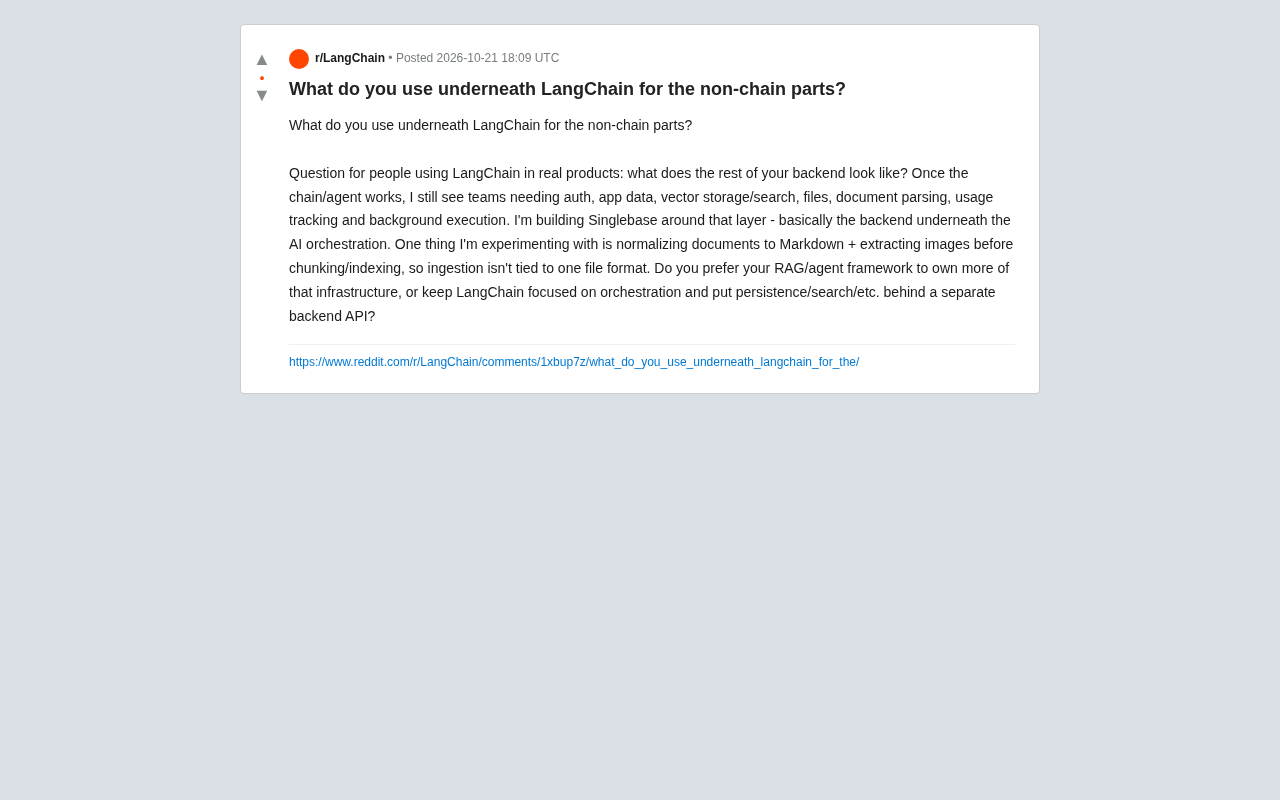
When building LangChain-based AI applications, developers often focus on the orchestration logic of chains and agents, but what truly brings a product to life are the "non-chain" parts: authentication, application data storage, vector retrieval, file management, document parsing, usage tracking, and background task execution. A recent discussion on Reddit hits this pain point directly: once the chain works, how should the backend architecture be designed? Should LangChain handle everything, or should capabilities like persistence and search be delegated to independent backend APIs?
Why the "Non-Chain" Parts Take Center Stage
As an AI orchestration framework, LangChain's core value lies in abstracting LLM calls, tool usage, and flow control. But in real products, chains are just the tip of the iceberg. User authentication, business data, file uploads, vector databases, usage statistics, and async tasks form a massive supporting layer. The original Reddit poster is building Singlebase, positioned as "the backend layer beneath AI orchestration," and the needs they observed are quite representative: teams often only realize the complexity of backend infrastructure after the chain is up and running.
This layer isn't just about technology choices—it affects development efficiency and system maintainability. Cramming everything into LangChain can lead to framework bloat and deep coupling; stripping it all out can increase integration costs.
Document Ingestion: The Value of Unified Formatting
The original post mentions an experimental approach: before chunking and indexing, convert documents uniformly to Markdown and extract images, so the ingestion process doesn't depend on specific file formats. This idea deserves deeper scrutiny. In traditional RAG pipelines, document parsing is often tightly bound to file types (separate parsers for PDF, Word, HTML), leading to high maintenance costs and poor extensibility. After normalization to Markdown, text structure is preserved, images are handled separately, and chunking and embedding can proceed on a unified representation, simplifying the downstream flow.
This approach is especially suited to scenarios with mixed document formats. However, the conversion process may lose layout information or complex table structures, so trade-offs are needed. But as a means of reducing format coupling, it aligns with the backend abstraction trend—converging diversity at the entry point.
RAG (Retrieval-Augmented Generation) means letting a large language model, before generating an answer, first retrieve relevant document fragments from an external knowledge base and then inject these fragments as context into the prompt. A typical RAG ingestion pipeline has four stages: document parsing (restoring PDF, Word, HTML, etc. to plain text), chunking (splitting long text into short segments suitable for embedding models), embedding (converting each segment into a high-dimensional vector with a vector model), and indexing (writing vectors into a vector database to support approximate nearest neighbor retrieval). The article's "unify to Markdown before chunking and indexing" acts on the very first parsing stage—converging format diversity at the entry point so the subsequent three stages can reuse the same code, which is the key to reducing maintenance costs.
Framework Boundaries: What Should LangChain Be Responsible For?
The core question of the original post is: Do you want the RAG/agent framework to own more infrastructure, or should LangChain focus on orchestration while persistence, search, etc. sit behind independent backend APIs? This is really a question of framework responsibility boundaries.
LangChain's design philosophy leans toward orchestration. Its built-in vector stores, document loaders, and other components are convenient, but production environments often require more specialized solutions (such as Pinecone, Weaviate, Postgres+pgvector). Decoupling infrastructure into independent APIs brings better replaceability and team division of labor—the backend team can independently optimize storage and search, while the AI team focuses on chain logic. But this also means more integration work and interface maintenance.
In community discussions, many developers lean toward a "light LangChain" model: use LangChain for prototyping, but in production control the critical path yourself to avoid framework lock-in. Especially when fine-grained usage tracking, multi-tenant isolation, or custom authentication is required, an independent backend is more flexible.
pgvector is a vector extension for PostgreSQL that natively supports vector column types and approximate nearest neighbor indexes (IVFFlat, HNSW) in the relational database, allowing similarity queries directly via SQL. Its difference from dedicated vector databases like Pinecone, Qdrant, and Weaviate is that dedicated databases are optimized for extreme performance and distributed scaling in large-scale vector retrieval, whereas pgvector's advantage is "no new component introduced"—business data, metadata filter conditions, and vectors live in the same database, enabling transactional writes and JOIN queries with low operational complexity. This is another common route beyond the article's "separating application data from the vector store": in scenarios of moderate scale requiring strongly consistent metadata filtering, many teams choose pgvector to avoid multi-system synchronization issues.
Common Component Choices in Production
Although the original post doesn't detail specific tech stacks, based on common practice the non-chain parts typically involve:
- Authentication & authorization: Auth0, Clerk, or a self-built JWT solution.
- Application data: PostgreSQL or MySQL, separate from the vector store.
- Vector storage: Pinecone, Qdrant, Weaviate, or pgvector, depending on scale.
- File storage: S3-compatible object storage.
- Document parsing: Unstructured, LlamaParse, or a custom pipeline.
- Usage tracking: Custom event logs or combined with analytics tools.
- Background execution: Celery, RabbitMQ, or cloud task queues.
These components interact with the LangChain orchestration layer via APIs, forming a clear layered architecture.
Multi-tenant isolation means a single application instance serves multiple customers (tenants) at the same time, but requires each tenant's data, configuration, and usage to be logically or physically invisible to the others. In AI applications it has three key touchpoints: each tenant's vectors in the vector store need namespace or partition isolation to prevent unauthorized retrieval of others' documents; usage tracking must record token consumption per tenant for billing; and the authentication layer must inject tenant identity into every retrieval and generation call. The reason "an independent backend is more flexible" is precisely that these isolation logics often need to be implemented uniformly across storage systems, whereas framework built-in components usually provide only single-dimension abstractions and struggle to carry tenant-level policy control.
Architecture Recommendations: Layering and Decoupling
Based on the discussion, a pragmatic architectural direction is: limit LangChain to the orchestration layer, responsible for LLM calls, tool routing, and flow control; abstract capabilities like state, storage, and retrieval into independent services. This lets you leverage LangChain's ecosystem for rapid building while keeping backend components replaceable. For document ingestion, normalization at the entry point reduces downstream format dependencies.
Of course, this separation isn't absolute. For small teams or rapid prototyping, using LangChain's built-in components to accelerate development is reasonable; but as the product matures, gradually decoupling critical infrastructure is the more sustainable path.
Conclusion
This Reddit discussion reveals an often-overlooked aspect of AI application development: the backend infrastructure beneath the orchestration framework. Document normalization, framework boundary delineation, and component selection—these decisions directly affect system maintainability and extensibility. For teams building AI products, thinking early about the design of the "non-chain" parts may be more critical than optimizing the chain itself.
(This article is based on a Reddit discussion and common practices; specific choices should be tailored to your team's situation.)
Related articles

AI Digital Twin in Action: Using DOT to Automatically Track Bugs and User Feedback
DOTS engineers demonstrate how AI digital twin DOT collects cross-platform user feedback, categorizes issue themes, opens threads to investigate bug root causes, and submits PRs—showcasing a complete AI agent workflow for defect triage with auditable design.

Why Transistors Are No Longer Flat: The Evolution from Planar to Gate-All-Around
Transistor evolution from planar to FinFET to gate-all-around: why gates went from three-sided to four-sided wrapping to suppress short-channel effects and leakage current, extending Moore's Law.

Swarm Intelligence = a Single RL Agent? A Proof of Multi-Armed Bandit Equivalence
A paper proves that collective decision-making through local imitation in swarms is mathematically equivalent to single-agent reinforcement learning: N blind imitators act as N parallel environment samples, with an effective learning rate of 1/N. This article explains the derivation and implications of the Maynard-Cross Learning algorithm.