Bilibili's 748-Episode AI Agent Course Goes Viral: Zero-Background Builders Become the Hot New Role

Bilibili's viral 748-episode AI Agent course reflects the SME AI implementation gap and a low-barrier path into the field.
The article discusses a 748-episode beginner AI Agent tutorial on Bilibili, noting that its popularity reflects a real gap between SMEs' AI implementation needs and execution capability: enterprises need Agents embedded in business processes rather than chatbots, and standardized products can't cover fragmented scenarios—spawning the layman's role of "AI Agent builder." The course emphasizes zero-background, low-cost entry and a complete loop from concepts to enterprise-level practice. The author cautions that "expert in seven days" and "job on completion" are marketing talk; real delivery skills require project experience, so learners should focus on real small projects and prioritize workflow orchestration and tool integration.
Bilibili's 748-Episode AI Agent Course Goes Viral: Zero-Background Builders Become the Hot New Role
Recently, a set of AI Agent development tutorials on Bilibili—marketed as "all 748 episodes, the most comprehensive and detailed"—has drawn attention. The video titles boldly claim "from beginner to expert in seven days" and "get a job as soon as you finish," and throw out a daring prediction: AI Agent builders will become the new profession born this year. Setting aside the marketing talk, what this course really reflects is the genuine gap in AI implementation demand among small and medium-sized enterprises (SMEs), and the low-barrier path for ordinary people to enter the large-model space.
Why Are AI Agent Builders Seen as a Hot Opportunity?
The video offers a straightforward reason: the demand gap among SMEs is growing. Bosses all know AI can boost efficiency, but when it comes to actually implementing it in their business, "nine out of ten bosses are clueless" and simply can't integrate it. This disconnect is precisely where ordinary people have an opportunity.

From an industry perspective, this judgment has a real basis. No matter how powerful large models become, what enterprises need isn't a chatbot—it's an Agent that can be embedded into specific business processes and automatically complete tasks. Standardized products on the market struggle to cover the fragmented scenarios across countless industries, which creates demand for people who can "custom-build Agents." The course names this role "AI Agent builder," which is essentially a layman's term for an AI application implementation engineer.
AI Agent refers to a software system that uses a large language model as its reasoning core, is capable of autonomously planning steps, calling external tools (such as search, databases, enterprise APIs), adjusting its behavior based on execution results, and ultimately completing specific tasks. Compared with a simple chatbot, the key difference of an Agent lies in its "ability to act": it doesn't just generate text—it can read business data, trigger workflows, write to systems, and form an end-to-end task loop. Common industry implementations include single-Agent setups orchestrated via prompts, multi-Agent collaboration composed of a planner and executors, and solutions that combine RAG (Retrieval-Augmented Generation) to access enterprise knowledge bases. Only by understanding this distinction can you see why enterprises need not "a model that chats better" but an execution unit that can be embedded into business processes—and why the "builder" role emphasizes workflow orchestration and tool integration capabilities.
Can You Really Get Started with Zero Background? The Course's Hands-On Promise
The video repeatedly emphasizes one point: helping enterprises build AI Agents that can actually be implemented doesn't require a deep programming background—you can absolutely get started at low or even zero cost.
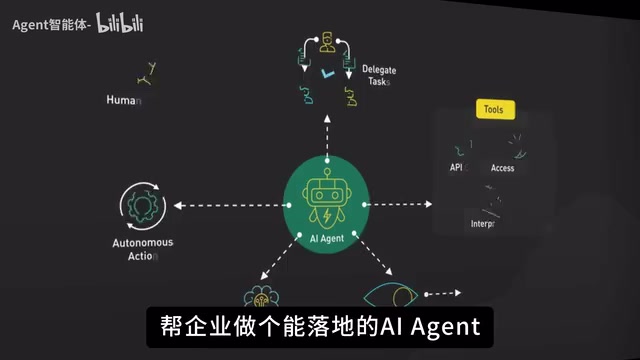
The selling point of this course is that it "doesn't dwell on empty concepts or make grand promises," focusing instead on the complete loop from zero background to independently building and delivering an Agent. The author claims to break down, step by step, the path validated by beginners, enabling learners to build an Agent deliverable to clients in a short time. In addition, the video mentions compiled zero-to-start tutorials, enterprise-level Agent building tutorials, and accompanying hands-on project documentation, directing viewers to claim them via a pinned comment.

What needs to be viewed rationally is that "from beginner to expert in seven days" is typical course marketing talk. Agent building involves requirements breakdown, tool calling, workflow orchestration, testing and tuning, and more—reaching a truly deliverable level requires project experience. But the course does have value in lowering the psychological barrier to entry and providing a structured path, especially for learners without a formal technical background who want to enter the AI application layer.
Function Calling / Tool Use is the core technical mechanism for implementing AI Agents: developers declare available external functions to the model in structured descriptions (such as querying orders, sending emails, calling payment APIs), and during reasoning the model decides whether to call, which function to choose, and generates parameters in the correct format; the system executes and passes the result back to the model to continue reasoning. It connects the large model's "language ability" to real business systems' "hands and feet," and is also what distinguishes an Agent from pure text generation. For zero-background learners, the key to mastering tool calling is understanding interface description specifications, parameter validation and exception handling, and how to design prompt structures that let the model reliably choose the right tool—these are usually easier to pick up than writing complex algorithms, but they also most test one's understanding of business details.
Who Is This Course For? How to Use It?
From its content positioning, this 748-episode course covers the full chain from concepts to enterprise-level practice, and the accompanying documentation reduces learners' search costs.
The target audience includes: technical staff looking to transition into AI application development, business staff who need to implement AI in their companies, and freelancers hoping to take on custom Agent projects for SMEs. The suggested approach is not to be intimidated by the episode count, nor to watch everything in order, but to learn by doing around a real small project, prioritizing Agent workflow orchestration and tool integration—these two are the core of enterprise delivery.
Workflow orchestration refers to organizing multiple steps (model reasoning, tool calling, conditional branching, human review, data read/write) into repeatable, executable processes. Common implementations include visual orchestration platforms (drag-and-drop node connections) and code frameworks (such as LangChain, Dify, Coze, etc.). Orchestration capability determines whether an Agent can reliably handle branches and exceptions in real business scenarios—for example, "first check inventory; if out of stock, hand off to a human; otherwise generate a quote and send it." In enterprise delivery, what clients actually pay for is often not a particular model but a reliable, maintainable, observable process. Therefore, orchestration and tool integration are regarded as the core skills of an AI Agent builder, and the main criterion for judging whether they can independently deliver projects.
Look at the Opportunity Narrative Calmly
Phrases like "get a job as soon as you finish" and "avoid 99% of detours" bear the obvious hallmarks of traffic-driven courses, and learners should maintain independent judgment. But it is true that AI Agents, as a key form of large-model implementation, are making Agent-building skills a marketable ability. For ordinary people, rather than chasing the title of a "new profession," it's better to actually validate an Agent that solves a concrete business problem—that's the real ticket in.
One-line Summary
Bilibili's 748-episode AI Agent course has gone viral, reflecting the AI implementation gap among SMEs and a low-barrier path into the field.
Paragraph Summary
The article centers on a Bilibili AI Agent tutorial series marketed as 748 episodes of zero-background content, pointing out that behind its popularity lies a real disconnect between SMEs' demand for AI implementation and execution capability: enterprises need not chatbots but Agents that can be embedded into business processes and complete tasks automatically, and standardized products struggle to cover fragmented scenarios—hence the layman's role of "AI Agent builder." The course emphasizes zero-background, low-cost entry, promises a complete loop from concepts to enterprise-level practice, and directs viewers to claim accompanying documentation in the comments. The author also cautions that "from beginner to expert in seven days" and "get a job as soon as you finish" are course marketing talk; genuinely deliverable skills still require project experience. The recommendation is to learn around a real small project and prioritize workflow orchestration and tool integration.
Related articles
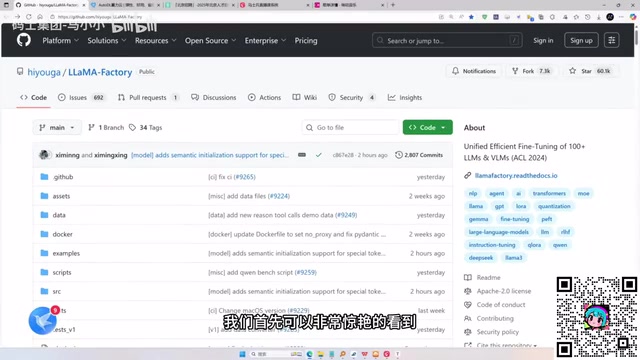
LLaMA-Factory in Practice: A Complete No-Code Guide to Fine-Tuning Large Models
An introduction to LLaMA-Factory, the open-source fine-tuning tool: its 60.1K-star background, supported models and algorithms, local vs. cloud deployment, and CUDA setup steps.

Zeng Ming's Deep Retrospective: Why OpenAI May Not Be the Ultimate Winner — and Why the Corporate System Will Disappear
Zeng Ming's deep retrospective on the AI endgame: model companies are just infrastructure, OpenAI and Anthropic won't be the final winners; the next battle is the Agent entry point standard; the corporate system will disappear as AI restructures collaboration, and only mission-driven companies can survive the cycle.

OpenHands v1.28.0: OpenCode and PI Added as Built-in Agents, API Keys Requestable In-Conversation
OpenHands ships 5 releases in 21 days: v1.27.0 adds OpenCode and PI as built-in agents, v1.28.0 enables in-chat key requests. ACP integration, credential reuse, model list changes, and upgrade advice.