Bilibili's 748-Episode AI Large Model Zero-to-Hero Course: A Full Breakdown from RAG to Agent in Practice
Bilibili's 748-episode AI large model course covers fundamentals, advanced topics, and hands-on projects systematically.
A Bilibili creator released a 748-episode AI large model course divided into Fundamentals, Advanced, and Hands-On sections. It covers foundational understanding, prompt engineering, RAG, LangChain, Function Calling, Memory, LangGraph multi-Agent collaboration, and engineering deployment, culminating in three enterprise projects: knowledge base Q&A, e-commerce customer service, and stock analysis. Aimed at developers with programming basics, the course provides code materials and a learning roadmap.
A course on Bilibili claims to be the "most comprehensive and detailed" AI large model course for absolute beginners, spanning a total of 748 episodes divided into three sections: Fundamentals, Advanced, and Hands-On Projects. The creator claims to have scoured nearly all large model content on Bilibili and YouTube, spending four months decomposing core knowledge points into a structured curriculum.
Looking at the course structure, this tutorial attempts to solve a long-standing pain point: many large model tutorials on the market either pile up concepts like Transformer and context windows without any practical application, or they throw API code at you directly while ignoring the establishment of foundational understanding.
Fundamentals: Understand Large Models Before You Start Building
The goal of the Fundamentals section is to build a foundational understanding of large models. The course starts with several fundamental questions: What is a large language model? How does it differ from regular search? Where are the capability boundaries of large models? Which scenarios can they handle and which can't they? The answers to these questions directly determine the rationality of technology choices in subsequent development.
After establishing basic understanding, the course moves into prompt engineering. According to the creator's description, this section covers a complete path from basic principles to prompt tuning, chain-of-thought prompting, structured output, and on to Vibe Coding.
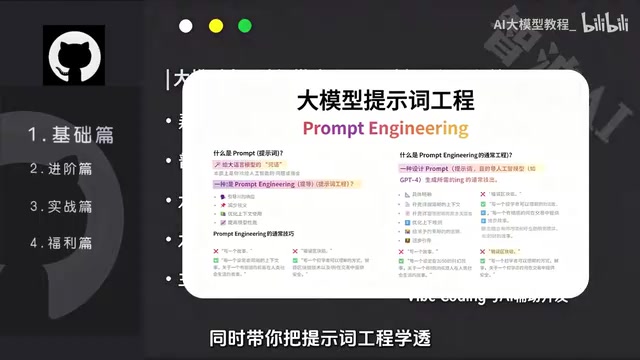
Prompt engineering, as the first threshold in large model application development, matters because: even with the most powerful model, poorly designed prompts lead to enormous differences in output quality. Placing this section in Fundamentals rather than Advanced suggests the course designer considers prompt skills to be a prerequisite for all subsequent development.
This section also includes an introduction to the development history of large models and an overview of the mainstream ecosystem, helping learners understand the logic behind the current technological landscape.
Chain-of-Thought (CoT) is a prompting technique proposed by Google in 2022. Its core idea is to have the model output intermediate reasoning steps before giving a final answer. For example, when facing a math word problem, the model no longer blurts out the result directly but instead lists the calculation process step by step. Research shows that this "think first, answer later" pattern can significantly improve the accuracy of large models on complex reasoning tasks, especially in arithmetic, commonsense reasoning, and symbolic manipulation. CoT implementations include zero-shot CoT (adding "let's think step by step" to the prompt) and few-shot CoT (providing examples that contain reasoning steps). Subsequent enhancements such as Self-Consistency and Tree of Thoughts have also emerged, making CoT one of the key techniques in prompt engineering for boosting model reasoning capabilities.
Vibe Coding is an informal term that emerged around 2024, describing a new programming paradigm driven by natural language conversation for code generation. Developers no longer write code line by line but express intent in colloquial descriptions to AI coding assistants (such as GitHub Copilot, Cursor, Claude, etc.), which generate code frameworks or specific implementations, and developers then iterate through conversation. This mode emphasizes "if it feels right, keep going," de-emphasizing traditional syntax details, and is suited for rapid prototyping and personal projects. However, Vibe Coding has also been criticized for lacking rigorous software engineering standards—generated code may have security vulnerabilities, performance issues, or be difficult to maintain, making it better suited for exploratory scenarios rather than production-grade systems.
Advanced: RAG, LangChain, and Agent Development
The Advanced section is the most technically dense part of the entire course. The course starts with RAG (Retrieval-Augmented Generation), covering everything from principles to the complete pipeline, including vector database selection, document chunking optimization, multi-path retrieval, and Rerank reordering.
RAG is placed first in the Advanced section because it solves one of the most critical obstacles to large model deployment—lagging knowledge updates and hallucination issues. By connecting to external knowledge bases, RAG enables large models to answer questions based on the latest and most accurate documents, which is the foundational architecture for enterprise-level applications.
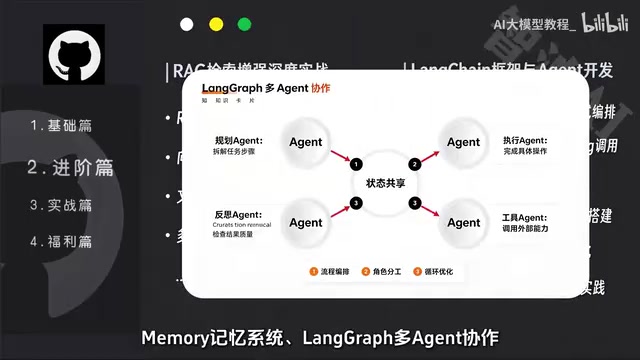
At the framework level, the course chooses LangChain as the hands-on framework, covering modules such as Tools binding and Function Calling, the Memory system, and LangGraph multi-Agent collaboration. These topics correspond to the most active technical directions in current large model application development: enabling models not just to answer questions but also to call tools, remember context, and collaborate with other Agents to complete tasks.
Debugging, evaluation, and engineering deployment are also included in the Advanced section. This is worth noting—many tutorials stop at "getting the demo to run," but in real business scenarios, evaluation systems, performance optimization, and deployment solutions are the keys to determining whether a project can go live.
Vector databases are the core storage component in RAG architecture, specifically designed for efficiently storing and retrieving high-dimensional vector data. In the RAG pipeline, documents are converted into vectors by embedding models (such as text-embedding-3, BGE, etc.) and stored in a vector database. When a user asks a question, the question is also vectorized, and the database uses approximate nearest neighbor (ANN) algorithms to quickly find the most semantically similar document chunks. Common vector databases include Pinecone, Weaviate, Milvus, Qdrant, and Chroma. Selection requires weighing index types (such as HNSW, IVF), filtering capabilities, scalability, latency, and cost. The quality of a vector database directly affects RAG retrieval performance, so document chunking strategy, embedding model selection, and index parameter tuning often need to be jointly optimized.
Rerank is the fine-ranking step after multi-path retrieval in RAG. Initial retrieval (such as vector similarity search or keyword search) typically returns many candidate documents, but some may be semantically related yet practically useless. Rerank models (such as Cohere Rerank, BGE Reranker) score the relevance between candidate documents and the question more precisely, reorder them, and keep the Top-K most relevant chunks sent to the large model for answer generation. Compared to relying solely on vector similarity, Rerank can significantly improve answer accuracy and relevance, especially when handling complex queries or multi-hop reasoning. The trade-off is an additional model inference call, which impacts latency and cost, so it is often used in conjunction with multi-path retrieval strategies to balance effectiveness and efficiency.
LangGraph is an extension library released by the LangChain team, focused on building stateful, multi-step Agent workflows. Traditional LangChain Chains are linear, while LangGraph models workflows as graph structures where nodes represent specific operations (such as calling a model or executing a tool) and edges represent control flow. It supports loops, conditional branching, and persistent state, enabling multiple Agents to collaborate, call each other, or switch on demand. LangGraph is particularly suited for implementing complex multi-Agent systems—for example, one Agent handles planning, another handles execution, and a third handles review. Its core advantage is providing fine-grained control over Agent behavior while maintaining compatibility with the LangChain ecosystem. For Agent applications requiring dynamic decision-making and long-running operation, LangGraph has become one of the current mainstream orchestration frameworks.
Hands-On: Three Enterprise-Level Projects
The Hands-On section includes three projects: an enterprise knowledge base Q&A system, an e-commerce intelligent customer service assistant, and a stock analysis agent.
The first project starts from RAG architecture, connecting the complete chain from document chunking to vector database construction to semantic retrieval—a comprehensive application of RAG technology. The second project layers on intent recognition, multi-turn dialogue, knowledge base fine-tuning, and sentiment analysis, making it more complex. The third project targets financial scenarios, involving data acquisition, time-series analysis, visualization reports, research report summarization, and risk alerts.
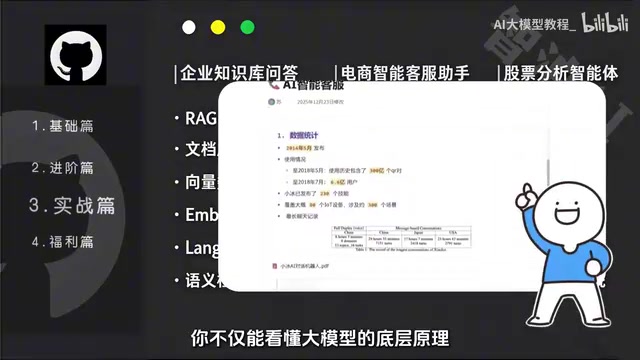
The selection of three projects covers three typical scenarios—knowledge management, customer service, and financial analysis—corresponding to the industries where large model deployment is currently most concentrated. The course emphasizes that "every episode comes with accompanying code materials," and if delivered as promised, this significantly lowers the barrier to entry for self-taught developers.
Who This Course Is For
Based on the course design, the target audience is developers with some programming foundation but lacking systematic understanding of large models. The course does not require prior knowledge of Transformer architecture or deep learning theory, but basic programming skills are needed to complete the hands-on project code.
The 748-episode volume means extremely fine knowledge granularity, but it also demands sustained commitment from learners. The creator claims "from beginner to expert in seven days," which is clearly more of a marketing statement—the actual learning period depends on daily time investment and depth of practice.
The course provides source code, course materials, prompt templates, and a learning roadmap, available by commenting in the comment section. For developers hoping to systematically get started with large model application development, the level of systematization in this course is indeed relatively rare among free content on Bilibili.
One-line Summary
Bilibili's 748-episode AI large model course, split into Fundamentals, Advanced, and Hands-On, systematically covers everything from cognition to project deployment.
Paragraph Summary
A Bilibili creator released a "most comprehensive and detailed" AI large model zero-to-hero course with 748 episodes, divided into Fundamentals, Advanced, and Hands-On sections. Fundamentals builds foundational understanding and covers prompt engineering; Advanced dives into RAG, LangChain, Function Calling, Memory, and LangGraph multi-Agent collaboration, plus debugging, evaluation, and engineering deployment; Hands-On ties it all together through three projects: enterprise knowledge base Q&A, e-commerce intelligent customer service, and stock analysis agent. The course emphasizes accompanying code materials, targeting developers with programming foundations but lacking systematic large model knowledge. The 748-episode volume means extremely fine granularity, but "seven days from beginner to expert" is more marketing than reality—the actual learning period depends on investment.
Related articles
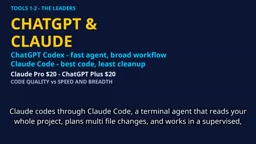
2026 AI Coding Tools Comparison: Claude, ChatGPT, Gemini — Which Is the Best?
A 2026 comparison of five mainstream AI coding tools — Claude Code, ChatGPT Codex, Gemini, DeepSeek, and GitHub Copilot — on real projects, pricing, and code quality, to help you decide where that $20/month should go.

ChatGPT Codex Can Clone Any Software? Testing the Risks and the Truth
YouTube shorts claim ChatGPT Codex or Claude Code can clone Adobe, Excel, and Figma for lifelong free use. We break down the feasibility, legal risks, and DM-funnel tactics—and explain what AI coding tools are truly good for.

Kilo Code Is Free to Install but Charges for API: Cost Estimation and Configuration Guide
Kilo Code is free to install, but connected AI models are billed per token. This guide covers VS Code extension and CLI setup and shows how to estimate API costs.